
Hobbyist with a regular workspace
You usually sit at the same desk and want warmth around your hands or body; heating the whole room may not be necessary.


If you mainly want warmth in one fixed spot, a focused desk heater could suit your needs. If you also want to warm the air around your workspace, consider a ceramic fan heater with multiple settings. Before choosing, check that you can position the heater safely and plug it directly into a suitable socket. A product specification or listing alone does not prove that an individual model meets all applicable requirements.
You usually sit at the same desk and want warmth around your hands or body; heating the whole room may not be necessary.
You switch between your desk and other work areas, and want to weigh up whether focused warmth is enough or whether you also want to warm the room.
You work among materials or equipment, so first check where a heater can be positioned safely and whether there’s a suitable socket within reach.
A good fit if: you mainly want warmth in one fixed spot.
Bear in mind: a focused airflow won’t automatically heat the whole hobby room.
A good fit if: you also want to warm the air around your workspace and would like a choice of power settings.
Bear in mind: check the setting you want, how long you’ll use it for and how to position it safely. Manufacturers’ noise figures can’t be compared unless they’re based on the same measurement conditions.
A good fit if: you want direct radiant heat in one fixed spot; Milieu Centraal mentions a workbench as a possible heating area.
Bear in mind: the warmth is localised, so it’s not an equivalent choice if you want to heat the air in the room or regularly move around.
First, decide which area you want to warm. Then compare the available settings, the noise while you’re working on your hobby, and the positioning and connection instructions for the exact model.
| What to consider | What should you check? | Who should consider this? |
|---|---|---|
| Warmth at your seat or throughout the room | Decide where you sit or stand while working on your hobby, then compare the model’s air outlet, any oscillation function and power settings. | If I mainly want warmth at my regular desk, I don’t necessarily need to heat the whole room. Around 33% of consumers prioritise focused warmth. |
| Safe positioning and connection | Check the instructions for clearance, air intake and outlet, cable length, and access to a suitable socket. The Fire Service advises plugging electric heaters directly into a socket rather than using a multi-socket adaptor or cable reel. | If you work among materials or equipment, first check whether there’s a safe place to put the heater and a suitable socket available. Around 27% of consumers prioritise safe positioning. |
| Noise while you work on your hobby | If a noise figure is provided, check which setting and measurement conditions it applies to. Only compare figures when those conditions match. | If I work with concentration for long periods, I want to know whether the fan noise is suitable for my workspace. Around 20% of consumers prioritise low fan noise. |
| Energy use while the heater is running | Multiply the power in kW by the number of hours the chosen setting is actually on to calculate energy use in kWh. A thermostat can affect how long the heater runs. | If you already know how long the heater is usually on for, you can make a more informed comparison of its settings and energy use. Around 20% of consumers prioritise running costs. |
The heater’s power and the number of hours it’s on together determine its energy use. The material name alone doesn’t tell you how much electricity your usage will require.
Compare the setting you expect to use: power in kW × hours switched on = kWh. Multiply this by your electricity rate if you want to work out the cost.
Focused warmth at one desk and extra heating for the air in the room meet different needs. Airflow directed at one spot doesn’t mean the whole room will get warm.
First decide which area you want to heat. Only then compare the airflow, oscillation function and settings of the exact model.
The Fire Service advises plugging electric heaters directly into a socket. The space around the heater and the instructions for the exact model also matter.
Before buying, check that you can follow the positioning instructions and use a socket directly. Keep the air vents clear and don’t cover the heater.
The Capsule Desk HFX10B03.LB is a focused ceramic model for warmth at a desk. The Capsule HFX30C18.AG is a separate model with power settings of 900 and 1800 W.
Eurom describes the Safe-t-Heater 1500 as a compact ceramic fan heater for extra warmth, for example in a study or home office.
According to Rowenta, the ceramic Intense Comfort SO9330F0 offers two power settings for extra warmth.
These product picks are ceramic fan heaters for providing extra warmth around a workspace. Compare their settings and positioning instructions with the heating needs of your hobby room.
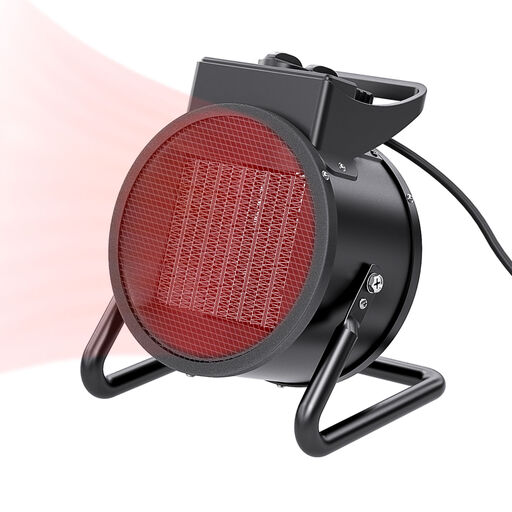 No image available
An option if you’re looking for a ceramic fan heater with multiple settings to warm the area around your workspace.
The product title lists 2 kW, three settings, a thermostat and a 70° oscillation function.
According to the product information, place the heater on a stable, dry surface, keep textiles and other flammable materials at least 1 m from the air outlet, and don’t cover the appliance.
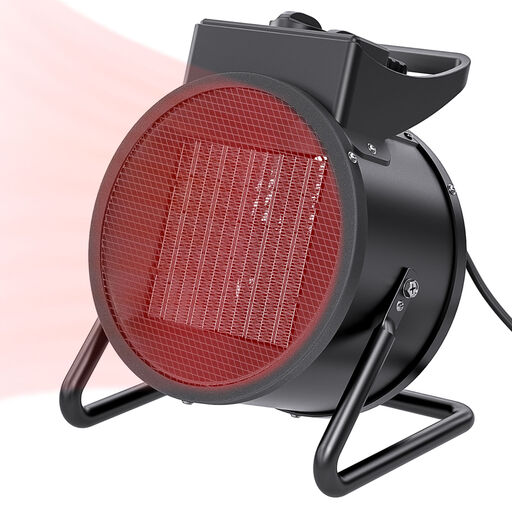 No image available
An option if you’re considering a ceramic fan heater with three settings for extra warmth.
The product title lists 3 kW, a PTC heating element and three settings.
 No image available
A compact ceramic heater to compare if you’re looking for warmth at your workspace.
The product information lists three settings, including 600 W and 1500 W, and a tabletop stand.
According to the product information, use an earthed socket, not an extension lead or adaptor; keep flammable materials at least 1 m away and don’t block the air vents.
 No image available
An option if you want to compare settings, oscillation and an adjustable thermostat for your workspace.
The product title lists 1800 W; the product information lists four settings, oscillation, a timer and an adjustable thermostat.
According to the product information, keep flammable materials at least 1 m from the heater and don’t cover the appliance.
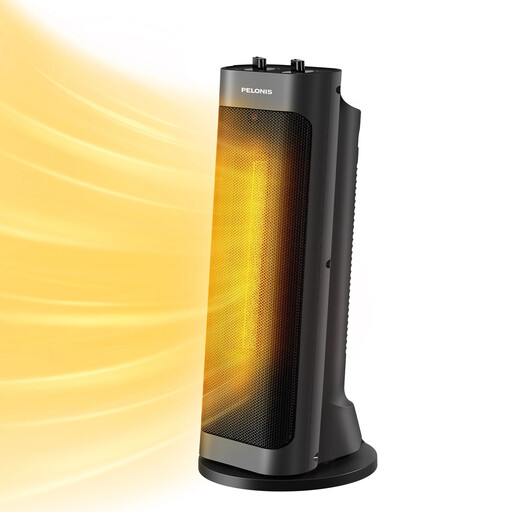 No image available
An option if you’re looking for a ceramic fan heater with multiple settings and oscillation for extra warmth.
The product title lists 2000 W; the product information lists four heat settings, a thermostat and 70° oscillation.
According to the product information, place the heater on a stable surface, keep flammable materials at least 1 m from the air outlet and don’t block it.
It could be a good fit if you mainly want warmth in one fixed spot. If you also want to warm the air around your workspace or move around the room, compare a fan heater with power settings and, potentially, an oscillation function.
The Fire Service advises plugging electric heaters directly into a socket rather than using a multi-socket adaptor or cable reel. Also check the instructions for the exact model and leave the space around the appliance clear as directed.
Multiply the power in kW by the number of hours that setting is actually on; the result is the energy use in kWh. One hour of continuous use at 360 W is 0.360 kWh, and one hour at 1500 W is 1.5 kWh. A thermostat can change the actual running time.
Follow the positioning instructions for the exact model, keep the air vents clear and use a suitable socket directly. Check that there’s enough space around materials and equipment, and don’t cover the heater.
No. A product listing or CE claim alone doesn’t prove that an individual unit meets all applicable requirements. Electrical appliances within the scope of the relevant rules are subject to European safety requirements. Applicable ecodesign requirements also apply to portable electric heaters for local space heating, with revised provisions in force since 1 July 2025. Check the documentation and requirements for the exact model.