Who is a ceramic heater at your desk suitable for?

Working from home in a cold workspace

If you spend part of the day at the same desk, consider whether you’d prefer warmer air around your workspace or direct heat on your body. Milieu Centraal explains that you feel infrared heat when you’re within its range.

Living with limited space for a heater

A small desk or limited floor space means finding a spot where the air vents stay clear and the heater can stand securely. The fire service advises plugging electric heaters directly into a wall socket, not into a cable reel or extension lead.

Someone who often uses supplementary heating

If you use a heater regularly, the heat setting, thermostat and number of hours it’s switched on all affect its electricity use. Milieu Centraal recommends taking the energy use of electric heating into account when choosing supplementary heating.

What should you look for when buying?

Ceramic fan heater

Choose this if: you want warm air at your desk for a limited period and can place the heater safely, with plenty of space around it.

Bear in mind: fan noise and electricity use during longer periods of use; safety features don’t replace safe positioning.

Infrared panel

Choose this if: you usually sit in the same spot and mainly want direct heat on your body. Milieu Centraal explains that you feel the warmth when you’re within the panel’s range.

Bear in mind: you won’t feel the direct warmth outside that range, so the panel needs to be positioned where its heat can reach you.

Existing room heating

Choose this if: you want to keep the room warm for longer or find that your flat cools down quickly.

Bear in mind: it may not provide the same direct warmth at your desk; compare its actual energy use with local electric supplementary heating.

What to consider What should you check? Who is this important for?
Heat where you need it Decide whether you mainly want to heat yourself or the air around your workspace too. For a heater, check the heat settings and thermostat. If I mainly want to heat the spot where I sit at my desk, I look at how the heat is distributed. Around 29% of consumers prioritise targeted warmth.
Safe positioning and connection Check the positioning instructions, stability and whether the cable can reach a wall socket directly. Keep the air vents clear. If you have limited space, you’ll want to check first that the heater can be positioned and connected safely. This is the biggest consideration for around 29% of consumers.
Electricity use Compare the power rating for each setting, the thermostat and the expected hours of use. Calculate energy use in kWh by multiplying the power in kW by the actual running time. If I plan to use the heater often, I compare how long it’ll be in use and its electricity consumption with other heating options. Running costs are the main consideration for around 24% of consumers.
Noise and space Check the noise levels for each setting and measure the available space; also check where the warm air is blown out. If you need to concentrate or have limited space, take noise and airflow into account before choosing a heater. Around 18% of consumers prioritise a quiet environment and workspace.

Common buying mistakes

  • Assuming ‘ceramic’ or ‘eco’ automatically means lower electricity bills

    Energy use depends on factors including the power rating, the number of hours it’s used and how the thermostat works. A lower setting uses less power while heating, but also produces less heat.

    Compare the heat settings and calculate energy use using the power rating in kW and the actual time the heater is switched on. If you work in the same spot, you could also compare direct, local heating options.

  • Setting up a small heater without checking the space

    A compact size doesn’t remove the need for a stable position, clear airflow and a suitable connection. The fire service advises plugging electric heaters directly into a wall socket.

    Measure the available space, follow the model’s instructions and check that the cable can safely reach the socket.

  • Assuming the stated heating area applies to every home

    Rowenta bases the stated coverage of the Intense Comfort Hot SO9420 on a newly built, well-insulated room that meets the French RT2012 standard. That coverage won’t necessarily apply to every flat.

    Consider the insulation, how long you’ll use the heater and the area you actually want to heat. Treat a manufacturer’s coverage figure as conditional information.

Brands to consider

Eurom

The Safe-t-Heater 1500 is a compact ceramic heater with three power settings, designed for spaces such as study rooms and home offices.

  • Eurom lists settings of 500, 1000 and 1500 W, a thermostat, oscillation and tip-over and overheat protection.
  • The cable is listed as 150 cm; the model specifications don’t mention a timer. A lower setting doesn’t prove that the same amount of heat is produced using less electricity.

Tristar

The KA-5074 is a ceramic heater with two heat settings, oscillation and a timer.

  • Tristar lists 900 and 1800 W, 75° oscillation, a 24-hour timer and tip-over and overheat protection.
  • The listed noise level is 56 dB; check that the noise and dimensions are right for your workspace.

Duux

The Threesixty² distributes warm air in all directions and can be controlled on the unit or via an app.

  • Duux lists 1800 W, three settings and 38 dB on the lowest setting.
  • The manufacturer’s claim that it heats a room faster isn’t an independent comparison for your flat. Its all-round airflow means you’ll need to think about where to place it if your desk is crowded.

Rowenta

The Intense Comfort Hot SO9420 has several heat settings and wide oscillation.

  • Rowenta lists settings of 1000, 1400 and 2400 W and 42 dB(A) on the lowest setting.
  • According to Rowenta, the stated coverage of 35–40 m² applies to a newly built, well-insulated room that meets the RT2012 standard. It won’t necessarily apply to every Dutch flat.

Xiaomi

The Smart Tower Heater Lite is a ceramic tower heater with a thermostat, timer and app control.

  • For model LSNFJ02LX, Xiaomi lists settings of 1400 and 2000 W and dimensions of 184 × 184 × 500 mm at 220–240 V.
  • The manufacturer’s claim that it heats up in three seconds doesn’t, by itself, tell you anything about its total electricity use.

Joybuy products for supplementary heating at your desk

These products are ceramic fan heaters for local supplementary heating. Compare the power settings and the space available before choosing a model.
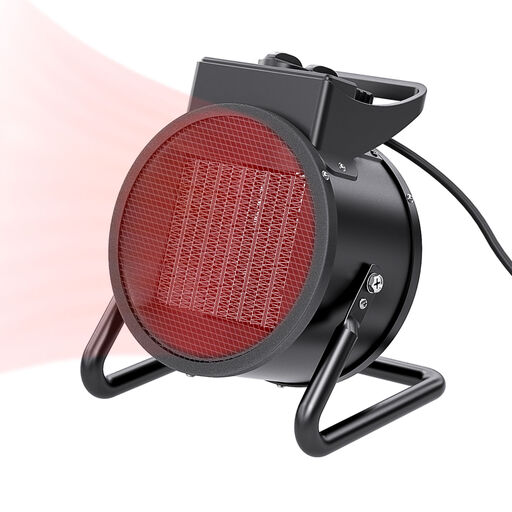
LZQ ceramic fan heater with thermostat, 2 kW

LZQ ceramic fan heater, 2 kW

The listed thermostat and three settings are useful if you want to adjust the heat at your workspace.

The product name lists a PTC heating element, three settings and 2 kW.

Before buying, check the CE marking and documentation for the specific version.

Joybuy
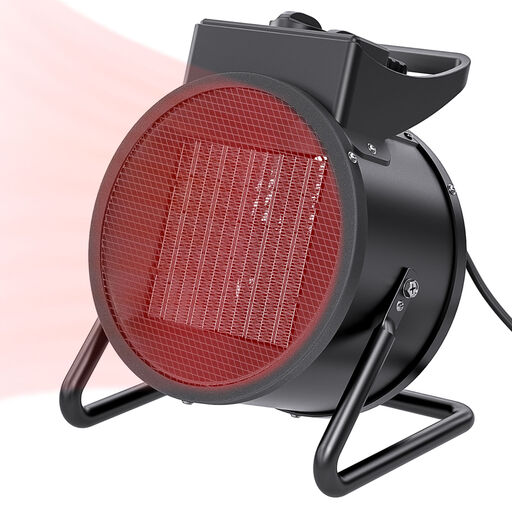
LZQ ceramic fan heater with thermostat, 3 kW

LZQ ceramic fan heater, 3 kW

The three settings and thermostat can help you tailor the heat to suit how you use it.

The product name lists a PTC heating element, three settings and 3 kW.

Before buying, check the CE marking and documentation for the specific version.

Joybuy
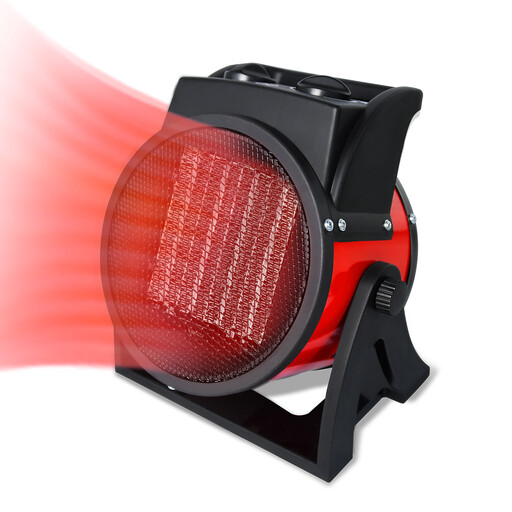
LZQ ceramic heater with thermostat, 2 kW

LZQ ceramic heater with thermostat, 2 kW

The three heat settings are useful if you want to tailor the heat to how you use the heater in a flat.

The product name lists a PTC heating element, thermostat and 2 kW.

Before buying, check the CE marking and documentation for the specific version.

Joybuy

Xiaomi Desktop Heater, 600 W, with 45° oscillation

Xiaomi Desktop Heater, 600 W

This desk heater could be a good fit if you’re looking for a model specifically described as suitable for placing on a desk.

The product name lists 600 W, 45° oscillation, an adjustable thermostat and tip-over and overheat protection.

Before buying, check the CE marking and documentation for the specific version.

Joybuy

OmniHeat ceramic fan heater with remote control and timer

OmniHeat ceramic fan heater, 1800 W

The range of settings and timer are useful if you want to adjust the heat and how long the heater runs.

The product name lists 1800 W, four heat settings, an adjustable thermostat, oscillation, remote control and overheat and tip-over protection.

Before buying, check the CE marking and documentation for the specific version.

Joybuy

Frequently asked questions

How should I plug in an electric heater at my desk?

It’s best to plug an electric heater directly into a wall socket. The fire service recommends doing this for appliances that use a lot of electricity, rather than using a cable reel or extension lead. Also check that the cable can safely reach the socket.

How do I calculate a heater’s electricity use?

Multiply the power rating in kW by the actual number of hours the heater runs at that setting to calculate its energy use in kWh. Then multiply this by your own rate per kWh. Allow for periods when a thermostat switches the heater off. Milieu Centraal gives the example of a 1000 W heater running for 500 hours without a thermostat, which uses 500 kWh; the rate in that example isn’t the rate on your current energy tariff.

Does an electric heater need a CE marking in the Netherlands?

According to the NVWA, CE marking is compulsory for electrical products covered by the applicable Dutch Commodities Act regulations. Check the marking and product documentation for the specific version; safety features alone don’t prove that a product complies. According to the European Commission, the energy label for local space heaters doesn’t apply to electric models, so the absence of such a label doesn’t in itself mean that an electric heater is illegal.

What can I do if my heater is faulty?

If there’s a problem, contact the seller. According to the Dutch government, there’s no fixed statutory guarantee period for all products in the Netherlands; what you can expect depends on factors including the product and normal use. A manufacturer’s guarantee doesn’t replace your statutory rights.
