
Student with a chilly workspace
You mainly want warmth at your desk and are looking for a compact appliance with airflow suited to where you sit. Xiaomi Netherlands and De’Longhi describe models designed to provide focused warmth at a desk.


If you mainly want to stay warm while studying at your desk, start with a compact desk heater. If you’d also like to warm the air in the room, compare freestanding models with multiple heat settings and a thermostat. The stated power rating tells you how much electricity the heater uses while a setting is on, but it doesn’t prove that the heater is energy-efficient or can heat an entire room. Before buying, check the positioning instructions for the exact model and whether you can plug it directly into a fixed wall socket.
You mainly want warmth at your desk and are looking for a compact appliance with airflow suited to where you sit. Xiaomi Netherlands and De’Longhi describe models designed to provide focused warmth at a desk.
You want to warm the air in the room as well as your workspace, so you compare heat settings, thermostats and the space needed for safe positioning. Eurom and Inventum describe freestanding models for this kind of use.
You want to know how much electricity a heater might use during a study session, so you compare its power rating with how long it will be on. Milieu Centraal also suggests focused heating, such as an infrared panel, as an option for a fixed workspace.
Suitable for: mainly warming the area where you sit during short study sessions, if you can position the heater in line with the instructions.
Trade-off: the lower stated power rating limits hourly electricity use at full power, but it doesn’t mean the whole room will get warm.
Suitable for: occasionally warming the air in the room as well as your workspace, if you have enough room to position it safely.
Trade-off: a higher setting delivers more heat and also uses more electricity while it’s on; Inventum limits the KC222WOS to well-insulated spaces or occasional use.
Suitable for: sitting in one fixed spot for long periods, if you mainly want to warm yourself rather than the air in the room.
Trade-off: Milieu Centraal explains that the local warmth from an infrared panel disappears as soon as you move outside its range.
| What to consider | What to look for | Who should pay particular attention? |
|---|---|---|
| Warmth where you sit | Check the dimensions, whether the airflow is adjustable, the stated power rating and the clearance specified in the instructions. | If I mainly want to stay warm while studying, I look for airflow that suits my workspace. Around 33% of consumers prioritise focused warmth where they sit. |
| Electricity use | Compare the power rating for each setting. For continuous use, calculate: power in kW × hours of use = kWh. Multiply this by your own price per kWh. | If I switch the heater on during a study session, I want to estimate its electricity use based on the setting I choose and how long I use it. Around 25% of consumers focus mainly on running costs. |
| Safe positioning | Read the instructions for the exact model and check its positioning requirements, safety features and whether it can be plugged into a fixed wall socket. | If there isn’t much room around my desk, I want to know in advance whether I can position the appliance safely in line with the instructions. Around 25% of consumers make safe positioning their main consideration. |
| Warming the room briefly | Check the settings, thermostat, any oscillation feature and the usage restrictions for the exact model; don’t judge its suitability by its power rating alone. | If I also want to warm the air in my room, I compare models designed for that use and check how much space they need. Around 17% of consumers prioritise this need. |
A ceramic heating element doesn’t automatically make a heater an energy-efficient choice for heating a room over long periods. Its stated power rating and how long it’s switched on both affect electricity use.
Compare the power rating for each setting with the number of hours you expect to use it. Calculate the cost using your own electricity tariff, and decide first whether you want to warm yourself or the whole room as well.
The longer it’s switched on, the longer it uses electricity; a thermostat or lower setting doesn’t guarantee a set saving.
Even a small appliance needs room for air to circulate and must be positioned according to the manufacturer’s clearance and placement instructions. Paper, textiles and furniture can get in the way of a safe, clear position.
Check the instructions before buying and choose a spot where you can use the heater as directed. The Dutch Fire Service advises plugging electric heaters directly into a fixed wall socket, not into a multi-socket adaptor or cable reel.
A tip-over switch or overheat protection doesn’t replace the instructions for use. The Inventum KC222WOS manual explicitly warns against covering the heater.
Keep the air vents clear and follow the instructions for the exact model. Don’t assume the maintenance or usage instructions for another appliance will apply.
According to De’Longhi, the Capsule Desk HFX10B03.LB is a 360 W personal ceramic desk heater.
Xiaomi describes a compact Desktop Heater; the specifications page lists model ZMNFJ01YMEU with a power rating of 600 W.
The Safe-t-Heater 1500 is a freestanding ceramic heater with settings of 500, 1000 and 1500 W.
According to Inventum, the KC222WOS is a ceramic heater for occasional supplementary heating or well-insulated spaces, with a maximum power rating of 2000 W.
According to Tristar, the KA-5038 has ceramic heating settings of 750 and 1500 W.
This selection includes compact desk heaters and freestanding ceramic heaters with multiple settings for occasional supplementary heating.
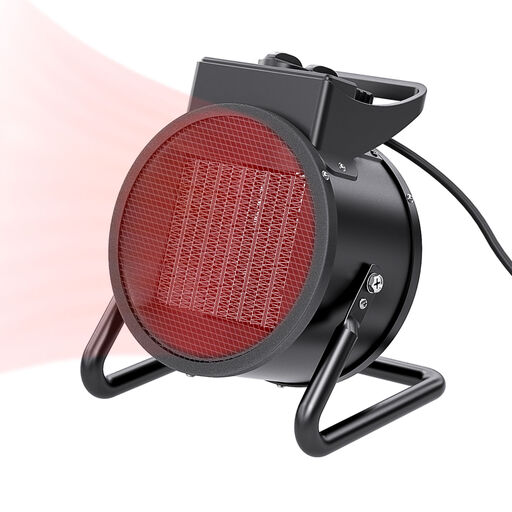 No image available
A freestanding model to compare if you occasionally want to warm the air in the room as well as the area where you sit; check that you can position it as directed in the instructions.
The product name lists a PTC heating element, thermostat and 3 settings.
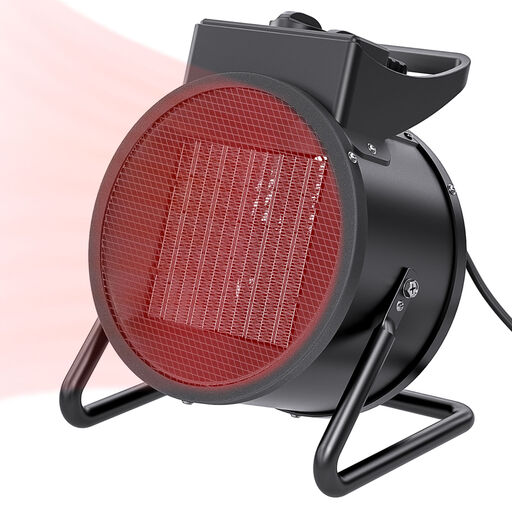 No image available
A freestanding model to compare for occasional supplementary heating; consider the space available and how long you’ll use it for.
The product name lists a PTC heating element, thermostat and 3 settings.
 No image available
A compact ceramic heater to compare for a small workspace, if you can meet the positioning requirements.
The product name lists 1500 W and 3 settings. The product description specifies a stable, flat surface and at least 1 metre of clearance; keep the appliance away from flammable materials.
 No image available
This compact desk model is suited to anyone mainly looking for warmth where they sit; Xiaomi specifies that it should be used on a flat surface.
Xiaomi lists 45° oscillation, an adjustable thermostat, and tip-over and overheat protection. The stated dimensions are 142 × 132 × 188 mm. Don’t cover the heater, keep it away from flammable materials and don’t use it in a damp environment.
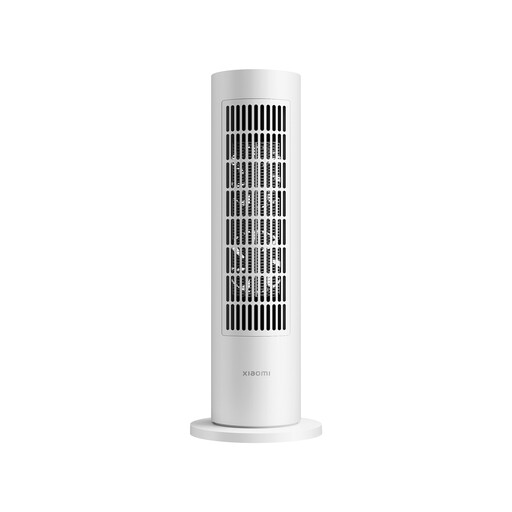 No image available
A freestanding tower heater to compare if you’d also like to warm the air in the room occasionally; check that you have enough clear space.
The product name lists 70° oscillation and 4 settings. The product description specifies a stable surface and warns against covering the appliance or placing it near flammable materials or in wet areas.
The Dutch Fire Service advises plugging electric heaters directly into a fixed wall socket rather than into a multi-socket adaptor or cable reel. Also check the instructions for the exact model; this is safety advice, not a general legal requirement for electrical connections established here.
Follow the cleaning instructions for the exact model and keep the airflow clear. The Inventum KC222WOS manual warns against covering the heater; don’t assume model-specific maintenance instructions will apply to another appliance.
For four hours of continuous heating at the stated power rating, the calculated electricity use is 1.44 kWh at 360 W, 2.4 kWh at 600 W and 6 kWh at 1500 W. These power ratings correspond to De’Longhi, Xiaomi and Eurom respectively. Multiply the relevant amount by your own price per kWh; a thermostat that switches the heater off intermittently will change its actual electricity use.
No. According to the Dutch government, there is no fixed statutory warranty period in the Netherlands: you’re entitled to a product that meets the required standard, and what you can reasonably expect is taken into account. If a product is faulty, the retailer is your point of contact; any manufacturer’s warranty is in addition to this.
According to the European Commission, the requirement for an EU energy label does not apply to electric local space heaters. This is separate from the applicable requirements for electrical safety and CE marking.