
Vandaag of morgen in huis

Kwaliteit gegarandeerd

Welkomstaanbiedingen ontgrendelen: GRATIS bezorging | Tot 80% korting | Gratis 30 dagen JoyPlus-proefperiode
Download de app
A ceramic frying pan can be ideal for eggs, pancakes, vegetables and everyday one-pan dishes. However, a smooth coating is not the only thing that matters. A pan may not be suitable for induction, may not come with a lid or may not be dishwasher-safe. Terms such as “non-stick”, “titanium” and “PFAS-free” are also not always clearly explained.
Before buying, pay attention to three things: hob compatibility, the exact material claims and maintenance requirements. This will help you avoid buying a pan that no longer suits your kitchen or cooking habits after just a few months.
An induction frying pan needs a magnetisable base. A pan suitable for gas, electric and ceramic hobs will not automatically work on induction. Always check the product specifications rather than relying solely on the title or product photo.
Size also matters. A 20 cm pan is handy for one person or a small kitchen, while 28 to 32 cm offers more room for a family meal. On a small induction zone, a wide pan may also heat less evenly.
A titanium ceramic coating may, according to the product information, be designed to improve scratch resistance. This does not mean that metal utensils, high temperatures or prolonged heating while empty are risk-free. Ceramic coatings tend to last longer when you cook at low to medium heat and use wooden or silicone utensils.
Pay attention to the wording too. “PFAS-free frying pan”, “PFOA-free frying pan” and “PTFE-free” are different claims. Check which substances the manufacturer specifically mentions. According to the product information for some models in this overview, they are PFAS-, PFOA- and PTFE-free; check the product’s current specifications before buying.
A dishwasher-safe frying pan is not automatically oven-safe. Handles made from Bakelite, silicone or plastic may have limitations. Some pans clearly state that oven use is not permitted.
For example, according to the product information, the USELUCK 7-piece set is described as dishwasher-safe and suitable for all hobs, but not as oven-safe. The separate USELUCK pan with lid, according to the same information, is not suitable for use in the dishwasher or oven. These differences matter if you want to clean up quickly or finish dishes in the oven.
Most ceramic pans consist of an aluminium or stainless-steel base with a ceramic non-stick coating. Aluminium is relatively light and conducts heat quickly. A multi-layer stainless-steel construction may be heavier, but is worth considering if you often move a pan from the hob to the oven or table.
A frying pan without toxic substances is not a precise technical category. Instead, look for specific claims such as PFAS-free, PFOA-free, PTFE-free, lead-free or cadmium-free. These claims come from the manufacturer’s product information; do not present them as a general feature of every ceramic pan.
Check whether the pan is suitable for:
A pan described as “universal” should also be supported by the specifications. According to the product description, the 28 and 32 cm Tefal Easy Cook & Clean models are suitable for gas, electric and ceramic glass hobs, but not for induction. These models are therefore unsuitable for an induction kitchen.
A standard frying pan is suitable for frying and quick sautéing. A deep sauté pan with a high rim is more practical for curry, pasta, stews and larger portions. A lid helps with simmering and reduces splashing.
For everyday family cooking, 26 to 28 cm are often useful sizes. A compact 20 cm pan is better suited to a one-person household, campervan or limited storage space. If you need several sizes, you could consider a ceramic cookware set. Check whether all the components are genuinely dishwasher- and oven-safe, as the features may vary from one set to another.
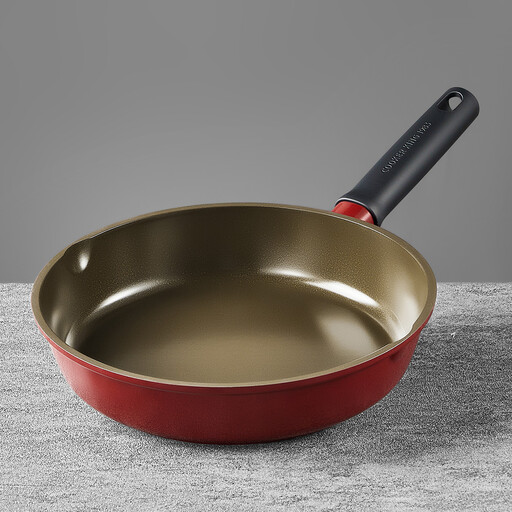
Why it suits this profile: A practical size for everyday meals, without having to buy a full set straight away. According to the product name, this pan is suitable for induction and features a titanium-containing ceramic coating.
The product title states that it is both PTFE- and PFOA-free and suitable for induction. Check these details again on the product page before ordering.
28 cm; suitable for induction according to the product information; specific coating claims in the product title.
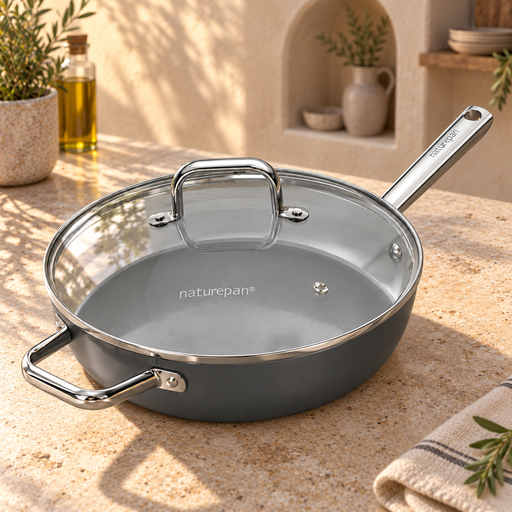
Why it suits this profile: The high rim and glass lid are ideal for sauces, stews and larger portions. According to the product information, the pan is suitable for all common hobs and for use in the oven up to 260 °C.
The specifications list hob compatibility, the oven limit and dishwasher suitability separately. This means you do not have to infer these features from general marketing language.
28 cm; high rim; lid included; dishwasher-safe and oven-safe up to 260 °C according to the product information.
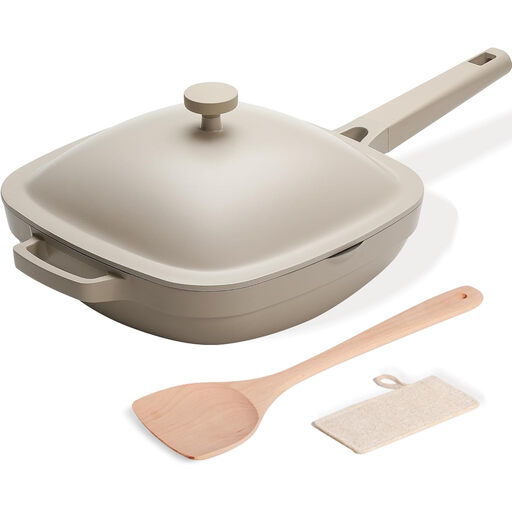
Why it suits this profile: The deep design is intended for sautéing, braising, stir-frying and one-pan meals. The product information states that it offers 45% more cooking surface than standard round pans.
The limitations are clearly stated: it is not suitable for the dishwasher or oven. This helps prevent a disappointing purchase for anyone specifically looking for easy maintenance.
3.8-litre capacity; lid, wooden spatula and scrubber included; suitable for all hobs according to the product information.
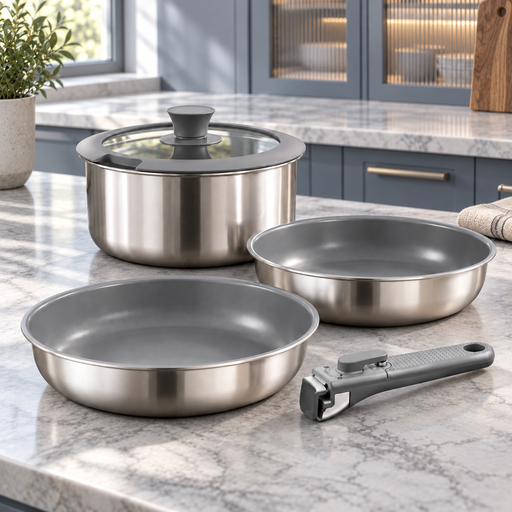
Why it suits this profile: The set includes two frying pans, a saucepan, a lid and a detachable handle. This can be useful when cupboard space is limited, such as in a campervan or small kitchen.
The handle is detachable, but according to the safety information it must be securely locked in place before you lift the pan. The set also states that it is induction-compatible and dishwasher-safe.
Two frying pans; detachable handle; suitable for induction, oven use up to 250 °C and the dishwasher according to the product information.
We have put together a complete, up-to-date list of products that fully meet these strict selection criteria and the applicable European safety regulations.
Use a new pan in accordance with the manufacturer’s instructions. In practice, these habits can help reduce wear on the coating:
“Dishwasher-safe” means that the manufacturer permits this use; it does not promise that the coating will last indefinitely as a result. For many pans, hand washing may be the gentler option.
It varies from model to model. The ceramic coating itself does not determine this; the base is particularly important. Look specifically for “induction suitable” or “induction ready” in the specifications. If in doubt, also check the product page or the manufacturer’s information.
Its service life depends on temperature, frequency of use, utensils and cleaning methods. There is no fixed lifespan that applies to every pan. Low to medium heat, avoiding metal utensils and gentle cleaning can help reduce wear on the coating. Replace the pan when the coating becomes visibly damaged or food consistently starts to stick.
A PFAS-free claim says something about the substances specified in the product information, but not automatically about every aspect of use or nutrition. Check exactly what the manufacturer’s statement covers and follow the use and safety instructions. You should also choose a size, base and maintenance method that suit your kitchen.
