
Vandaag of morgen in huis

Kwaliteit gegarandeerd

Welkomstaanbiedingen ontgrendelen: GRATIS bezorging | Tot 80% korting | Gratis 30 dagen JoyPlus-proefperiode
Download de app
A ceramic frying pan may seem easy to choose at first. However, pans can vary considerably in their materials, heat distribution, hob compatibility and care requirements. A low price may be tempting, but a pan that sticks, warps or turns out not to work on induction could end up costing you more.
Joybuy Product Recommendation Officer has filtered the key product information and brought together the practical points to consider. This will help you compare a PFAS-free frying pan, aluminium frying pan, stainless steel frying pan and frying pan set based on the features that really matter in a British kitchen.
Many models are made from aluminium with a ceramic non-stick coating. That’s different from a pan made entirely of ceramic. Aluminium is light and heats up quickly, while the ceramic coating helps food release easily. So always check both the base material and what the inside of the pan is made from.
Also look out for claims such as “non-toxic” or “healthy cooking”. According to the brand’s own information, a product may be free from PFAS, PTFE or PFOA, but you should check these claims against the specific product description and any supporting documentation. Don’t treat them as a blanket guarantee for every product labelled “ceramic”.
A pan may be suitable for gas, electric and ceramic hobs but still not work properly on induction. Induction requires a magnetic base. Look specifically for induction compatibility in the specifications, and check that your hob recognises the size of the pan’s base.
An induction frying pan often has a thicker or layered base, too. This can help distribute heat more evenly, but it can also make the pan heavier.
A dishwasher-safe frying pan can go in the dishwasher according to its product description, but hand-washing may help keep the non-stick coating in good condition for longer. Abrasive cleaners, steel wool and metal spatulas can damage the coating. Heating an empty pan on high for too long or placing a hot pan straight under cold water can also shorten its lifespan.
For one person or a student room, 20 to 22 cm is often a practical choice. A 24 cm pan is a good size for eggs, vegetables, dumplings and meals for one or two people. For a household of two or three, a 26 to 28 cm pan gives you more room. A 32 cm pan is handy for larger portions, but needs more storage space and a suitably sized cooking zone.
Don’t just look at the pan’s overall diameter. The base may be noticeably smaller, reducing the usable cooking surface.
A ceramic non-stick pan is particularly useful for cooking with little oil and for easy cleaning. Its performance depends on the temperature, utensils and care. Wooden, silicone or nylon spatulas are best. A Teflon-free frying pan may have a ceramic coating, but check whether the product information explicitly states that it is PTFE-free, too.
Some models are labelled PFAS-free, PTFE-free or PFOA-free in their product specifications. Be precise when describing these claims: according to the brand’s product information, these substances have not been intentionally added. This is a product specification, not a medical claim.
An aluminium frying pan is lightweight and heats up quickly. This makes it a good choice for students, everyday breakfasts and dishes where you need to move the pan around regularly. A stainless steel pan is generally less forgiving if food sticks, but it doesn’t need a chemical coating on the inside. According to the product description, the PURECOOK models use 304 stainless steel with a three-layer composite base. The inside has no chemical coating; the ceramic coating is on the outside.
A lid is useful for simmering, steaming and keeping leftovers warm. If you want a frying pan with a lid, check that the lid is included and whether it’s oven-safe.
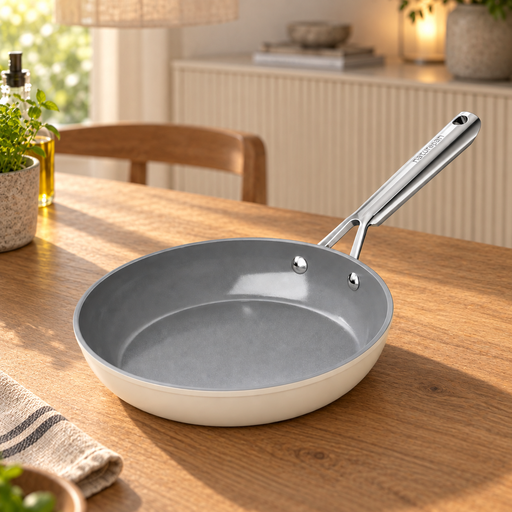
Why it suits this profile: A handy size for students, couples and everyday breakfasts. The aluminium body keeps the weight down, and according to the product information, the pan is suitable for induction, gas, electric and ceramic hobs.
The specifications clearly identify the material as aluminium with a ceramic coating and list hob compatibility. Hand-washing is recommended to protect the coating.
24 cm diameter; suitable for induction; oven-safe up to 230 °C without the lid; dishwasher-safe, but hand-washing is recommended.
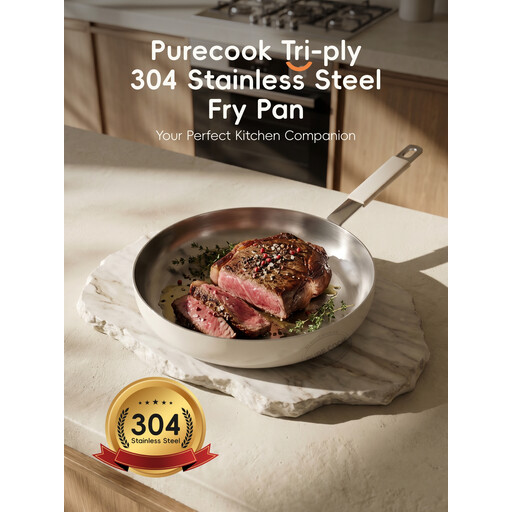
Why it suits this profile: For home cooks who prefer a stainless steel frying pan without a chemical coating on the inside. The 24 cm size is designed for everyday meals for two to three people.
The product description specifies 304 stainless steel, a three-layer base and no chemical coating on the inside. The pan is suitable for induction and gas.
Three-layer composite base; no chemical coating on the inside; heat-resistant silicone sleeve on the handle; smooth rim.
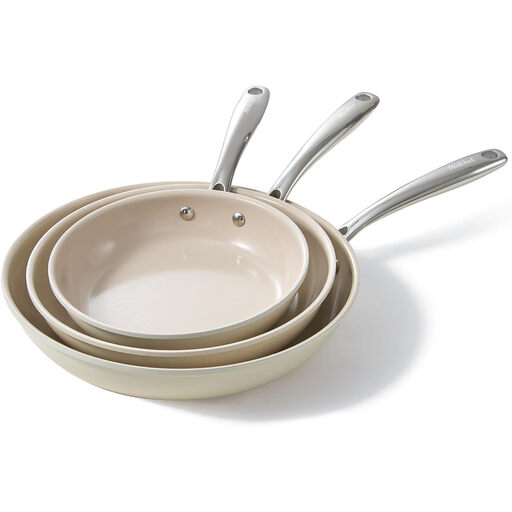
Why it suits this profile: The set includes 20, 24 and 28 cm pans. You can use different sizes for small portions, breakfast and larger stir-fries.
The three different diameters make it easier to choose the right pan for each dish. According to the product information, the set is suitable for induction, gas and electric hobs. Hand-washing is recommended, despite the stated dishwasher-safe rating.
20, 24 and 28 cm; aluminium construction; ceramic coating; suitable for all hobs according to the product specifications; oven-safe up to 842 °F according to the brand.
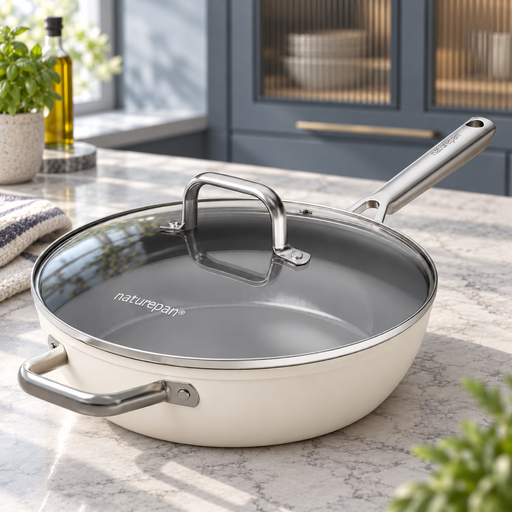
Why it suits this profile: Its deep shape and included lid make it practical for sauces, vegetables, slow-cooked dishes and larger family portions.
The product information lists the size, depth, lid and hob compatibility separately. The lid must be removed before using the pan in the oven.
28 cm diameter; 7.5 cm-high body; matching lid included; suitable for induction, gas, electric and ceramic hobs.
We’ve put together a complete, up-to-date list of products that meet these strict selection criteria and current European safety regulations.
That depends on the base. Only choose a frying pan for induction if the manufacturer explicitly says it’s suitable. A magnetic composite base or stainless steel induction base is usually needed. Also check the diameter of the base and your hob’s cooking zone.
Lifespan varies by product and use. Low to medium heat, soft spatulas and hand-washing can help protect the coating. Replace the pan if the coating becomes visibly damaged or starts peeling, or if food keeps sticking.
Not necessarily. PFAS-free may be an important purchase criterion, but also consider heat distribution, size, handle, hob compatibility and care. According to some brands’ own information, certain ceramic coatings are free from PFAS, PTFE and PFOA. Always check the exact product specifications for the model you’re buying.
