
Vandaag of morgen in huis

Kwaliteit gegarandeerd

Welkomstaanbiedingen ontgrendelen: GRATIS bezorging | Tot 80% korting | Gratis 30 dagen JoyPlus-proefperiode
Download de app
A ceramic frying pan may seem straightforward to choose at first glance. However, pans vary considerably in their coating, base, size and care requirements. A low price can be appealing, but a pan that is not suitable for induction or quickly loses its non-stick performance can end up costing more in the long run.
The Joybuy Product Recommendation Officer helps you assess the key differences without taking marketing claims as facts. Below, you’ll find what to look for in a ceramic frying pan with a non-stick coating, a PFAS-free frying pan and a model for everyday cooking.
Many pans consist of an aluminium or stainless-steel body with a ceramic coating. This is perfectly normal: aluminium keeps the pan lightweight and provides fast heat distribution, while the coating forms the cooking surface. Always check the material of both the pan and the non-stick coating.
A ceramic-coated aluminium pan is different from a pan made entirely of ceramic. For everyday use on a Dutch hob, the combination of material, base and coating is particularly important.
Product pages sometimes use terms such as PFAS-free, PFOA-free and PTFE-free interchangeably. Check exactly which claim is stated. According to the manufacturers’ own product information, coatings from brands including BUYDEEM, Redchef, Brabantia and SENSARTE are free from certain substances. This is a product specification from the manufacturer, not a general guarantee of the coating’s lifespan or cooking performance.
Even a scratch-resistant frying pan remains vulnerable to metal utensils, abrasive sponges and prolonged heating without food or oil. “Scratch-resistant” therefore does not mean scratch-proof.
A 28 cm frying pan provides room for several portions, but the effective base may be smaller than the upper rim. On an induction hob, the base must align properly with the cooking zone. A pan that is too large for a small zone may heat unevenly.
A 24 cm frying pan is generally more practical for one to three people. If you cook for a family or prepare larger quantities, it is better to consider a 26 or 28 cm pan. A deep ceramic sauté pan is more useful for sauces, stir-fries and dishes containing liquid.
Look out for the following:
According to the product description, a reinforced coating may provide additional wear resistance, but you should still use wooden, silicone or plastic utensils. To extend the pan’s lifespan, allow it to cool down before washing it.
A good induction frying pan has a magnetic, flat base. Also check whether the pan is suitable for:
Also pay attention to exceptions. According to the product information, the 28 cm Tefal Easy Cook & Clean is suitable for gas, electric and ceramic cooking, but not for induction. A pan can therefore work on many types of hob without being universally compatible.
Choose the size based on your household and the dishes you prepare:
Also check the weight. A heavy base may provide more stable heating, while a lightweight model is easier to handle. A lid, pouring rim or two pouring spouts can be practical when preparing sauces and stews.
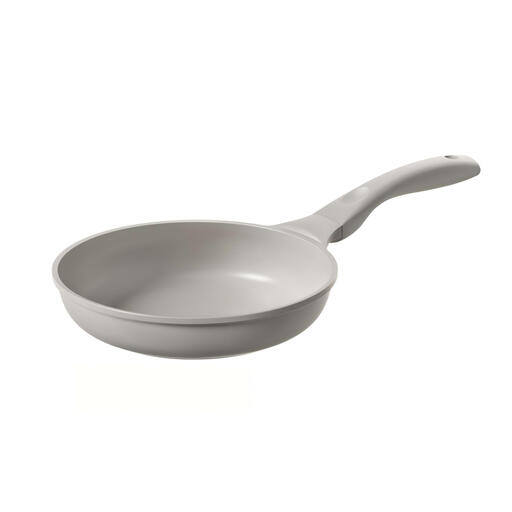
Why it suits this profile: The 24 cm size is practical for everyday cooking and suitable for induction, gas and electric hobs. According to the product information, the coating is PFAS-, PFOA- and PTFE-free.
The hob compatibility and coating composition are clearly stated in the product specifications. Avoid using metal utensils to help prevent scratches.
24 cm diameter, ceramic non-stick coating and dishwasher-safe design according to the product description.

Why it suits this profile: This pan combines a PFAS-free ceramic coating with 100% recycled forged aluminium and oven resistance up to 200 °C.
The manufacturer lists the coating, compatible hobs and maximum oven temperature separately. This makes it easier to compare products than relying solely on the term “ceramic”.
Suitable for all the heat sources listed, oven-safe up to 200 °C and dishwasher-safe; hand washing is recommended for a longer lifespan.
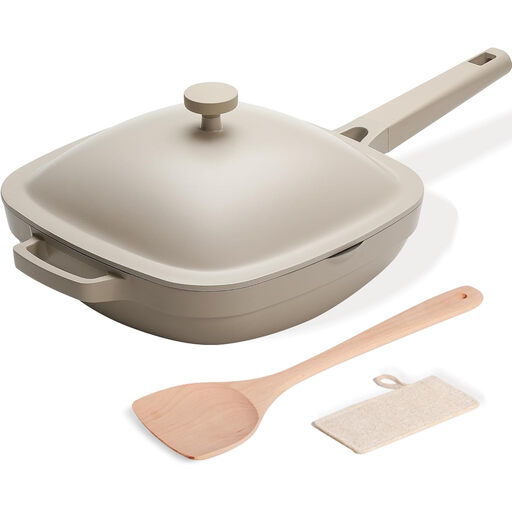
Why it suits this profile: The deep shape, 3.8 QT capacity, lid and pouring spouts make it suitable for stir-fries, slow cooking, meal prep and dishes with sauce.
The product information explicitly states that this pan is not dishwasher-safe or oven-safe. Knowing these limitations in advance helps prevent incorrect use.
Cast aluminium, ceramic coating, raised lid and wooden spatula included. Suitable for all the hob types listed.
We’ve put together a complete, up-to-date list of products that fully meet these strict selection criteria and the applicable European safety regulations.
A ceramic coating will generally remain usable for longer if you:
A dishwasher-safe frying pan can go in the dishwasher, but many manufacturers still recommend hand washing. Heat, dishwasher detergent and contact with other pans can put additional strain on the coating.
That depends on the base. Choose a model that explicitly states induction compatibility. If in doubt, also check the recommended diameter of the cooking zone and the diameter of the pan’s base.
Its lifespan depends on the temperature, frequency of use, utensils and cleaning method. There is no fixed lifespan that applies to every pan. Once the coating visibly starts to come away, becomes damaged or food consistently sticks to it, replacing the pan is advisable.
“Healthy frying pan” is not a technical quality standard. A PFAS-free frying pan may suit consumers who wish to avoid these substances, but always check the exact product claim, the material and the usage instructions. According to the manufacturer’s own product information, a coating may be PFAS-, PFOA- or PTFE-free; treat this as a product specification rather than a medical or health claim.
