
Vandaag of morgen in huis

Kwaliteit gegarandeerd

Welkomstaanbiedingen ontgrendelen: GRATIS bezorging | Tot 80% korting | Gratis 30 dagen JoyPlus-proefperiode
Download de app
At first glance, choosing a ceramic frying pan might seem straightforward. However, pans vary significantly in their coating, heat distribution, size and maintenance. A low price can be tempting, but a pan that isn’t suitable for induction hobs or quickly loses its non-stick properties will ultimately prove a false economy.
Pay particular attention to these three common pitfalls:
A ceramic non-stick pan typically has a ceramic coating on an aluminium or steel pan body. When looking for a PFAS-free frying pan, seek a clear mention of the coating. Some product descriptions, for example, state “PFAS-free”, “PTFE-free” and “PFOA-free”. That is far more verifiable than a vague claim like “healthy cooking”.
Brand information remains a claim made by the supplier. According to the product information, the coating on the Redchef Starlight series is free from PTFE, PFOA and PFAS. According to the product information, the Brabantia Onyx and Dusk pans are PFAS-free. Use this information as a buying criterion, but always check the current specifications on the product page.
A frying pan without PFAS and PTFE can suit consumers who wish to avoid these substances in their cookware. However, “healthy frying pan” is not an official product category: on its own, it tells you nothing about cooking results, lifespan or food safety.
If you have an induction hob, choose only an induction frying pan where induction is explicitly listed as a suitable heat source. For a home with gas, an electric hob and induction, an all-hob frying pan is the most practical choice.
Aluminium conducts heat quickly and makes a pan relatively lightweight. For induction, aluminium is usually fitted with a magnetic layer or a composite base. Also check whether the diameter of the pan base matches your cooking zone. A large pan on a small induction zone may heat less evenly.
The diameter determines not only how much food fits in the pan, but also how easy it is to handle.
A pan with a lid is useful for simmering and braising. A shallow frying pan, on the other hand, is better for frying and flipping. If you want both functions, you could also consider a ceramic pan set or a sauté pan with a glass lid.
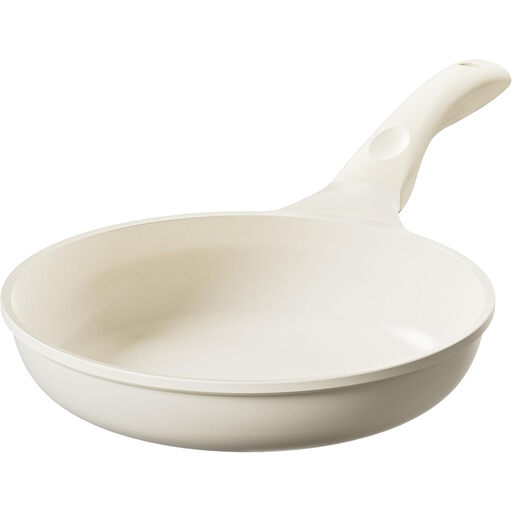
Why it fits this profile: The 24 cm size is ideal for everyday portions, such as eggs, vegetables or a piece of meat. According to the product information, the pan is suitable for induction, gas and electric hobs.
The product information explicitly states a ceramic coating without PTFE, PFOA and PFAS. Dishwasher-safety is also mentioned; hand washing remains a cautious choice for long-term coating care.
24 cm; aluminium, ceramic and stainless steel; ergonomic bakelite handle; suitable for induction, gas and electric cooking.

Why it fits this profile: This 24 cm pan combines a PFAS-free ceramic coating with a body made from 100% recycled forged aluminium. The pan is suitable for everyday cooking and oven use.
The specifications state the coating is PFAS-free and mention suitability for induction, gas, electric, ceramic and halogen hobs. The oven limit of 200 °C is also listed.
24 cm; RCS-certified recycled aluminium according to the product information; oven-safe up to 200 °C; dishwasher-safe.
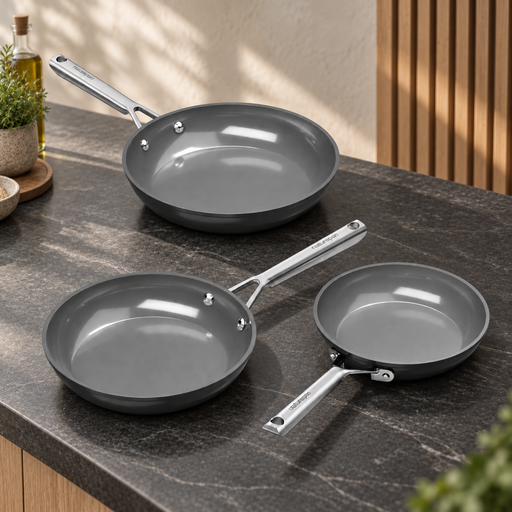
Why it fits this profile: Three sizes offer flexibility for single-person meals, family portions and larger dishes. According to the product information, the set is suitable for induction, gas, ceramic and electric cooking.
The product description specifies a ceramic coating reinforced with diamond and titanium and states that the coating is PTFE-, PFAS- and PFOA-free. Use wooden, silicone or plastic spatulas.
Set of 20, 24 and 28 cm; oven-safe up to 260 °C according to the product specification; dishwasher-safe; stainless steel handles.
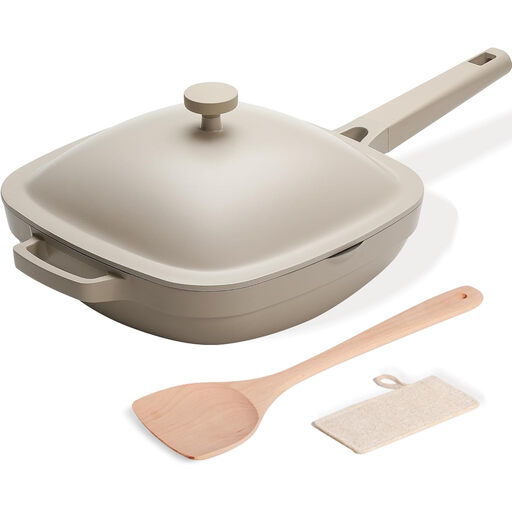
Why it fits this profile: The deep shape and 3.8-quart capacity are ideal for sautéing, stir-frying, braising and meal prep. The lid helps with dishes that need to retain moisture.
The product information mentions a PFAS-free Ti-ceramic coating and suitability for all hob types. It also clearly states that the pan is not dishwasher-safe and not oven-safe.
3.8-quart capacity; lid, wooden spatula and scrubber included; two pouring spouts; suitable for gas and other hobs according to the product specification.
We have compiled a full, up-to-date list of products that fully meet these strict selection criteria and comply with current European safety regulations.
A ceramic non-stick layer will generally last longer if you don’t put unnecessary strain on the pan. Follow these practical guidelines:
That depends on the model. A ceramic coating says nothing about whether the base is induction-compatible. So check that “induction” is explicitly listed among the suitable heat sources. Many models in the selection above are, according to their product information, suitable for induction, gas and electric hobs.
The lifespan depends on use, temperature, utensils and cleaning. Ceramic coatings can gradually lose their non-stick properties, especially with overheating, scratches or harsh cleaning. There is therefore no fixed lifespan that applies to every pan.
Not automatically. PFAS-free describes one aspect of the coating, but it doesn’t tell you everything about portion size, cooking temperature, maintenance or nutritional value. Check the full product specifications and use the pan according to the manufacturer’s safety instructions.
