
Vandaag of morgen in huis

Kwaliteit gegarandeerd

Welkomstaanbiedingen ontgrendelen: GRATIS bezorging | Tot 80% korting | Gratis 30 dagen JoyPlus-proefperiode
Download de app
A ceramic frying pan may seem simple to choose at first glance. However, pans vary considerably in their coating, base, size, care requirements and compatibility with different heat sources. A low price can be appealing, but a pan that warps, is unsuitable for induction or quickly loses its non-stick properties may ultimately cost you more.
As a Joybuy Product Recommendation Officer, I focus primarily on verifiable product specifications. Marketing terms such as “healthy”, “indestructible” or “oil-free cooking” mean little on their own. Instead, look at the materials, the instructions for use and the specific limitations.
Ceramic coatings are often presented as an alternative to traditional non-stick coatings. However, always check whether the product information explicitly states that the pan is PFAS-free, PTFE-free and PFOA-free. The word ceramic alone is not enough.
When a brand describes a coating as non-toxic or healthy, you should read this as a product claim made by the brand. According to Redchef’s own information, several models are free from PTFE, PFOA and PFAS. This is a materials description from the product listing, not a medical claim and no guarantee that every cooking result will automatically be healthy.
A dishwasher-safe frying pan can be convenient, particularly in a household with several pans. However, various manufacturers recommend washing by hand with a soft sponge to help preserve the ceramic coating for longer. Hot water, dishwasher detergent and harsh cleaning can affect its lifespan.
Always allow the pan to cool before washing it. Holding a hot pan directly under cold water can cause thermal shock and contribute to warping. Also use wooden, silicone or nylon utensils instead of metal spatulas.
A frying pan for all heat sources must be suitable for the hob you use at home. Look specifically for mention of induction, gas, electric hobs, ceramic hobs and halogen. Not every ceramic pan works on induction: it needs a magnetic base for this.
For induction, also pay attention to the diameter of the pan base. A 24 cm frying pan may have a smaller effective base. Position the pan as centrally as possible on the cooking zone and avoid preheating it empty for extended periods.
A ceramic non-stick pan usually consists of an aluminium body with a ceramic coating. Aluminium heats up quickly, while a suitable base should distribute the heat evenly across the pan. Stainless steel may be added for extra strength or induction compatibility.
Check the following points:
Do not confuse a scratch-resistant claim with unlimited resistance to wear. Even a durable frying pan needs to be used with care.
A 24 cm frying pan is practical for one to three people and suitable for eggs, vegetables, fish or a small portion of meat. A 20 cm pan is better suited to single portions or side dishes. For families, 26 or 28 cm pans are often more convenient, as they give you more room without forcing ingredients to overlap.
A larger pan does require a suitably sized cooking zone. On a gas hob, the flame should remain beneath the base rather than rising up the sides. With induction, a good match between the base and cooking zone is important for even heating.
Ceramic coatings may become less effective at releasing food over time, particularly when exposed to high temperatures, dry heating or abrasive cleaning. Follow the manufacturer’s instructions for use:
A dishwasher-safe frying pan can go in the dishwasher, but hand washing may be the wiser choice if you want to preserve the coating for as long as possible.
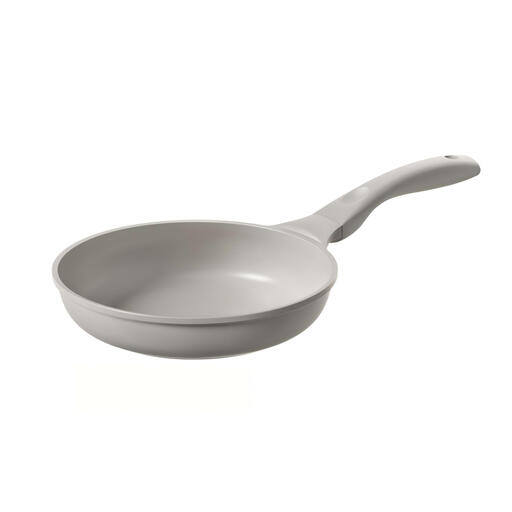
Why it suits this profile: A manageable size for everyday cooking and smaller households, compatible with induction, gas and electric hobs.
The product information states that it has a PTFE-, PFOA- and PFAS-free ceramic coating and explicitly lists several heat sources.
24 cm, aluminium, ceramic and stainless steel construction, ergonomic Bakelite handle and product information stating that it is dishwasher-safe.

Why it suits this profile: For those who value the origin of the materials, a sturdy handle and use on different heat sources.
The pan is described as PFAS-free, suitable for induction and fitted with two ceramic non-stick layers. Hand washing is recommended for a longer service life.
100% recycled forged aluminium according to the stated RCS marking, oven-safe up to 200 °C and dishwasher-safe.
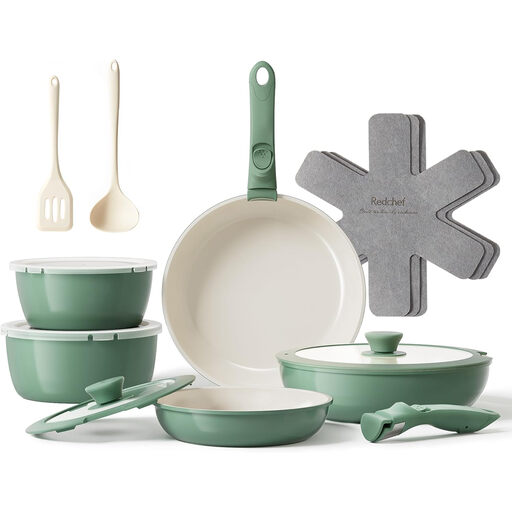
Why it suits this profile: Handy for families, small kitchens or anyone who wants to move pans between the hob, oven and fridge.
The set states that it is compatible with gas, electric, ceramic and induction hobs. According to the product information, the detachable handles save up to 75% of storage space.
16 pieces, product information stating that it is PTFE-, PFOA- and PFAS-free, a stackable design and oven use once the handle has been removed.
We have put together a complete, up-to-date list of products that fully meet these strict selection criteria and the applicable European safety regulations.
This varies from model to model. Check whether the product information explicitly states induction-compatible. An aluminium pan without a magnetic base will generally not work on induction. According to their product information, pans such as the Redchef and Brabantia models mentioned above are suitable for induction, gas and electric hobs.
Its lifespan depends on temperature, utensils, cleaning and storage. A ceramic coating can wear more quickly if the pan is heated empty, used at high temperatures or exposed to metal spatulas. Hand washing with a soft sponge, cooking over a low to medium heat and using pan protectors when stacking can help preserve its properties for longer. A manufacturer’s durability claim is not a fixed service life.
PFAS-free describes the stated composition of the coating. It does not mean that a pan provides a medical or health benefit. You should also choose a pan with clear materials information, a stable handle, suitable heat-source compatibility and straightforward care instructions. This will help you make a practical choice that fits your everyday cooking routine.
