
Vandaag of morgen in huis

Kwaliteit gegarandeerd

Welkomstaanbiedingen ontgrendelen: GRATIS bezorging | Tot 80% korting | Gratis 30 dagen JoyPlus-proefperiode
Download de app
A ceramic frying pan might seem straightforward to choose at first glance. Yet pans differ greatly in coating, base, size and care. One pan may be suitable for induction, but still heat unevenly. Or the packaging might say “dishwasher safe”, while hand washing keeps the coating in better condition for longer.
For British households, these three pitfalls are particularly important:
A ceramic non-stick pan has a smooth coating that, according to product information, can help food release more easily. Manufacturers often link this to cooking with less oil. However, this says nothing about any medical effect or automatically about the lifespan of the coating.
If you’re looking for a frying pan without PFAS and PFOA, you need to read the product specification carefully. With Redchef pans, for example, the manufacturer states a coating without PTFE, PFOA and PFAS. With SENSARTE, according to the product information, certain substances including PFOA and PFOS have not been intentionally added to the coating. These are product claims from the brands; if in doubt, check the current specifications and any conformity information.
When using ceramic coatings, it’s best to use:
A dishwasher-safe frying pan is convenient, but dishwasher cycles can put extra strain on the coating and handle over time. Hand washing is therefore often a sensible choice, even if the manufacturer allows dishwasher use.
An aluminium frying pan generally heats up quickly. However, aluminium alone won’t work on an induction hob. For that, you need a magnetic base, usually made of stainless steel.
So check whether the pan is explicitly suitable for:
A pan for all hob types usually has an adapted or magnetic base. Also pay attention to the diameter of the base. If the cooking zone is much larger or smaller than the base, the heat may be distributed less evenly. The Tefal Renewal 24 cm, for example, has a base diameter of 18 cm according to the product information; that’s relevant when choosing the right induction zone.
A 20 cm pan is suitable for an omelette, a single portion or a small side dish. A 24 cm frying pan is a versatile size for everyday use. For multiple people, 28 cm or a deep sauté pan is more practical.
Also consider:
A pan described as “non-stick” won’t automatically stay scratch-free for years. Even a ceramic coating requires careful use and should be replaced when it visibly peels, flakes or becomes damaged.
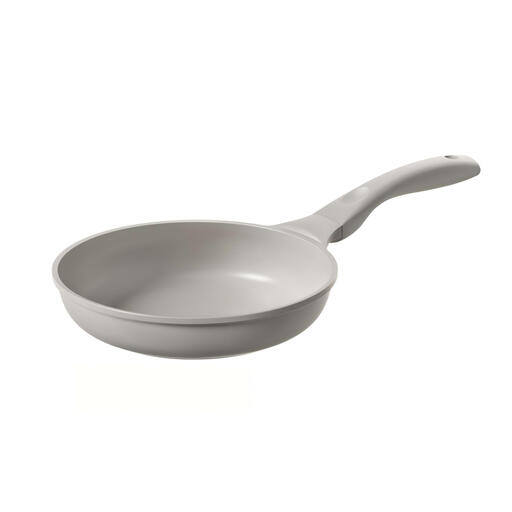
Why this fits the profile: The 24 cm size is suitable for everyday portions and the pan is compatible with induction, gas and electric hobs according to the product information.
The stated PTFE-, PFOA- and PFAS-free ceramic coating makes the product specification clearer than a general term like “healthy cooking”.
24 cm size, ceramic coating, ergonomic Bakelite handle and suitability for multiple hob types.

Why this fits the profile: This pan combines a 24 cm size with recycled forged aluminium, a PFAS-free ceramic coating and an oven-safe handle.
The product specification lists the coating, hob compatibility and maximum oven temperature of 200 °C separately.
PFAS-free according to the product information, suitable for all heat sources, oven-safe and dishwasher-safe; hand washing is recommended.
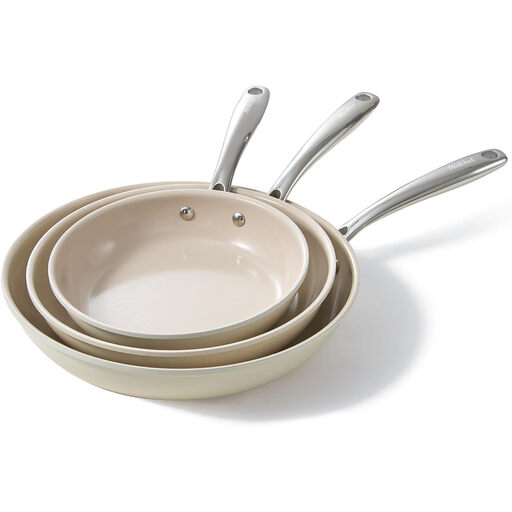
Why this fits the profile: The set includes 20, 24 and 28 cm, so you can prepare small portions, family meals and multiple dishes.
The three specific diameters prevent you from using one awkward in-between size for every type of cooking.
Three sizes, forged aluminium construction, ceramic coating, induction compatibility and oven safety according to the product information.
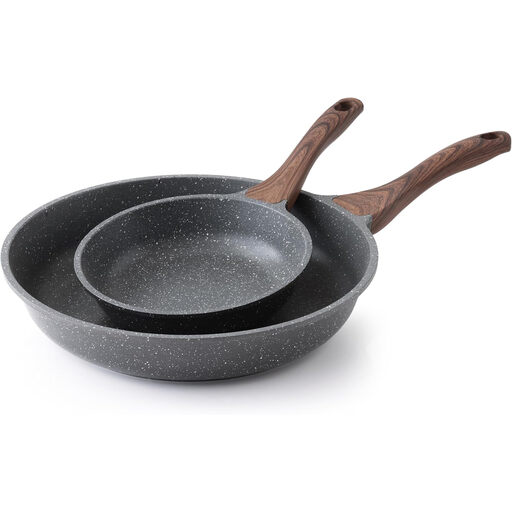
Why this fits the profile: The combination of a small omelette pan and a large frying pan suits families who cook several different dishes at the same time.
The set states a magnetic stainless steel base for induction and other hobs. Hand washing is recommended to preserve the coating.
Two sizes, glass lid, Bakelite handles and, according to the manufacturer, a coating without intentionally added PFOA, PFOS, APEO, lead and cadmium.
We’ve put together a full, up-to-date list of products that fully meet these strict selection criteria and current European safety regulations.
That depends on the base. An aluminium pan will only work on induction if a magnetic layer or induction base has been added. So always check that “induction suitable” is explicitly stated in the product information.
The lifespan depends on temperature, frequency of use, utensils and cleaning. Don’t heat the pan empty on a high setting, avoid metal spatulas and steer clear of sudden temperature changes. Replace the pan when the coating visibly flakes, peels or becomes badly damaged.
Some models are dishwasher safe according to the manufacturer, such as certain Redchef and Brabantia pans. However, several product descriptions recommend hand washing to keep the coating in good condition for longer. Let the pan cool down first and use a soft sponge. It takes little extra time and limits unnecessary wear.
