
Vandaag of morgen in huis

Kwaliteit gegarandeerd

Welkomstaanbiedingen ontgrendelen: GRATIS bezorging | Tot 80% korting | Gratis 30 dagen JoyPlus-proefperiode
Download de app
A ceramic frying pan might seem straightforward to choose at first glance. Yet pans vary greatly in coating, size, hob compatibility and maintenance. Marketing terms like “diamond-reinforced”, “healthy” or “scratch-resistant” only mean something once you check the technical details.
For British households, there are three main pitfalls to watch out for:
A frying pan with a ceramic non-stick coating usually has a metal core with a ceramic layer on the inside. Aluminium conducts heat quickly and keeps the weight low. Stainless steel offers a sturdy outer construction, but can be heavier.
Some models use a titanium-reinforced frying pan or a coating with diamond particles. According to the manufacturer’s product description, this construction can increase wear resistance. That’s no guarantee the pan will never scratch. So use wooden, silicone or plastic utensils and avoid prolonged dry heating.
Also look out for terms like PFAS-free frying pan, PFOA-free frying pan and PTFE-free. A claim about the composition should come from the product information or conformity documentation of the brand. According to the product description of various Sanho and Naturepan models, these coatings are free from PFAS and PFOA; always check the current information on the product page.
A good induction frying pan has a base suitable for magnetic heating. The base must sit flat on the hob zone. A multi-layer base can help with even heat distribution, but the result also depends on the hob, the diameter of the zone and the heat level you choose.
The models mentioned are, according to their product descriptions, suitable for multiple heat sources, including:
A pan that works on all hobs is practical if you move house or cook both at home and in a campervan. Also check whether the handle and the pan itself are oven-safe. These features vary by model.
Choose the diameter based on your usual portions:
A high rim and a lid make a pan more suitable for one-pot dishes, simmering and larger quantities. For a small kitchen, caravan or campervan, a pan set with a detachable handle can save space. Just check that the handle is properly locked before lifting.
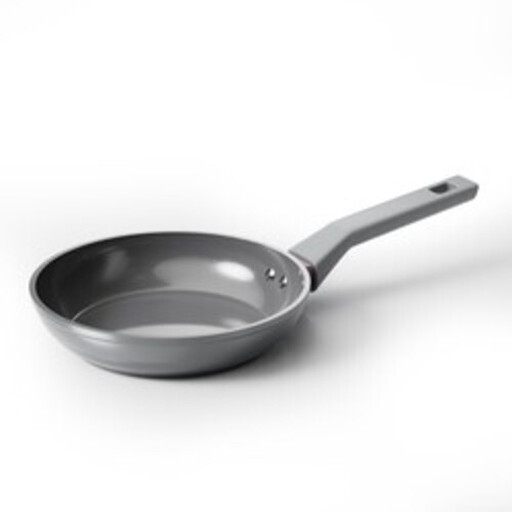
Why this fits the profile: The compact size takes up little space and is practical for one person, a small kitchen or simple breakfast dishes.
The product description mentions a PFAS- and PFOA-free coating and suitability for induction. The pan is not oven- or microwave-safe; that prevents wrong expectations at purchase.
20 cm diameter, suitable for induction and dishwasher according to the product information. Use low to medium heat and soft utensils.
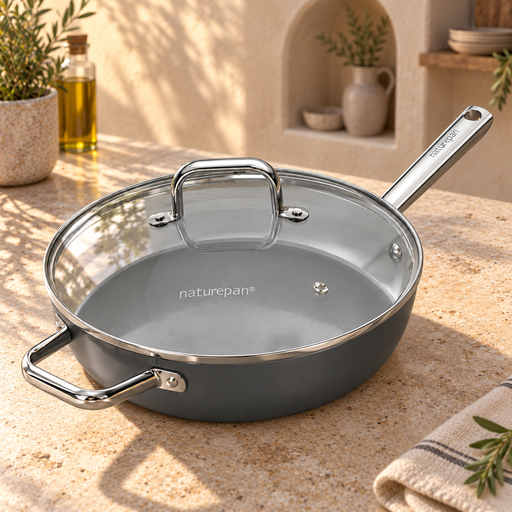
Why this fits the profile: The high rim, lid and generous size suit families and home cooks who make stir-fries, stews or one-pot meals.
The product information explicitly states induction compatibility, dishwasher safety and an oven limit of 260 °C. Use oven gloves and check the manual for safe oven use.
28 cm, high sides, glass lid and a ceramic coating that is PFAS-, PTFE- and PFOA-free according to the product description.
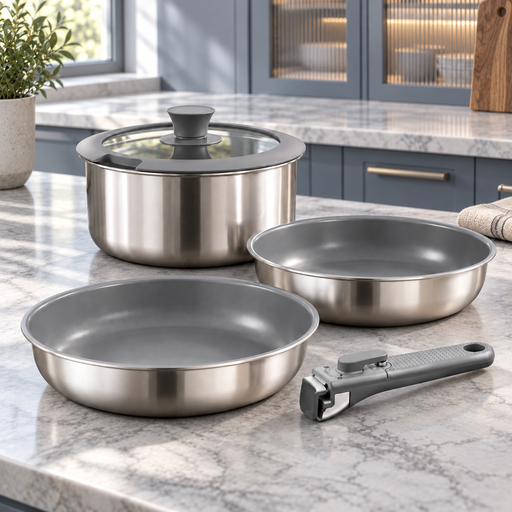
Why this fits the profile: The set combines two frying pans, a saucepan, lid and detachable handle. That’s handy for families, campervans and small kitchens.
The detachable handle helps with stacking and storage. Check that the locking mechanism is fully secure before each lift.
Suitable for induction, gas, electric and ceramic hobs. According to the product description, the handles are oven-safe up to 250 °C and the set is dishwasher-safe.
We’ve put together a full, up-to-date list of products that fully meet these strict selection criteria and current European safety regulations.
A scratch-resistant frying pan is not the same as a scratch-proof pan. With these habits, the non-stick coating will generally last longer:
A dishwasher-safe frying pan can go in the dishwasher, but hand washing can keep the coating and appearance in better condition for longer. Always follow the care instructions for your specific model.
It can be, but not automatically. Check whether the product description says “suitable for induction”. Especially with aluminium pans, a suitable metal base is needed.
The lifespan depends on heat use, utensils, cleaning and how often you use the pan. A ceramic coating can wear down when you use high temperatures, metal spatulas or harsh cleaning agents.
The term healthy frying pan is not a technical guarantee. According to the product information of some models, the coatings are PFAS- and PFOA-free. Check the current product specifications for that and use the pan according to the safety instructions. A pan on its own doesn’t prevent health problems; the benefit lies mainly in the stated material composition and the fact that you can cook with little oil.
