
Vandaag of morgen in huis

Kwaliteit gegarandeerd

Welkomstaanbiedingen ontgrendelen: GRATIS bezorging | Tot 80% korting | Gratis 30 dagen JoyPlus-proefperiode
Download de app
A ceramic frying pan might seem straightforward to choose at first glance. Yet pans vary greatly in coating, size, hob compatibility and maintenance. A low price can be tempting, but a pan that doesn’t work on induction or quickly loses its non-stick properties is ultimately not a cost-effective purchase.
As a Joybuy Product Recommendation Officer, I’ve filtered the most important product information into practical points. This way, you can see more quickly which ceramic frying pan suits your hob, household and cooking style.
The term ceramic non-stick pan usually refers to the type of non-stick coating, but it doesn’t always tell you which substances have or haven’t been used. So check whether the product information clearly states that the pan is PFAS-free, PTFE-free or free from both.
Also look out for the difference between “free from intentionally added substances” and a general claim. According to the product information for the Brabantia Dusk, Brabantia Onyx, Brabantia Nocta, Naturepan and Tefal Renewal, these models are PFAS-free. With other pans, only PFOA-free may be mentioned. That is not the same as a frying pan without PFAS and PTFE.
A frying pan of 28 or 32 cm offers space for larger portions, but also needs a suitable cooking zone. With induction, the diameter of the magnetic base is particularly important. A pan that is too large can heat unevenly when the base doesn’t sit properly over the cooking zone.
So don’t just look at the total diameter, but also at the base diameter where available. The Tefal Renewal 24 cm, for example, has a base of 18 cm according to the product information. That helps you check whether it matches your induction zone.
A dishwasher-safe frying pan can go in the dishwasher after use, but aggressive detergents and high temperatures can put more strain on the ceramic coating over time. That’s why many manufacturers recommend hand washing with a soft sponge, even when the pan is technically suitable for the dishwasher.
With a non-stick pan, it’s best to use wooden, silicone or plastic utensils. Avoid steel wool, scouring pads and sharp metal spatulas. Also, let the pan cool down before washing it to limit thermal shock and possible warping.
A ceramic frying pan often consists of an aluminium pan body with a ceramic coating. Aluminium is relatively light and conducts heat quickly. That makes an aluminium frying pan pleasant for daily use, but a light pan can also react more quickly to temperature changes.
Check these points:
According to the product description, the Brabantia Dusk uses 100% recycled forged aluminium with an RCS marking and a two-layer ceramic coating. Naturepan mentions a ceramic coating that, according to the product information, is reinforced with diamond and titanium particles. These are verifiable product specifications, but not a guarantee that a coating will last indefinitely.
For one person or small portions, a 20 cm pan is often practical. A 24 cm size works well for meals for around two to three people. A 28 cm pan offers more room for multiple ingredients, but also takes up more space on the hob and in the cupboard.
A frying pan set can be more cost-effective if you regularly prepare different portion sizes. Just check whether you’ll actually use both sizes. The Brabantia Dusk set contains 20 and 24 cm pans and, according to the product information, is suitable for cooking for one to three people. Naturepan offers a set with 20, 24 and 28 cm.
An induction frying pan must have a suitable magnetic base. Also check whether the pan is suitable for gas, electric, ceramic and halogen hobs. Some models seem versatile but have important limitations.
An oven-safe frying pan should always be used within the stated maximum temperature. According to the product information, the Brabantia Dusk is oven-safe up to 200 °C. Naturepan states a maximum of 260 °C. Tefal Renewal is suitable for all the hobs mentioned according to the product description, but is not dishwasher-safe. The handle and coating partly determine whether use in the oven is safe.

Why this fits the profile: Two common sizes offer flexibility for eggs, vegetables and smaller family meals. According to the product information, the set works on induction, gas, electric, ceramic and halogen hobs.
The product information states a PFAS-free ceramic coating, clear sizes and oven use up to 200 °C. Hand washing is still recommended to preserve the coating for longer.
20 and 24 cm in one set; recycled forged aluminium; dishwasher-safe according to the product description.
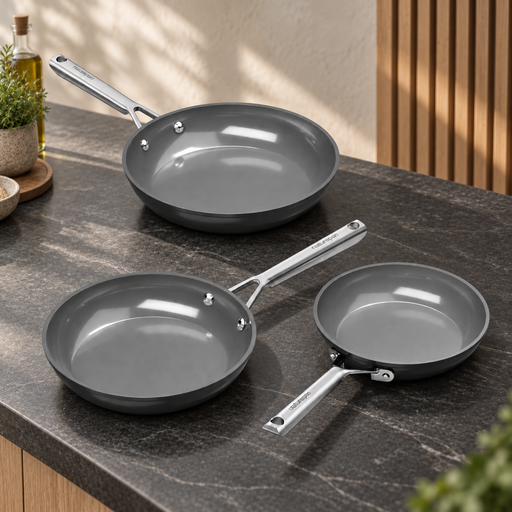
Why this fits the profile: The three sizes are suitable for a wide range of portions and recipes. According to the product information, the set is compatible with induction, gas, ceramic and electric hobs.
The coating is described as PTFE-, PFAS- and PFOA-free. The stated oven temperature of up to 260 °C makes the usage limits verifiable.
Three sizes; diamond and titanium reinforced ceramic coating according to the product description; dishwasher-safe.
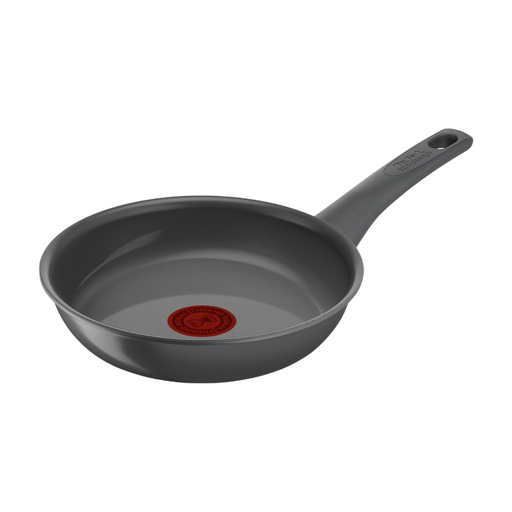
Why this fits the profile: This size is aimed at daily meals for up to around three people. According to the product information, the pan has a heat indicator and is suitable for induction, gas, electric, ceramic and halogen hobs.
The product information mentions a PFAS-free ceramic coating and clearly states that hand washing is required. So the maintenance limitation is known upfront.
100% recycled aluminium according to the product description; heat indicator; pouring spout; not suitable for the dishwasher.
We’ve put together a full, up-to-date list of products that fully meet these strict selection criteria and comply with current European safety regulations.
A ceramic coating generally stays usable for longer if you don’t heat the pan empty on a high temperature. Heat on a low to medium heat and use enough fat as per the recipe. Don’t cut food in the pan and only stack pans with a protective layer in between.
Regularly check that the handle is firmly attached and that the coating isn’t damaged. If the coating is peeling or heavily damaged, further use is not advisable. Always follow the temperature limit, especially with an oven-safe frying pan.
That varies by model. An induction frying pan must have a suitable magnetic base. Check the packaging or product page for an explicit “induction-compatible” mention. The Brabantia, Naturepan and Tefal models mentioned in this article state induction compatibility in their product information.
The lifespan depends on use, temperature and maintenance. Metal utensils, empty heating, high temperatures and sudden temperature changes can put more strain on the coating. Hand washing with a soft sponge and cooking at a moderate temperature help to preserve the non-stick layer for longer.
No. PFAS-free describes the absence of certain substances according to the product claim, while ceramic refers to the type of coating. There are also pans without a coating, such as stainless steel models. Those require a different cooking technique and can cause food to stick more easily. So check the material, coating and hob compatibility separately.
