
Vandaag of morgen in huis

Kwaliteit gegarandeerd

Welkomstaanbiedingen ontgrendelen: GRATIS bezorging | Tot 80% korting | Gratis 30 dagen JoyPlus-proefperiode
Download de app
A ceramic frying pan may seem easy to choose at first. However, pans can vary considerably in size, base, coating and care requirements. A low price can be tempting, but a pan that doesn’t work well on your induction hob or quickly starts sticking offers little benefit.
Look out for these common pitfalls:
A ceramic pan usually has an aluminium body with a ceramic non-stick coating. Aluminium heats up quickly, while the coating helps food release more easily.
If you’re looking for a PFAS-free frying pan, check that it’s explicitly described as free from PFAS, PFOA and PTFE. These are product claims and should be checked for each model. According to Redchef’s own product information, its ceramic coatings are free from PFAS, PFOA and PTFE. Naturepan’s product information makes the same claim for its diamond- and titanium-reinforced ceramic coating.
A PFAS-free frying pan isn’t automatically maintenance-free. Use wooden, silicone or plastic utensils, and avoid metal spatulas. “Scratch-resistant” also doesn’t mean that scratches are impossible.
The diameter determines how much food you can cook at once:
A 24 cm pan often offers a good balance between weight and cooking surface. According to the product specifications, the 24 cm Naturepan frying pan is designed for meals for two to three people. The 28 cm Naturepan sauté pan has a body height of 7.5 cm and comes with a glass lid.
A ceramic induction frying pan needs a suitable magnetic base. Also check the diameter of the base. A pan may be 28 cm wide but have a smaller effective base. The stated base diameter of the 24 cm Naturepan is 19.1 cm; for the 28 cm sauté pan, it’s 21.2 cm.
Also consider the following:
The recommendations below are based on verifiable product specifications, such as dimensions, compatibility with heat sources, coating and care instructions.
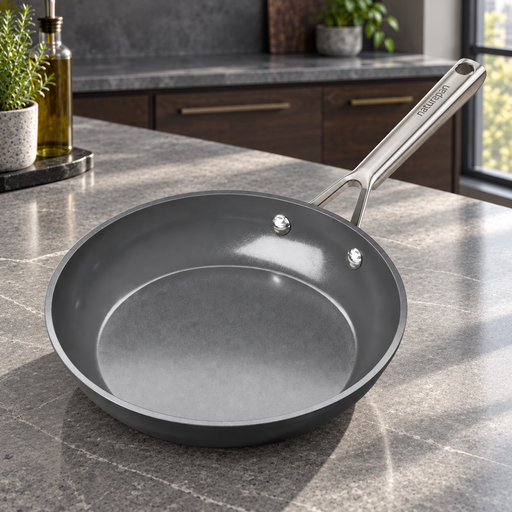
Why it suits this profile: Its size is suitable for everyday portions for two to three people, and it works on induction, gas, ceramic and electric hobs.
The product specifications list the compatible heat sources, oven-safety up to 260 °C and dishwasher-safety. So you don’t have to rely on a vague claim about compatibility.
24 cm diameter; aluminium body; ceramic coating stated to be free from PFAS, PFOA and PTFE according to the product information; suitable for four heat sources.
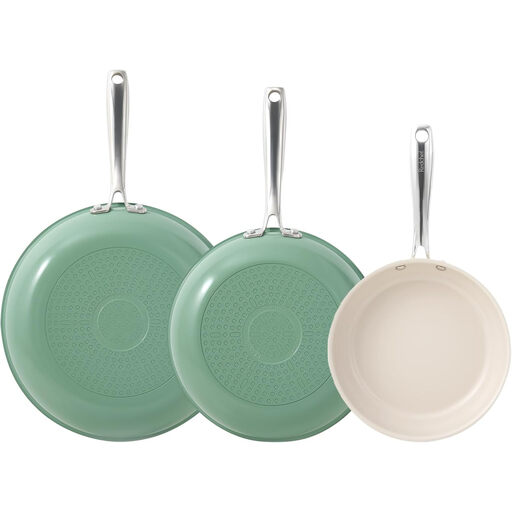
Why it suits this profile: The set includes three sizes—20, 24 and 28 cm—so you can use the right pan for different portions and dishes.
The set explicitly states that it’s compatible with induction, gas and electric hobs. The product information recommends hand-washing to help the coating last longer, despite listing a dishwasher option.
Three diameters; aluminium construction; ceramic coating; stainless-steel handles; oven-safe according to the product description.
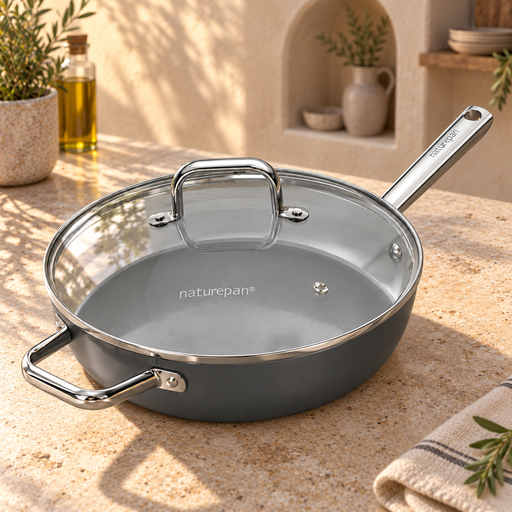
Why it suits this profile: Its high sides and lid make this ceramic sauté pan suitable for sauces, stews, stir-fries and one-pot meals.
The product description lists the base diameter, body height, four compatible heat sources and an oven limit of 260 °C. It also states that the pan is dishwasher-safe.
28 cm size; high sides measuring 7.5 cm; glass lid; suitable for induction, gas, ceramic and electric hobs.
We’ve put together a complete, up-to-date list of products that meet these strict selection criteria and the applicable European safety regulations.
A ceramic non-stick frying pan will retain its performance better if you follow these instructions:
A dishwasher can be convenient, but hand-washing with a soft sponge is often gentler on the coating.
That depends on the base. Only choose a model that explicitly states induction compatibility. Also check that the base sits flat against the cooking zone.
Its lifespan depends on heat, utensils, cleaning and storage. High heat, heating the pan while empty and metal spatulas can wear down the coating more quickly. It’s therefore not possible to give a reliable fixed lifespan.
“PFAS-free” describes the absence of certain substances according to the product information; it isn’t a general health claim. Cooking performance and care also depend on the construction, temperature and instructions for the specific pan.
