
Vandaag of morgen in huis

Kwaliteit gegarandeerd

Welkomstaanbiedingen ontgrendelen: GRATIS bezorging | Tot 80% korting | Gratis 30 dagen JoyPlus-proefperiode
Download de app
A ceramic frying pan might seem straightforward to choose at first. However, models can vary considerably in size, hob compatibility, coating and care requirements. A pan may look appealing, but prove too small for a family, turn out to be unsuitable for induction or wear out more quickly if used incorrectly.
For households in the UK, three pitfalls are particularly important:
An aluminium frying pan with a ceramic coating is lightweight and heats up quickly. This makes it a practical choice for eggs, pancakes, vegetables and everyday frying. However, heat distribution also depends on the pan’s thickness and base construction.
Look out for these terms:
Use wooden, silicone or nylon utensils where possible. Avoid wire wool and abrasive cleaners.
The right diameter depends on portion size and cooking style:
Don’t just look at the diameter across the top. The base diameter determines how much contact the pan makes with the hob zone. For example, a 28 cm pan may have a considerably smaller flat base.
A ceramic induction frying pan needs a magnetically compatible base. Also check the maximum oven temperature and whether the handle can go in the oven. Some models have a time limit or require the lid to be removed.
Practical tips:
A ceramic sauté pan with higher sides and a lid is better suited to simmering, sauces and larger dishes than a shallow frying pan.
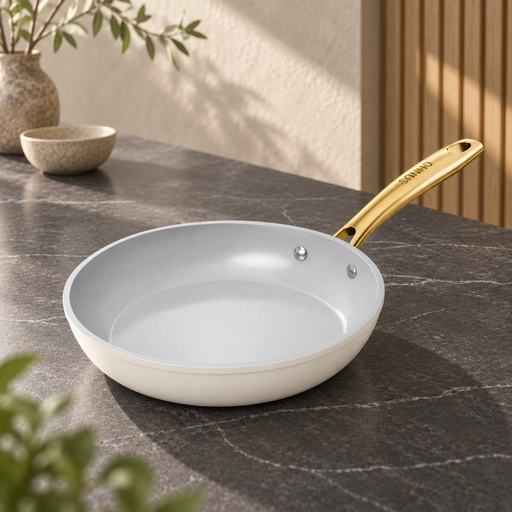
Why it suits this profile: Its compact size is practical for a student, someone setting up home for the first time or a household that usually cooks small portions. According to the product information, the pan is suitable for induction, gas, electric and ceramic hobs.
The product information clearly lists hob compatibility and a maximum oven temperature of 230 °C, with a usage limit of 60 minutes.
20 cm diameter, aluminium body, ceramic non-stick coating and dishwasher-safe according to the product specifications. Hand-washing is recommended.
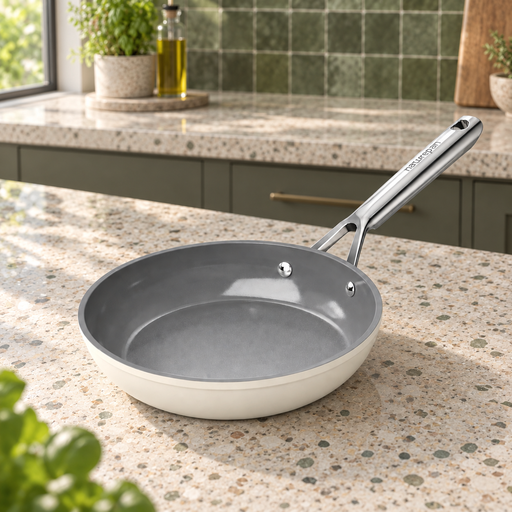
Why it suits this profile: This compact model combines an aluminium body with a ceramic coating reinforced with diamond and titanium, according to the product description, and a stainless steel handle.
The product specifications explicitly list the materials, base diameter, compatible hobs and oven use up to 260 °C.
Suitable for induction, gas, electric and ceramic hobs; dishwasher-safe according to the product information.
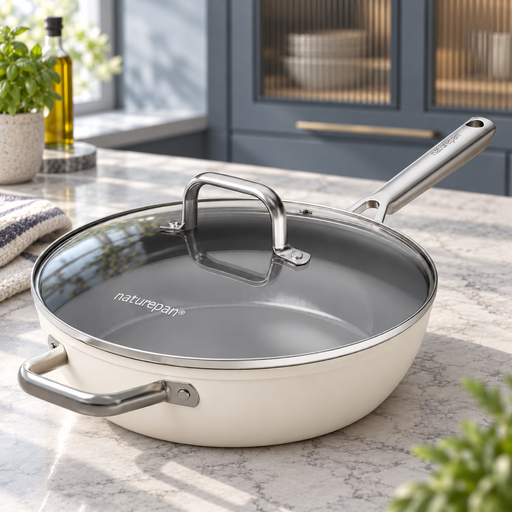
Why it suits this profile: Its 7.5 cm-high sides and included lid make it well suited to sauces, stir-fries and meals for several people.
The pan has a maximum oven temperature of 230 °C. It is not suitable for microwave use, and the lid must be removed before putting the pan in the oven.
28 cm size, ceramic coating, induction compatibility according to the product information and a matching lid.
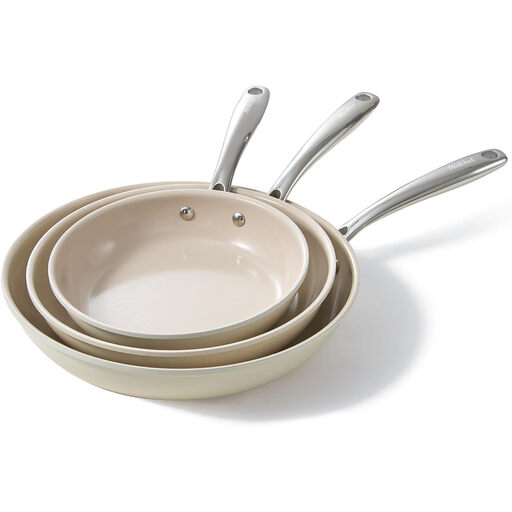
Why it suits this profile: The set includes 20, 24 and 28 cm pans, so you can switch between cooking an omelette, making a family meal and preparing larger portions.
The different diameters mean you won’t have to use the same pan for every dish, whether it’s too large or too small. The product information advises against using metal utensils.
Aluminium construction, ceramic coating, stainless steel handles and, according to the product information, compatibility with induction, gas and electric hobs.
We’ve put together a complete, up-to-date list of products that meet these strict selection criteria and the applicable European safety regulations.
That depends on the base. Only choose a model that is explicitly listed as suitable for induction. An aluminium pan without a magnetic base won’t automatically work on an induction hob. Also check the diameter of the hob zone and whether the base is flat.
Lifespan varies by product and use. Low to medium temperatures, using little oil, non-abrasive utensils and hand-washing can help protect the coating. Heating the pan empty for too long, using metal spatulas and abrasive cleaning products can damage the coating more quickly. Always follow the manufacturer’s care instructions.
No, these are different terms. PFAS is a collective name for a large group of substances; PFOA is one specific substance within that group. Check the exact claim in the product information. Some models are described by their manufacturer as being free from PFAS, PTFE and PFOA, but such claims should be checked for the specific product and not automatically applied to all ceramic pans.
