
Vandaag of morgen in huis

Kwaliteit gegarandeerd

Welkomstaanbiedingen ontgrendelen: GRATIS bezorging | Tot 80% korting | Gratis 30 dagen JoyPlus-proefperiode
Download de app
A ceramic frying pan can be useful for eggs, vegetables, fish and dishes where you want to use very little oil. However, the word “ceramic” does not tell you everything about quality or suitability. The pan’s material, base, coating and care requirements all determine how pleasant it is to use every day.
Pay particular attention to these common pitfalls:
If you are looking for a PFAS-free frying pan, look for a specific statement such as “PFAS-free” or “without intentionally added PFAS”. Terms such as “non-stick”, “healthy cooking” or “natural coating” are not sufficient on their own to assess the composition.
The product descriptions for several models in this selection state that their coatings are PFAS-free. According to Redchef’s own product information, the Redchef Starlight Series also has a ceramic coating that is free from PTFE, PFOA and PFAS. This is a brand claim, so always check the current product specifications before buying.
A ceramic pan with a non-stick coating will generally perform best when used over a low to medium heat. Do not heat a coated pan empty for prolonged periods, and preferably use utensils made from wood, silicone or plastic.
The diameter determines how much you can cook at once:
A large pan on a small induction zone may heat unevenly. So do not look only at the diameter; also check the base diameter. Some models list this measurement separately.
An induction frying pan needs a magnetic base. Aluminium alone is not sufficient; the pan must have, for example, a magnetic layer or a composite base. Ideally, a pan described as suitable for all hobs should explicitly state compatibility with induction, gas, electric and ceramic hobs.
Also check:
An oven-safe frying pan can only be used in the oven if both the pan and the handle are suitable for oven use. According to the product information, the Brabantia Dusk models in this selection are described as oven-safe up to 200 °C. The Naturepan set states a maximum temperature of 260 °C. Always follow the lowest limit specified for the pan, handle and lid.
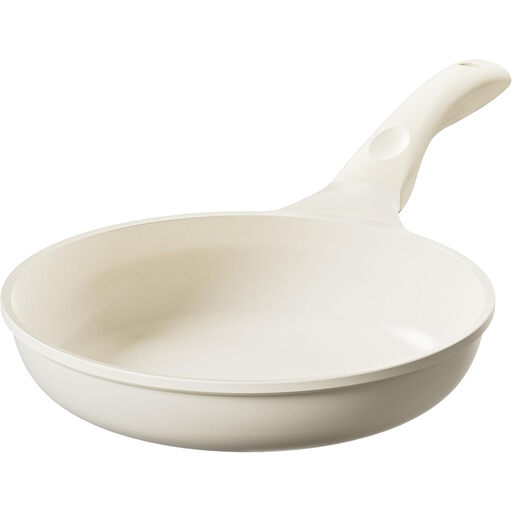
Why it suits this user profile: The 24 cm size is ideal for everyday portions and easy to manage for anyone choosing a ceramic frying pan for the first time. According to Redchef’s own product information, the pan is suitable for induction, gas and electric hobs.
The product information explicitly states that the ceramic coating is free from PTFE, PFOA and PFAS. Nevertheless, do not use metal utensils, as also stated in the warnings.
24 cm diameter, ergonomic Bakelite handle and, according to the product description, dishwasher-safe.
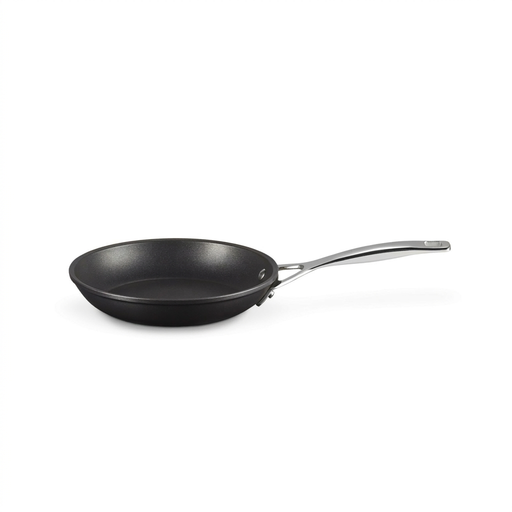
Why it suits this user profile: The 28 cm version provides plenty of room for larger portions and, according to the product information, is suitable for all hobs, including induction.
The specifications list the size, coating, hob compatibility and oven suitability separately. The coating is described as PFOA-free; this is a brand claim and is not the same as a general PFAS-free statement.
Reinforced non-stick coating, stainless-steel handle and a shallow shape for frying and searing.

Why it suits this user profile: This 30 cm ceramic wok is designed for stir-frying, stewing, boiling and deep-frying. According to the product description, its flat magnetic base is suitable for induction, gas, electric and ceramic hobs.
The honeycomb structure is intended to act as a buffer between utensils and the coating. The manufacturer recommends hand-washing and warns against sharp metal utensils, so scratch resistance has its limits.
Three-layer stainless-steel construction, 30 cm capacity and a glass lid for keeping an eye on the cooking process.
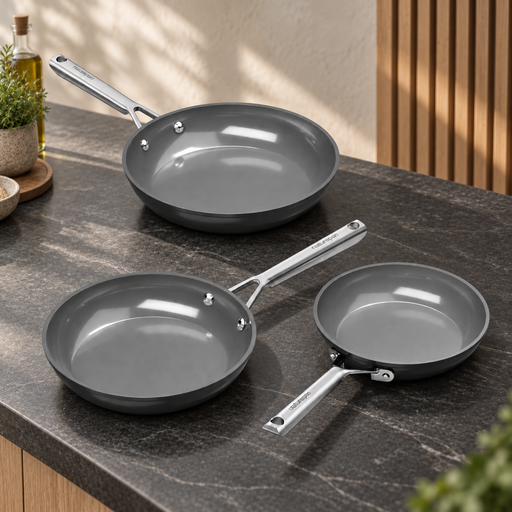
Why it suits this user profile: Three sizes make it possible to prepare both small portions and family meals with the same set. According to the product information, the pans are suitable for all common hobs and for oven use.
The product description explicitly states that the ceramic coating is free from PTFE, PFAS and PFOA. The set also specifies an oven limit of 260 °C; use only soft utensils to protect the coating.
Set of 20, 24 and 28 cm pans, with a diamond- and titanium-reinforced ceramic coating according to the product information.
We have put together a complete, up-to-date list of products that fully meet these strict selection criteria and the applicable European safety regulations.
A ceramic coating will generally continue to perform better when you follow the care instructions. Let the pan cool down after cooking before washing it. Avoid scouring pads, abrasive products and sudden changes in temperature. If you stack your pans, it is best to place a protective cloth between them.
Do not use a high temperature to heat an empty pan quickly. If the pan has a glass lid, you should also avoid thermal shock. A dishwasher can be convenient, but hand-washing with a soft sponge is often the gentler option.
That depends on the base. Choose a model that explicitly mentions induction compatibility. An aluminium pan without a magnetic base will not work on induction. Also check that the base diameter is suitable for your induction zone.
Its service life depends on the temperature, utensils, cleaning method and frequency of use. A coating may become less smooth over time. Hand-washing, low to medium heat and soft utensils can help limit unnecessary wear. Replace the pan when the coating visibly starts to peel or the handle is damaged.
“Healthy” is not a fixed technical quality classification. A ceramic pan can support cooking with little oil, but always check the official product specifications for PFAS information. Claims about a coating based on a brand’s own research or product information should not automatically be treated as a general guarantee for all ceramic pans.
