
Vandaag of morgen in huis

Kwaliteit gegarandeerd

Welkomstaanbiedingen ontgrendelen: GRATIS bezorging | Tot 80% korting | Gratis 30 dagen JoyPlus-proefperiode
Download de app
A ceramic frying pan may seem straightforward to choose on paper. However, models vary considerably in terms of heat-source compatibility, maintenance, size and coating. A pan suitable for gas will not automatically work on induction. And “dishwasher-safe” does not mean that the ceramic layer will deliver the same performance after years of intensive use.
For everyday cooking in a Dutch household, three things are particularly important: the right base, clear information about the coating and a size that suits your portions.
A frying pan for all heat sources should explicitly be suitable for induction, gas, electric hobs and, where applicable, ceramic or halogen hobs. Do not rely solely on the product title. Check the product specifications as well.
Not every pan with a ceramic coating works on induction. The 28 cm Tefal Easy Cook & Clean, for example, is suitable for gas, electric and ceramic cooking, but according to the product information it is not suitable for induction. It is therefore not the right choice for an induction hob.
A PFAS-free frying pan may appeal to anyone who wants to be mindful of the materials they use. Brands also use terms such as ceramic non-stick pan, titanium coating or extra scratch-resistant layer. These are not guarantees of an unlimited lifespan.
According to Redchef’s product information, the Starlight coating is free from PTFE, PFOA and PFAS. Similar material claims are made for Brabantia, SENSARTE, Tefal Renewal and Sanho. This information comes from the product descriptions provided by the respective brands, so such claims should not be presented as independently verified results.
A ceramic coating will generally remain usable for longer if you avoid metal utensils, do not leave the pan empty over high heat and avoid significant temperature changes.
A 24 cm frying pan is practical for eggs, omelettes and meals for one to three people. A 28 cm frying pan offers more room for multiple portions, vegetables or meat, but also requires a suitably sized cooking zone and enough storage space.
For a family, a deep ceramic pan or ceramic sauté pan may be more useful than a shallow frying pan. If you prepare stir-fries, a ceramic wok pan may be a better option. Do make sure that the shape and base are suitable for your hob.
Most models in this category combine an aluminium pan body with a ceramic coating. Aluminium heats up quickly, while a multi-layer or reinforced base can help distribute heat more evenly.
When checking a PFAS-free frying pan, look at:
A smooth ceramic layer can help food release easily, but non-stick performance is affected by temperature, the use of fat, cleaning and wear. As a result, it is usually best to use medium heat and let the pan cool down before washing it.
Induction requires a magnetically compatible base. Look specifically for “induction suitable” or “induction compatible”. This cannot be taken for granted with a pan designed for gas or electric hobs.
Oven suitability varies by model. According to the product information, the Brabantia Dusk is oven-safe up to 200 °C. Other pans, such as the 24 cm SENSARTE and the USELUCK pan, are not oven-safe according to the information provided. Check the handle too: bakelite and silicone have different temperature limits from stainless steel.
A dishwasher-safe frying pan is practical, especially in a busy household. However, several brands recommend hand washing with a soft sponge to help preserve the ceramic layer for longer. Avoid wire wool, scouring powder and metal scourers.
Do not put a hot pan straight under cold water. This can cause warping, particularly with aluminium models. “Dishwasher-safe” also does not mean that every component, such as the handle or coating, will withstand repeated dishwasher cycles indefinitely.
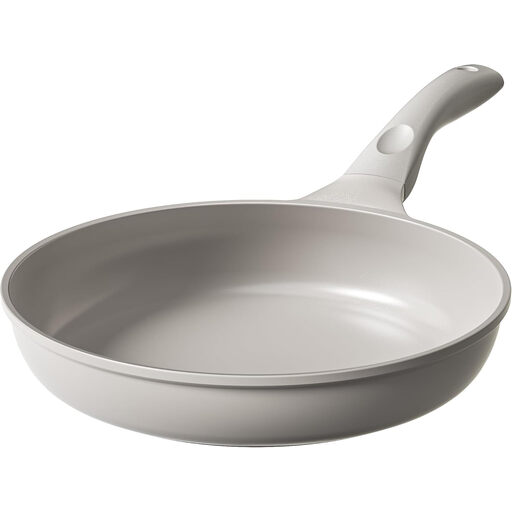
Why it suits this profile: The 28 cm diameter provides plenty of room for everyday meals for several people. According to the product information, this pan is suitable for induction, gas and electric hobs and features a PFAS-, PTFE- and PFOA-free ceramic coating.
The heat-source compatibility is clearly stated. Do not use metal utensils and handle the ceramic layer with care, even though dishwasher suitability is mentioned.
28 cm size, aluminium, ceramic and stainless steel construction, ergonomic bakelite handle and, according to the product information, dishwasher-safe.

Why it suits this profile: This model combines a compact size with a stainless steel handle and a pan body made from 100% recycled forged aluminium. According to the product information, the ceramic coating is PFAS-free and suitable for all the listed heat sources.
The product information states both induction compatibility and a maximum oven temperature of 200 °C. Hand washing is still recommended to protect the coating.
24 cm size, two layers of ceramic non-stick coating according to the product description, oven-safe up to 200 °C and dishwasher-safe.
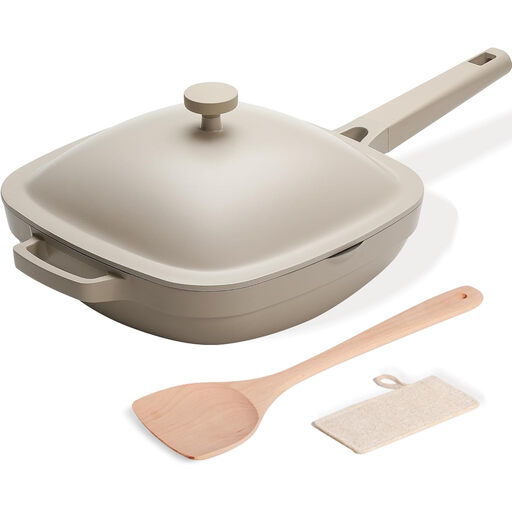
Why it suits this profile: The 3.8 quart deep pan is designed for sautéing, braising, stir-frying and meal prep. The lid, pouring spouts and larger cooking surface make it more practical for complete dishes than a shallow frying pan.
The specifications clearly state that this pan is not dishwasher-safe and must not be used in the oven. This helps prevent incorrect use; hand washing and moderate heat are essential.
Deep design, lid, two pouring spouts, wooden spatula and, according to the product information, suitable for all hobs.
We have put together a complete, up-to-date list of products that fully meet these strict selection criteria and the applicable European safety regulations.
These habits help minimise unnecessary wear:
Some models are, while others are not. Always check the product specification. A pan must be explicitly described as induction-suitable. According to their product information, the Redchef Starlight, Brabantia Dusk and USELUCK models are suitable for induction.
This depends on heat usage, utensils, cleaning and how often you cook. There is no fixed lifespan that applies to every pan. Replace the pan if the coating is visibly damaged or coming away, or if food continues to stick despite correct use.
This varies by model. According to the product information, Redchef, Brabantia and Sanho are described as dishwasher-safe. However, hand washing with a soft sponge is often recommended to help preserve the ceramic coating for longer. Always check the care instructions for your specific pan.
