
Vandaag of morgen in huis

Kwaliteit gegarandeerd

Welkomstaanbiedingen ontgrendelen: GRATIS bezorging | Tot 80% korting | Gratis 30 dagen JoyPlus-proefperiode
Download de app
A ceramic frying pan may seem easy to choose at first glance. However, small differences in the coating, base and handle can have a major impact on everyday use. For example, a pan described as suitable for all hobs may have a base that does not sit properly on your induction zone. And a dishwasher-safe frying pan may wear out more quickly with repeated cleaning than if you wash it by hand.
This buying guide helps you compare marketing claims with verifiable product specifications. That way, you can choose a ceramic non-stick frying pan that suits your hob, household and cooking style.
The terms PFAS-free frying pan, PFOA-free and ‘non-toxic’ are not always used in the same way. PFOA is just one substance within the broader PFAS group. So check whether the product information explicitly states that the coating is free from PFAS and PTFE, if that is important to you.
For several of the products below, this information is included in the product specifications. Do not present a brand claim as independently proven performance: according to information provided by Redchef and other brands, the coatings mentioned are PFAS- or PTFE-free. Always check the current product page and any conformity information before buying.
A frying pan for all hobs may be suitable for gas, electric, ceramic and induction hobs, but that does not automatically say anything about oven use. The pan, coating and handle must all have a specified maximum temperature.
Also note the difference between:
A 28 cm frying pan provides space for several portions, but it also requires a suitably sized cooking zone. A 24 cm pan is often easier to handle for eggs, vegetables or a meal for a few people. Also look at the base diameter: the top edge may measure 28 cm, while the heated area is smaller.
Ceramic coatings are generally applied to aluminium or a combination of aluminium and steel. Aluminium heats up quickly, while a thicker or reinforced base can distribute heat more evenly. Pay attention to the following points:
A ‘durable frying pan’ does not automatically mean that the non-stick coating will last indefinitely. Overheating, heating an empty pan and using metal spatulas can damage any coating. Allow a hot pan to cool before washing it and avoid sudden changes in temperature.
Induction requires a magnetic base. Also check whether the base diameter matches your cooking zone. On a gas hob, the flame should remain beneath the pan rather than rising up the sides.
A pan described as a PFAS- and PFOA-free frying pan may also be suitable for ceramic or electric hobs. Check this separately; the coating and heat source are two different properties.
Choose the size based on your usual portions:
A ceramic pan set may be more economical than buying three individual pans, but it takes up more storage space. Also check whether all the sizes have the same oven and dishwasher specifications.
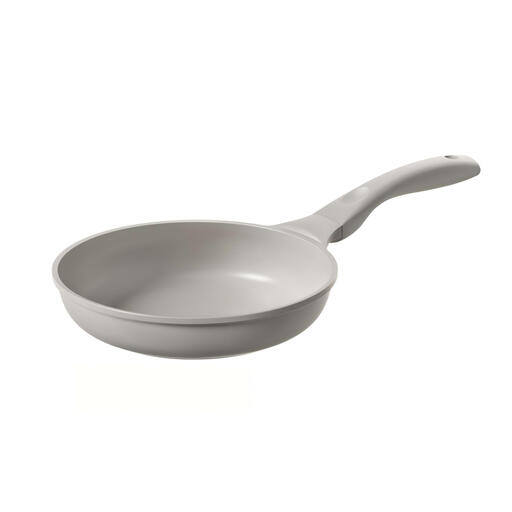
Why it suits this profile: The 24 cm size is easy to manage for everyday cooking and suitable for smaller households. According to the product information, this pan is suitable for induction, gas and electric hobs and is dishwasher-safe.
The product details explicitly state that the ceramic coating is free from PTFE, PFOA and PFAS, and list the permitted heat sources separately.
24 cm size; ergonomic Bakelite handle; suitable for induction, gas and electric cooking.

Why it suits this profile: According to the product specifications, this pan combines 100% recycled forged aluminium with a stainless steel handle and a PFAS-free ceramic coating.
The specifications state both the coating and hob compatibility. The oven limit of 200 °C is listed separately, so you do not have to work it out for yourself.
Oven-safe up to 200 °C; dishwasher-safe; suitable for all the listed heat sources.
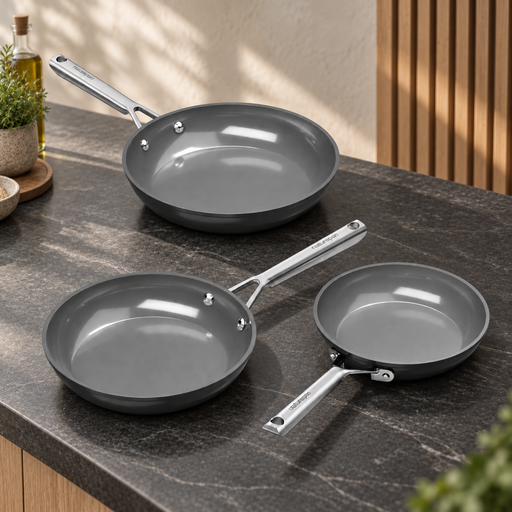
Why it suits this profile: The three sizes offer flexibility for families and home cooks who prepare several dishes. According to the product specifications, the set is suitable for induction, gas, ceramic and electric cooking.
The set lists specific sizes, a maximum oven temperature of 260 °C and a coating free from PTFE, PFAS and PFOA.
Three useful diameters; oven-safe up to 260 °C; dishwasher-safe according to the product information.
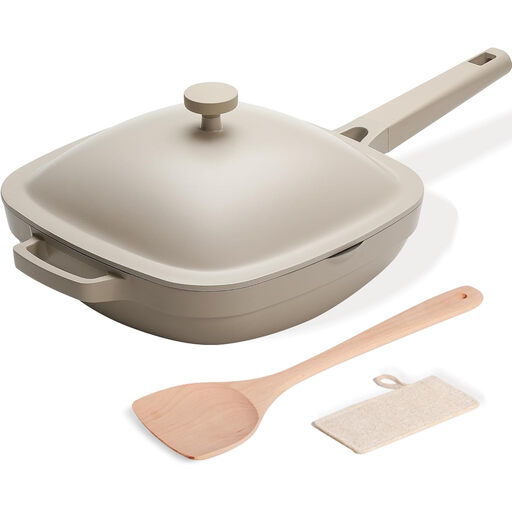
Why it suits this profile: According to the product information, this deep pan has a capacity of 3.8 quarts, a lid and two pouring spouts. It is well suited to stir-fries, stews and meal preparation.
The product specifications clearly state that this pan is neither dishwasher-safe nor oven-safe. This helps prevent incorrect expectations.
3.8-quart capacity; lid included; suitable for all the listed hobs according to the product information.
We have put together a complete, up-to-date list of products that fully meet these strict selection criteria and the applicable European safety regulations.
A ceramic frying pan will generally remain usable for longer if you avoid putting unnecessary strain on the coating:
A dishwasher-safe frying pan may be placed in the dishwasher when this is stated on the product page, but hand washing is recommended for several models to help protect the coating.
It can be, but always check the product specification. The pan must have a magnetically suitable base. Also check whether the base diameter fits the induction zone. A ceramic coating alone does not make a pan suitable for induction.
Its service life depends on heating, cleaning and the utensils you use. Do not use metal spatulas, do not heat the pan empty on the highest setting and follow the care instructions. Once the coating is visibly damaged or begins to peel, replacing the pan is advisable.
No. Also consider the base material, recycled aluminium, packaging, service life and care requirements. Some models specify the use of recycled aluminium, while others focus mainly on a particular coating. Compare these features separately rather than treating a single marketing term as the deciding factor.
