
Vandaag of morgen in huis

Kwaliteit gegarandeerd

Welkomstaanbiedingen ontgrendelen: GRATIS bezorging | Tot 80% korting | Gratis 30 dagen JoyPlus-proefperiode
Download de app
A ceramic frying pan can be useful for eggs, vegetables, fish and other dishes that can easily stick to the base. However, not every pan with a ceramic coating is the same. A low price may seem appealing, but an unsuitable base, unclear coating information or difficult care can quickly lead to a poor purchase.
This guide will help you assess marketing claims and choose a pan that suits your hob, household and cleaning routine.
Ceramic non-stick coatings are often presented as an alternative to traditional coatings. Even so, always check the product specifications. Look specifically for terms such as PFAS-free, PTFE-free and PFOA-free. The word “ceramic” alone does not provide enough information.
When a brand describes a coating as free from certain substances, this is a claim made in the brand’s product information. Do not therefore regard it as a medical or health claim, but as a material and product specification that you can check before buying.
A pan for gas or electric cooking will not automatically work well on induction. For a ceramic induction frying pan, the base must be suitable for magnetic heating and make sufficiently even contact with the cooking zone.
Look out for:
A pan may be described as suitable for all heat sources, while a small base may heat less evenly on a large induction zone.
A dishwasher-safe frying pan is convenient, but dishwasher detergents and high temperatures can put stress on the coating over time. Some products may be placed in the dishwasher, while hand washing is recommended to help preserve their non-stick properties for longer.
Therefore, check the official care instructions. For ceramic coatings, preferably use wooden, silicone or plastic utensils. Allow the pan to cool before washing it and avoid heating it empty for long periods.
An aluminium pan generally heats up quickly and is relatively light. A stainless-steel handle may be suitable for oven use, but it can become hot. Bakelite or silicone handles often feel cooler during use, but are not always oven-safe.
With a frying pan without Teflon, it is important not to look only at the product name. Check the full material description and look for:
For one person or a small household, 20 to 24 cm may be sufficient. A 26 to 28 cm pan offers more space for several portions, but also requires a suitably sized cooking zone and more storage space.
A high rim makes a pan more versatile for sauces, stews and stir-fries. This type of model is often described as a ceramic sauté pan or deep sauté pan. A lid is useful when you want to retain moisture or allow dishes to cook gently.
A fixed handle is straightforward to use. A removable handle can save space in a small kitchen, campervan or student room. With this type of system, always check that the handle is fully secured before lifting the pan and whether it needs to be removed for oven use.
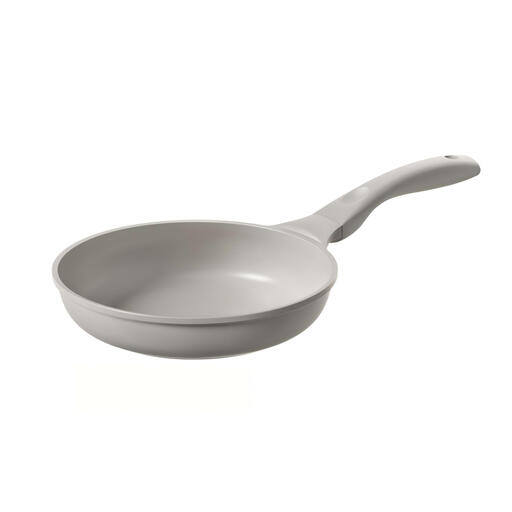
Why it suits this profile: A manageable size for everyday portions such as eggs, vegetables or a piece of fish. According to the product information, this pan is suitable for induction, gas and electric hobs.
The product information states that it has a ceramic coating without PTFE, PFOA or PFAS. Dishwasher use is also listed, although careful care is still advisable.
24 cm diameter, ergonomic Bakelite handle and compatibility with induction, gas and electric cooking.
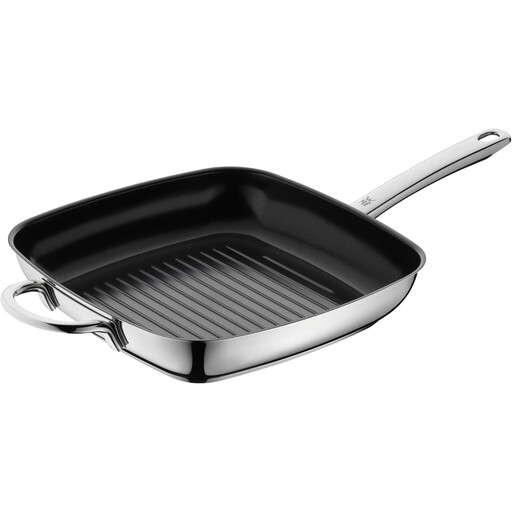
Why it suits this profile: Suitable for those who value a grilling surface and a stainless-steel construction. According to the product specifications, the pan works on all heat sources, including induction.
The specifications clearly state the ceramic coating, materials and heat sources. The pan is not dishwasher-safe; this is explicitly stated.
28 x 28 cm grilling surface, Cromargan 18/10 stainless steel, wide pouring rim and at least two years’ statutory warranty according to the product information.
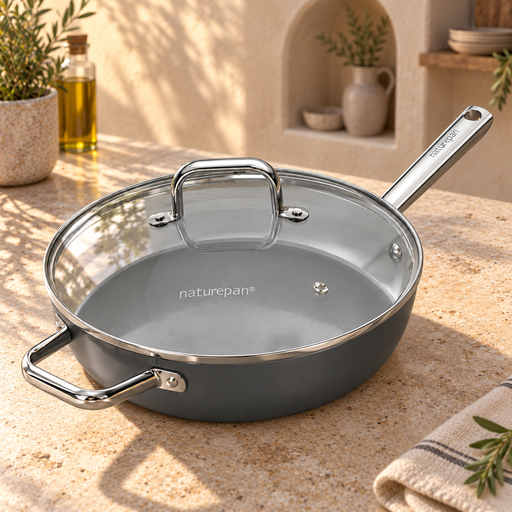
Why it suits this profile: The high rim and lid are ideal for one-pan meals, stews, sauces and larger portions for a family.
The specifications state the diameter, wall height, lid, induction compatibility and care instructions. This allows you to check in advance whether the pan suits your cooking routine.
28 cm diameter, 7.5 cm-high body, glass lid, suitable for all the listed heat sources and oven-safe up to 260 °C according to the product information.
We have put together a complete, up-to-date list of products that fully meet these strict selection criteria and the applicable European safety regulations.
The coating will generally remain in better condition when you avoid putting unnecessary strain on the pan. Follow these basic rules:
For a small household, a separate 24 cm pan may be sufficient. Families may benefit more from a 28 cm model or a ceramic pan set with different diameters. A set with removable handles saves cupboard space, but requires extra care when securing and moving the pans.
That depends on the base. Only choose a model that explicitly lists induction as a compatible heat source. Also check that the base diameter suits the induction zone. The Redchef, Naturepan and WMF models mentioned in this guide state that they are induction-compatible in their product information.
Its lifespan depends on heat, utensils and cleaning. Cooking at high temperatures for long periods, using metal spatulas and abrasive products can damage the coating more quickly. There is no fixed lifespan that applies to every model. Therefore, follow the manufacturer’s care instructions and replace the pan when the coating is visibly damaged or food consistently starts to stick.
Not automatically in every product description. “Teflon” generally refers to a brand name for a PTFE coating, while PFAS is a broader group of substances. Therefore, check separately whether the product information states PFAS-free, PTFE-free and, where applicable, PFOA-free. This allows you to compare ceramic pans based on concrete specifications rather than marketing language alone.
