
Same-day & Next-day Delivery

Quality Guaranteed

Unlock Your Welcome Offers: FREE Delivery | Up to 80% OFF | Free 30-day JoyPlus trial
Download the APP
As a Joybuy Product Recommendation Officer, I'm here to help you make the right choices. A good ceramic frying pan is an asset to any kitchen, especially if you're looking for an alternative to pans with traditional non-stick coatings. However, the market is filled with marketing claims that aren't always clear. Before you make a decision, it's important to know a few common pitfalls that can lead to unnecessary costs.
The search for a healthy frying pan often leads to ceramic options. But not every pan is created equal. Pay attention to these three points:
By understanding these points, you can search more effectively for a pan that truly suits your needs.
To avoid a bad purchase, focus on a few concrete specifications. These determine the performance and lifespan of your pan.
The core of the pan is just as important as the coating. Most ceramic pans have an aluminium body because this material is lightweight and conducts heat well. A thicker base (at least 4–5 mm) is crucial to prevent warping and ensures stable, even heat distribution.
For those who cook on induction, a pan with a ferromagnetic base is a requirement. A base made entirely of stainless steel or a 'sandwich base' (a layer of aluminium between two layers of stainless steel) typically performs better on induction than a simple steel disc glued to an aluminium base.
The main reason for choosing a ceramic pan is often the desire for a pfas-free frying pan. PFAS (per- and polyfluoroalkyl substances) are chemicals used in many traditional non-stick coatings (like PTFE). Ceramic coatings, made from natural materials like sand and clay, are a popular pfas-free pan alternative. Be aware: durability varies. Some brands, like Tefal and Brabantia, use reinforced ceramic coatings to improve scratch resistance.
The right size depends on your household.
An oven-safe frying pan is a major plus. It allows you to first sear a dish on the hob and then let it finish cooking in the oven. Always check the maximum temperature the pan (and especially the handle) can withstand. A stainless steel handle can often handle higher temperatures than a plastic (bakelite) one, but it also gets hotter on the hob.
Based on objective specifications, we have selected a number of pans that fit different user profiles.
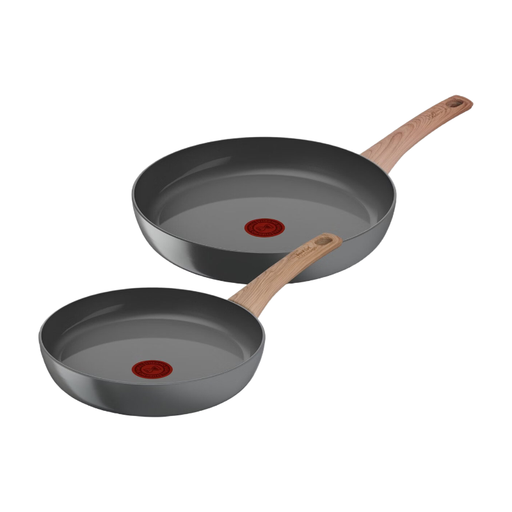
Why This Fits Their Persona: This set is ideal for anyone setting up a new kitchen or looking to replace their old pans in one go. You get the two most common sizes from a well-known brand without having to mix and match.
Tefal is transparent about its construction (100% recycled aluminium with a ceramic coating), and the improved induction base addresses the problem of uneven heating.
The Thermo-Signal technology indicates when the pan has reached the ideal cooking temperature, which helps prevent overheating and damage to the coating.

Why This Fits Their Persona: For those who cook daily and want a reliable, durable, no-fuss pan. The 24 cm size is perfect for most meals, and the Brabantia brand is known for its solid quality.
This pan is made of forged aluminium, which is stronger than cast aluminium and less prone to warping. The double ceramic layer is designed for extra scratch resistance.
Made from 100% recycled aluminium with an official RCS certification. A conscious choice for those who also care about the environment. The pan is oven-safe up to 200°C.
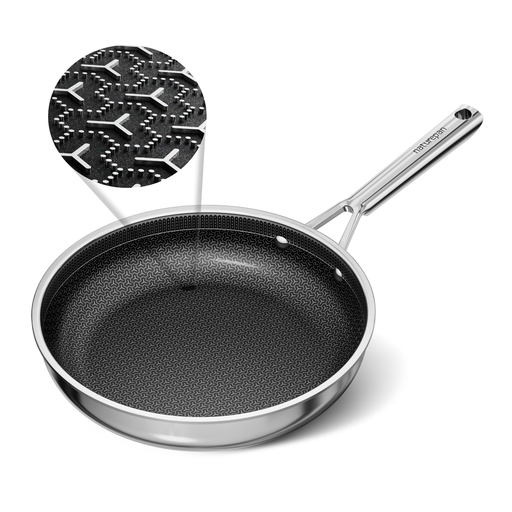
Why This Fits Their Persona: This pan is for the cook who wants to do more than just fry an egg. The hybrid structure combines the benefits of stainless steel (great for searing) with the convenience of a non-stick coating.
The laser-etched hexagonal pattern creates stainless steel 'peaks' that lift the food and protect the ceramic 'valleys' from scratches from cooking utensils. This directly addresses the fragility of the coating.
Extremely versatile: suitable for all heat sources and oven-safe up to 260°C. The 5-ply construction ensures superior heat distribution and retention.
We have compiled a complete, up-to-date list of products that fully meet these strict selection criteria and Dutch safety regulations.
The lifespan of a ceramic frying pan depends heavily on its use and maintenance. On average, you can expect it to last 1 to 3 years with regular use. To maximise its lifespan:
Although some manufacturers state that their pans are dishwasher-safe, it is strongly recommended to wash them by hand. The aggressive detergents and high temperatures in a dishwasher can damage the ceramic non-stick coating and significantly shorten its lifespan.
If a new pan starts sticking quickly, it could be due to overheating, which damages the pores of the coating. With an older pan, the non-stick layer may be worn out. Sometimes, there is also an invisible layer of burnt-on oil residue. You can try to clean the pan thoroughly by filling it with water and a splash of vinegar, letting it simmer gently, and then carefully cleaning it with a soft sponge.
