
Vandaag of morgen in huis

Kwaliteit gegarandeerd

Welkomstaanbiedingen ontgrendelen: GRATIS bezorging | Tot 80% korting | Gratis 30 dagen JoyPlus-proefperiode
Download de app
You're looking for a new frying pan. Probably because your current one sticks, the non-stick coating is peeling, or you want to adopt a more health-conscious approach to cooking. A ceramic frying pan seems like a logical choice. But the market is filled with marketing claims that aren't always clear. Before you make a decision, it's wise to understand three common pitfalls.
To find a pan that suits your cooking style and will last a long time, there are a few specifications you shouldn't overlook.
A key reason for choosing ceramic is the desire for a healthy pan. Traditional non-stick coatings can contain PFAS, a group of chemicals that can be harmful when overheated and do not break down easily in the environment. A Teflon-free pan with a ceramic coating is free from these substances (like PFOA and PTFE). When making your choice, look for labels that explicitly state it is PFAS-free. This provides the assurance that you are cooking without unwanted chemicals.
Not every pan works on every cooktop. If you cook on an induction hob, you need an induction-ready frying pan. This means the base of the pan must be magnetic. Pans made of pure aluminium or copper will not work on induction unless they have a special, magnetisable base plate. Always check the product information or packaging for the induction symbol (a coil-shaped icon).
Think about how you will use and store the pan.
Below are some options that align well with different needs and situations, based on their specifications.
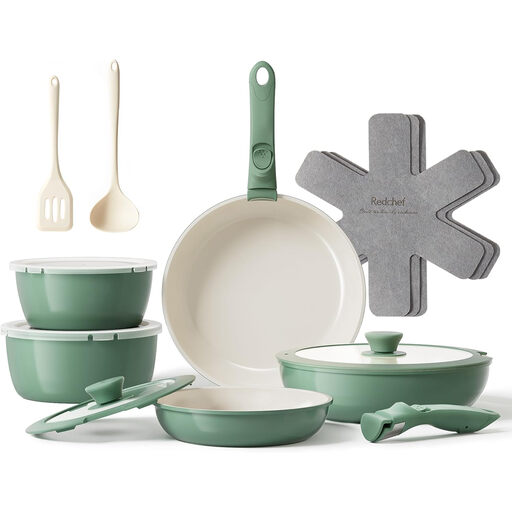
Why This Fits Their Persona: Ideal for those who need to be space-efficient, such as in a city apartment, camper, or student dorm. The detachable handle allows the pans and pots to be stacked compactly, saving up to 75% of storage space according to the manufacturer.
This set is more than just a single pan; it's a complete system. Its versatility (cooking, baking, serving, storing) makes it a practical investment rather than a simple pan that can only fry.
PFAS-free ceramic coating. The pans are oven-safe (up to 450°C according to Redchef) and suitable for all heat sources, including induction.
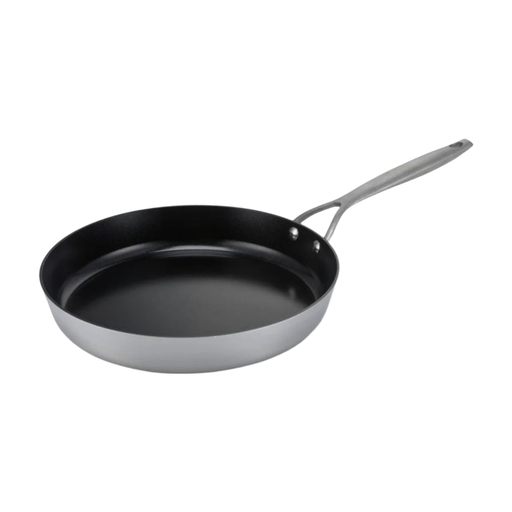
Why This Fits Their Persona: Suitable for families and home cooks looking for a reliable, no-nonsense pan for daily use. The 28 cm diameter is large enough for meals for several people. The pan is made from 100% recycled aluminium.
This pan focuses on the fundamentals: a solid forged aluminium construction ensures good, rapid heat distribution, which reduces the risk of hot spots. The riveted stainless steel handle provides a sturdy, secure grip.
Completely PFAS-free and suitable for all heat sources, including induction. The pan is oven-safe up to 200°C and is dishwasher-safe, although hand washing is recommended.
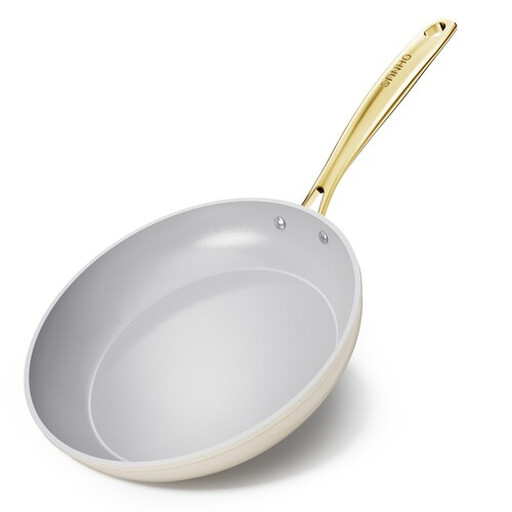
Why This Fits Their Persona: For the cook who invests in durability and performance. This pan focuses on a longer lifespan with a coating that, according to the manufacturer, is reinforced with diamond and titanium particles for improved scratch resistance.
The focus is on the durability of the coating, which attempts to bypass the pitfall of exaggerated scratch-resistance claims. The aluminium core with a stainless steel base is designed for fast and even heat distribution.
Completely PFAS-free and oven-safe up to a high temperature of 260°C. The pan is suitable for all heat sources, including induction, and the handle stays cool on the stovetop.
We have compiled a complete, up-to-date list of products that fully meet these strict selection criteria and safety standards.
The lifespan of a ceramic frying pan depends heavily on use and maintenance. On average, you can expect it to last for several years. To maximise its lifespan:
A healthy pan is primarily a pan that is free from unwanted chemicals. The main advantage of a ceramic coating is that it is guaranteed to be PFAS-free. Traditional non-stick coatings (like Teflon) can release fumes at very high temperatures (above 260°C). A ceramic pan offers more peace of mind in this regard.
Although ceramic pans have good non-stick properties, they are not immune to sticking, especially as the coating ages. A few tips:
