
Vandaag of morgen in huis

Kwaliteit gegarandeerd

Welkomstaanbiedingen ontgrendelen: GRATIS bezorging | Tot 80% korting | Gratis 30 dagen JoyPlus-proefperiode
Download de app
Ceramic bowls and dinnerware sets are suitable for everyday use, an elaborate dinner and entertaining guests. However, an attractive photo is not enough to make a good choice. A bowl may be too shallow for soup, a set may take up an impractical amount of space, or a glaze may prove less practical than the product name suggests.
Use these checks to compare pasta bowls, soup bowls, breakfast bowls and complete stoneware dinnerware based on the features that really matter in a British household.
Relief patterns, hand-painted rims and vibrant colours give ceramic bowls a distinctive appearance. However, check whether the surface is easy to clean. Deep patterns on the inside can trap food residue. A smooth glazed surface is generally more practical for everyday use than a heavily textured eating surface.
Pay attention to the shape too. Wide, shallow pasta bowls are suitable for pasta, salad and main courses, while deep soup bowls offer more protection against spills. A small breakfast bowl works well for yoghurt or fruit, but may not hold enough for a generous portion.
Terms such as microwave-safe dinnerware and dishwasher-safe dinnerware are useful, but always check which appliances are actually mentioned. Microwave-safe does not automatically mean oven-safe. When using an oven, temperature differences are also important: placing a cold bowl straight into a hot oven can create thermal stress.
Follow the care instructions on the product page and avoid sudden changes in temperature. Use oven gloves when handling hot bowls, even if the product description says that the item is oven-safe.
A dinnerware set for 4 people sounds practical, but check the exact contents. A set may include dinner plates, side plates and breakfast bowls, but no soup bowls or serving dishes. That may be enough for a family, but people who enjoy ramen, curry or large salads may find additional Japanese noodle bowls or ceramic dishes more useful.
Also check the number of pieces, the diameter and the available cupboard space. Stackable bowls help save space, but thick ceramic rims can still take up more room than lightweight bowls.
Ceramic and stoneware are made from clay and fired at high temperatures. Stoneware is often somewhat heavier and thicker, which can be useful for everyday use, but it also requires sufficient storage space. Look for terms such as lead-free and cadmium-free when these are included in the product information.
A glaze makes the surface smoother and helps with cleaning. Claims relating to scratch resistance, low water absorption or high heat resistance are product features taken from the manufacturer's description. Treat these as specifications of the product being offered and follow the stated conditions of use.
You can use the following guide to help you choose the right option:
A diameter of 15 cm, for example, is suitable for smaller portions or side dishes. A bowl measuring 8.5 inches, approximately 21.6 cm, offers more space for a meal or a large salad.
Choose dishwasher-safe dinnerware if everyday convenience is important to you. Also check whether the set is described as suitable for use in the microwave, oven, fridge or freezer. Do not place hot dinnerware on a very cold surface, and allow ceramic items to cool gradually after use.
A dishwasher can affect decorative rims and hand-painted details over time. Use a gentle cycle and avoid abrasive cleaning products if you want to keep the finish looking its best for as long as possible.
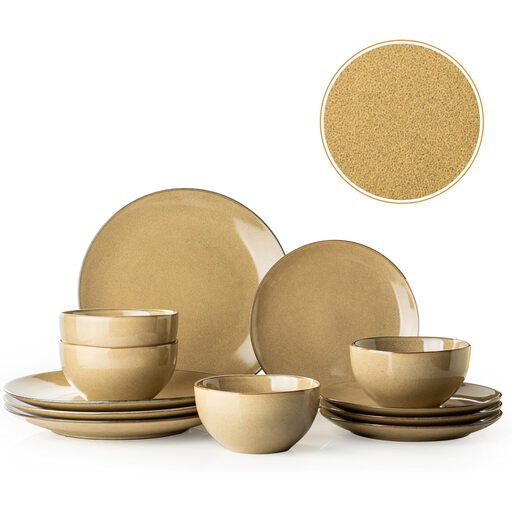
Why it suits this profile: This complete set covers the basics for four people with dinner plates, salad plates and breakfast bowls. That means you do not need to combine individual pieces straight away.
The contents and quantities are clearly stated: 4 dinner plates, 4 salad plates and 4 bowls. However, check whether you need additional bowls for soup or pasta.
Set for 4 people; microwave- and dishwasher-safe according to the product description; 23-ounce bowls.
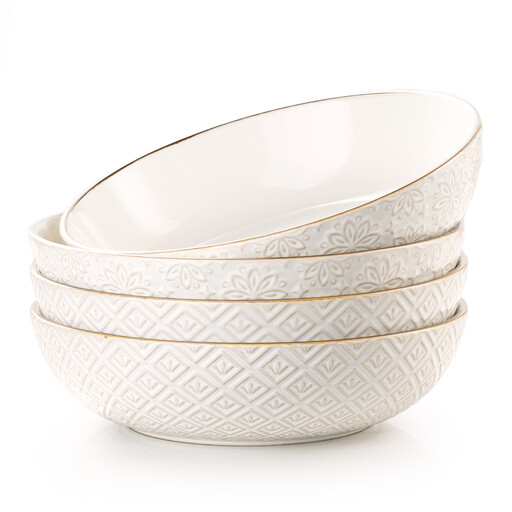
Why it suits this profile: The wide shape is suitable for generous portions of pasta, salad, soup, oven-baked dishes and fruit. The white finish complements a range of table settings.
The 8.5-inch diameter and 2.4-inch height make the dimensions easy to verify. The bowls are also designed to stack.
Set of 4; suitable for the dishwasher, microwave and oven according to the product description; stackable design.
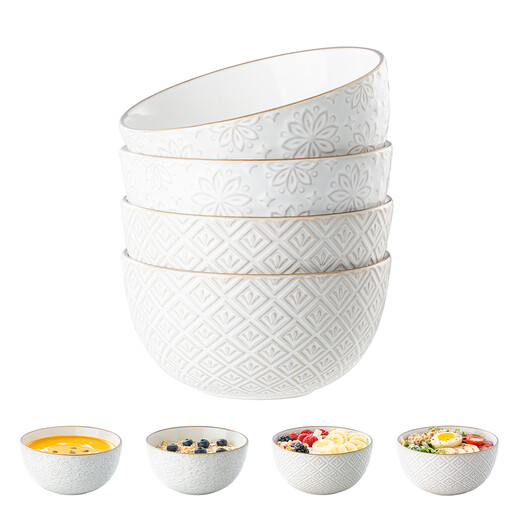
Why it suits this profile: The 29 oz capacity provides room for soup, ramen, pho, salad, fruit and breakfast. The relief pattern gives each bowl its own distinctive look.
The product information lists specific uses, a set of 4 and a stackable design. This makes it easier to match the size and intended use before buying.
29-ounce capacity; suitable for the dishwasher, microwave, oven and freezer according to the product description; listed as lead-free and cadmium-free.
For a gift, housewarming or addition to existing dinnerware, you can combine individual stoneware dishes, Japanese bowls and tapas bowls. When doing so, consider the colour, diameter and practical features of the existing set.
We have put together a complete, up-to-date list of products that fully meet these strict selection criteria and the applicable European safety regulations.
That depends on the product. Check whether the product description explicitly states that the bowls are microwave-safe. Do not place bowls with metallic rims in the microwave, and avoid sudden changes in temperature.
Its lifespan depends on the firing temperature, glaze, thickness and how it is used. Even a sturdy product can break after a hard impact. For long-lasting use, careful stacking, gradual cooling and non-abrasive cleaning are important.
A complete set can be practical when you need dinnerware for 4 people all at once. Individual bowls are more useful if you already own plates or specifically want to add pasta bowls, soup bowls or Japanese noodle bowls. So do not compare only the price, but also the number of pieces, capacity and features of each item.
