
Vandaag of morgen in huis

Kwaliteit gegarandeerd

Welkomstaanbiedingen ontgrendelen: GRATIS bezorging | Tot 80% korting | Gratis 30 dagen JoyPlus-proefperiode
Download de app
Ceramic bowls are suitable for breakfast, soup, pasta, salad and snacks. However, not every bowl is equally practical for everyday use. An attractive glaze says little about dimensions, stackability or compatibility with microwaves and dishwashers. If you focus only on colour or price, you may end up with bowls that are too small, take up too much cupboard space or become damaged quickly.
This buying guide helps you compare ceramic bowls based on verifiable product specifications. It highlights key considerations for households in the Netherlands, along with several popular options for different uses.
Ceramic pasta bowls are often wide and shallow. This makes them convenient for pasta, salad and main courses, but the external dimensions do not always indicate how much food they can hold. Therefore, check the capacity in millilitres or ounces as well as the diameter and height.
A bowl measuring approximately 21.6 cm wide and 6.1 cm high offers a different experience from a deep 15 cm soup bowl. For cereal or soup, a higher rim may be more comfortable; for pasta and salad, a wide bowl is often easier to use.
Marketing copy sometimes describes a product simply as “practical to use”. That does not automatically mean a bowl is suitable for the microwave, oven, freezer or dishwasher. Look for separate specifications covering:
According to the product descriptions of some sets, these uses are permitted. Always check the current product page and follow the usage instructions. Also avoid sudden temperature changes: placing a cold bowl directly into a hot oven can cause it to crack due to thermal stress.
Relief details, hand-painted rims and glossy glazes give ceramic tableware a distinctive appearance. On their own, however, they say nothing about impact resistance or scratch resistance. Look for information about:
According to the supplied product description, certain Dafuceramic models are made from lead-free ceramic. This is a product specification provided by the seller and is not a general characteristic of all ceramic bowls.
Choose the size based on your usual portions:
A bowl set with identical sizes creates a calm, cohesive look in the cupboard. A multi-size set can be more practical when you want to combine breakfast, soup and side dishes within the same tableware collection.
Ceramic, earthenware and stoneware each have different properties. Earthenware bowls often have a more robust, handcrafted appearance. Stoneware is generally fired at a higher temperature, but its precise characteristics depend on the manufacturer and finish.
Check whether the product description provides information about food contact, glaze and any lead-free or cadmium-free composition. A smooth interior is practical for cleaning. A relief pattern on the outside can look attractive, but may require a little more attention when washing by hand.
Stackable bowls take up less space, particularly in kitchen cupboards with limited depth. Examine the shape of the foot and rim: bowls that fit securely inside one another are generally easier to store neatly.
Dishwasher-safe bowls reduce the need for hand washing, but position them carefully so they do not knock against one another. When washing by hand, avoid abrasive scouring pads if the manufacturer advises against them. Microwave-safe bowls can still become hot, so use oven gloves or a cloth when removing them.
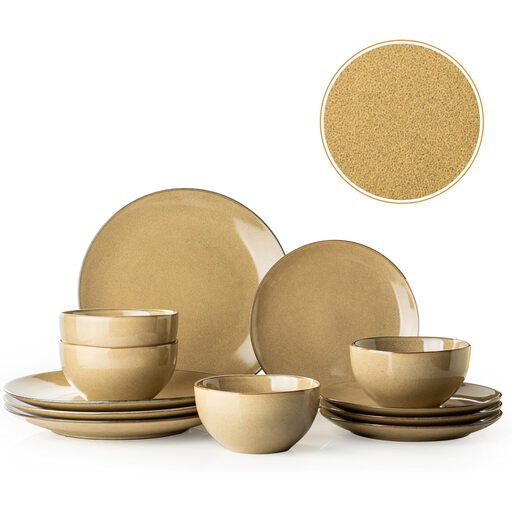
Why This Fits Their Persona: A complete set for four people is practical for furnishing a first home, moving house or attending a housewarming. The set includes four dinner plates, four salad plates and four 23 oz bowls.
The capacity and quantities are clearly specified, so you do not have to rely solely on the product photos. According to the product description, the pieces are microwave- and dishwasher-safe.
12 pieces for four people; bowls and plates combined in one coordinated tableware set.
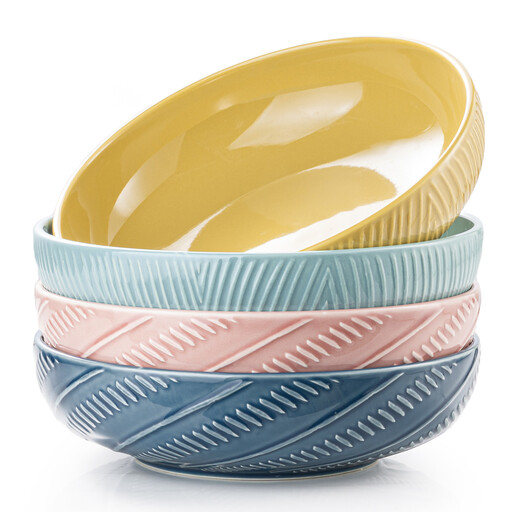
Why This Fits Their Persona: The wide shape and 36 oz capacity are designed for pasta, salads, soup, baked dishes and fruit. This makes the set well suited to families and entertaining, where one type of bowl needs to serve several purposes.
The stated dimensions of 21.6 × 21.6 × 6.1 cm make the shape clearer than a generic description such as “large bowl”. According to the product description, the bowls are stackable and suitable for the microwave, refrigerator, dishwasher and oven.
Set of four; wide, shallow shape; stackable design according to the product information.
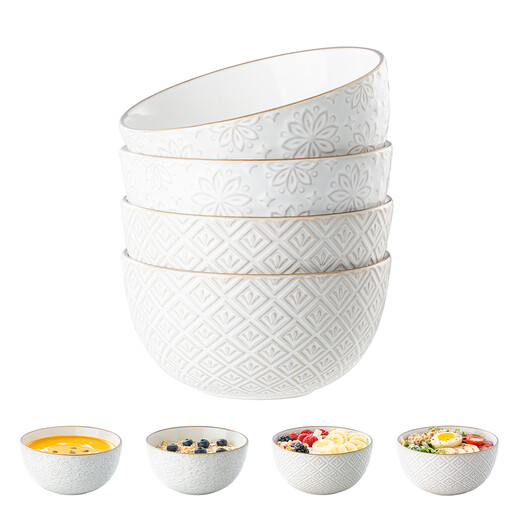
Why This Fits Their Persona: According to the product description, these bowls are intended for cereal, soup, salad, fruit, ramen, noodles and pho. The 29 oz capacity provides ample room for generous portions.
The product information specifies concrete uses, a set of four and a stackable design. The microwave, oven, freezer and dishwasher are also listed as suitable applications.
29 oz capacity per bowl; set of four; relief pattern and Arctic White colour according to the product listing.
Explore a current selection of bowls and compare materials, sizes, styles and intended uses before ordering.
A standalone Japanese bowl is a good choice when appearance and a specific use are important. The KAWASIMAYA models include a 6.5-inch Japanese ceramic noodle bowl and several 5-inch bowls. For these products, the supplied information focuses mainly on style and dimensions. Therefore, check the current details on capacity, care and appliance compatibility before purchasing.
A bowl set makes more sense when you are serving several people or want to use a coordinated style at the table. For everyday use in the Netherlands, a combination of breakfast bowls, soup bowls and ceramic pasta bowls is often more versatile than a collection consisting solely of small decorative bowls.
That depends on the specific model. Only use a bowl in the microwave when this is clearly stated in the product description. Avoid exposing the bowl to sudden temperature changes and take care when removing it, as ceramic can become hot.
A medium-sized breakfast bowl is often sufficient for cereal, yoghurt and fruit. For soup, ramen or larger portions, a model with a capacity of around 29 oz is more practical. A 36 oz wide pasta bowl is particularly well suited to pasta, salad and generous main courses.
Only stack bowls when the manufacturer confirms that the design supports it. Place them carefully in the dishwasher, avoid hard impacts and do not use abrasive cleaning products if the care instructions advise against them. Allow a bowl to cool before bringing it into contact with cold water.
