
Vandaag of morgen in huis

Kwaliteit gegarandeerd

Welkomstaanbiedingen ontgrendelen: GRATIS bezorging | Tot 80% korting | Gratis 30 dagen JoyPlus-proefperiode
Download de app
Ceramic bowls are suitable for many meals, from yoghurt and cereal to soup, pasta, ramen and salad. However, an attractive bowl is not automatically practical for everyday use. The size may be disappointing, the bowl may be too heavy for children, or a beautiful glaze may turn out not to be microwave-safe.
With this buying guide, you can compare ceramic bowls by dimensions, material, ease of use and maintenance. This helps you avoid buying a bowl that looks great in the product photo but is less suitable for your kitchen.
A small ceramic breakfast bowl is handy for fruit, snacks or yoghurt, but is not suitable for a generous portion of pasta or ramen. A ceramic pasta bowl with a wide shape and sufficient capacity is more practical. A low, wide bowl provides room for pasta and salad without food quickly spilling over the edge while you eat.
Do not only look at the diameter. Also check the height, capacity and shape. For example, a 15 cm bowl is not the same as a deep bowl measuring 15 cm. Where product information is given in inches, 6 inches is approximately 15 cm and 8.5 inches is approximately 21.6 cm.
Ceramic is not automatically oven-, microwave- or dishwasher-safe. Check the explicitly stated properties for each product:
A glazed surface may be easy to clean, but the product description should still state which appliances can be used safely. If in doubt, washing by hand is the safer option.
Relief patterns, hand-painted designs and striking colours can make a table look more appealing. On their own, they say nothing about resistance to breakage or scratches. So check the material, finish and care instructions.
Ceramic bowls remain fragile. Even a thick wall does not prevent a bowl from cracking if it is dropped or exposed to thermal shock. Compact, stable bowls are suitable for children’s small snacks and imaginative play, but supervision is still needed when using ceramic tableware.
The products in this selection are made from ceramic, stoneware, earthenware or porcelain. Their properties differ:
Look for descriptions such as “lead-free” or “food-safe” when these are stated for the product. A brand claim about durability or scratch resistance should be read as information from the product description. According to the manufacturer’s own information, certain models feature a food-safe glaze; always check the current product specifications before ordering.
Choose the size based on how you intend to use the bowl:
A set of 4 is practical for families or when you want to use several bowls at once. A set of 2 is better suited to a one- or two-person household and takes up less cupboard space.
Stackable bowls make a noticeable difference in a smaller kitchen. Check that the shape actually sits securely when stacked; a wide rim or asymmetrical decoration may take up additional space.
Wash bowls before using them for the first time. Do not use a scouring pad on decorative glazes, and allow hot bowls to cool before rinsing them with cold water. Use oven gloves when removing bowls from the oven, even where oven use is permitted.
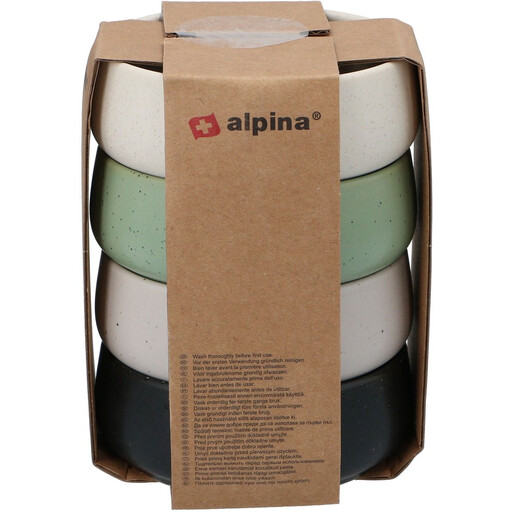
Why it suits this type of user: This compact set of 4 is designed for small portions, snacks and children’s hands. With a diameter of 9.5 cm, it is a straightforward starting point for anyone looking for several small ceramic bowls.
The size and intended use are clearly described. Do not expect a pasta bowl or deep soup bowl: this version is mainly suitable for small snacks and playtime.
Set of 4, round shape, multicoloured and, according to the product information, dishwasher-safe.
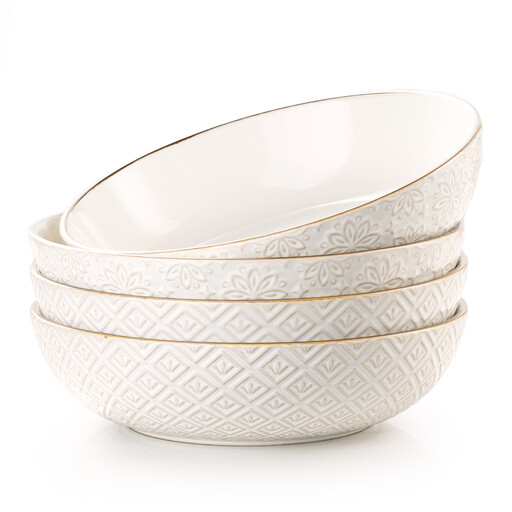
Why it suits this type of user: The wide bowls, measuring approximately 21.6 cm, are designed for pasta, salad, soup and main courses. The white finish works well with everyday tableware and a table set for several people.
The product specifications state the diameter, height, stackability and suitability for use in the dishwasher, microwave and oven. However, check the current instructions on the product page before buying.
Set of 4, wide shape, stackable design and, according to the description, suitable for the dishwasher, microwave, fridge and oven.
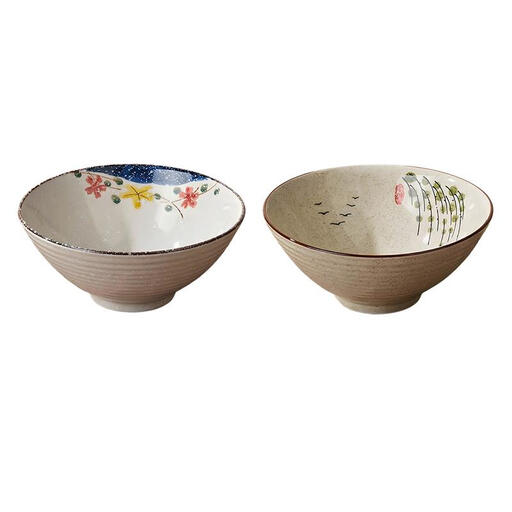
Why it suits this type of user: With a capacity of 1,200 ml per bowl, these Japanese bowls are designed for generous portions of ramen, soup, pasta, salad and rice dishes.
The capacity is clearly stated, making it easier to judge whether the bowls are suitable for large portions. According to the description, they are suitable for use in the microwave and dishwasher, but not in the oven or on a hob.
Set of 2, 1,200 ml per bowl, Japanese underglaze decoration and suitable for ramen, pasta and soup.
We have put together a complete, up-to-date list of products that fully meet these strict selection criteria and the applicable European safety regulations.
A smaller or medium-sized bowl is usually sufficient for breakfast and snacks. A ceramic soup bowl needs a little extra depth, while a ceramic pasta bowl can be wide and relatively shallow. A generous Japanese bowl with plenty of capacity is ideal for ramen and noodle dishes.
Looking for serving bowls for a family? Choose a set of 4 and check that all the bowls are the same size. For salads or fruit, a separate ceramic salad bowl measuring approximately 22 cm may be more suitable than four deep bowls.
This varies from product to product. Only use the dishwasher when this is explicitly stated in the product information. Decorative patterns and metallic rims may require extra care. Place bowls securely in the rack to reduce the risk of them knocking against other tableware.
Only when the manufacturer states that they are microwave-safe. Do not put a damaged bowl in the microwave and take care with temperature differences. A bowl can become hot after heating, even if the food itself has not been heated evenly.
Their lifespan depends on the material, glaze, use and care. A bowl that is not dropped, is not exposed to thermal shock and is cleaned according to the instructions can be used for many years. Check regularly for hairline cracks, chips and other damage. Replace tableware when the surface is no longer intact.
