
Anyone who juices celery every day
You want to weigh the yield against the time it takes to juice and clean up. JuiceNext’s celery test compares these factors across several tested models.


For a shared office, weigh yield against juicing time, noise and cleaning, so your juicer fits around breaks and the shared kitchen. In a celery test by JuiceNext, the Hurom H310A produced 364 ml of strained juice from 500 g, but took 5:58 to juice; the Kuvings AUTO10S tested took 2:35. A centrifugal juicer may be worth considering if compactness or ease of cleaning matters more, but check how the specific model performs with celery.
You want to weigh the yield against the time it takes to juice and clean up. JuiceNext’s celery test compares these factors across several tested models.
You want to leave the worktop clean and tidy quickly after use, so pay attention to cleaning and how easy the parts are to reach. Check the instructions for the exact model.
You want to know how a specific model performs while others are working. A noise measurement for a tested juicer is more useful than a general description such as ‘quiet’.
A good fit if: you juice celery regularly and want to compare the yield, juicing time and noise levels of specific models.
The trade-off: a higher yield doesn’t necessarily mean a shorter juicing time or quicker cleaning. The JuiceNext test shows differences between the models tested.
A good fit if: compact design or easy cleaning matters more to you than a proven yield with celery.
The trade-off: Philips describes the HR1832/30 as compact and claims it can be cleaned in under a minute; this isn’t an independent test with celery.
| What to consider | What to look for | Who should pay extra attention? |
|---|---|---|
| Yield and throughput | Compare strained juice and juicing time using the same amount of celery. JuiceNext tested 500 g per model. | If I mainly juice celery, I want to weigh up both yield and time. Around 29% of consumers in this office scenario prioritise yield and throughput. |
| Cleaning | Check which parts need to be taken apart and compare the cleaning time for the exact model. | In a shared kitchen, I want to leave the juicer tidy after my turn. Around 29% of consumers in this office scenario prioritise the cleaning routine. |
| Noise | Compare measurements taken under the same test conditions; also discuss when it’s appropriate to juice in the office. | If my colleagues are carrying on working, I want to know how loud the specific model is and how long it runs. Around 24% of consumers in this office scenario prioritise keeping noise down. |
| Time and space | Measure the available space and compare juicing times on the same basis. | If I have a short break or a crowded worktop, I want to know in advance whether the routine and appliance will fit. Around 18% of consumers in this office scenario prioritise time or space. |
JuiceNext’s table is ranked by the amount of strained juice produced from 500 g of celery. The top spot alone doesn’t tell you how long juicing takes or how much noise the appliance makes.
Compare yield, juicing time, noise and cleaning time together for the model you’re considering.
Philips’ claim that the appliance can be cleaned in under a minute applies to the HR1832/30; cleaning times in the JuiceNext test vary between the slow juicers tested.
Check the cleaning instructions for the specific model and agree who will tidy up after use.
According to Ondernemersplein, the statutory 14-day cooling-off period for consumers does not apply when a business owner makes a purchase for business purposes.
Measure the available space and check the returns and service terms that apply to your business purchase before placing your order.
JuiceNext’s celery test includes several Hurom slow juicer models, so you can compare results for specific models.
The AUTO10S is a slow juicer included in JuiceNext’s celery test.
The HR1832/30 is a centrifugal juicer you could compare if compactness or ease of cleaning is important.
Braun offers IdentityCollection centrifugal juicers as an alternative to slow juicers.
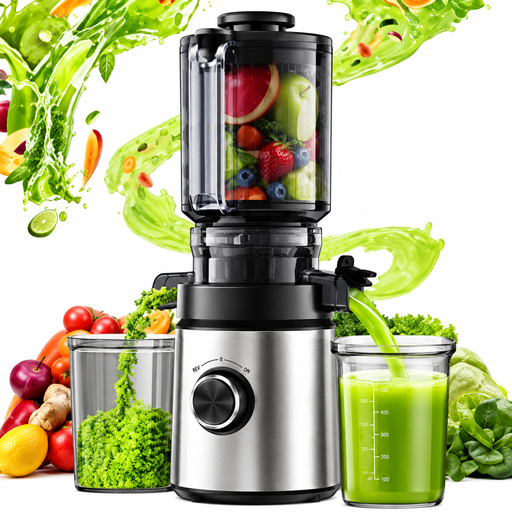
This selection includes slow juicers for fruit and vegetables, including a model whose product information specifically mentions celery.
 No image available
An option if you’re looking for a slow juicer for fruit and vegetables.
The product name lists a capacity of 2 l, a 130 mm feed chute and 2 glasses.
 No image available
The product information mentions celery, making this model a good fit if you want to juice this vegetable.
The product name lists a 600 ml juice jug and an 836 ml pulp container. The stated noise level is <72 dB; don’t compare this directly with measurements from a different test.
Cut fibrous vegetables, including celery, into 3–4 cm pieces. Use the appliance for no more than 10 minutes at a time, then let the motor rest for 20 minutes.
Compare yield, juicing time, cleaning time and noise under the same test conditions. JuiceNext’s test ranks its table by the amount of strained juice produced from 500 g of celery, so the top spot doesn’t automatically mean it’s the most convenient choice for an office.
Agree who will clear away the parts and pulp straight after use, and follow the cleaning instructions for your chosen model. The Netherlands Nutrition Centre advises setting your fridge to 4 °C to store highly perishable foods.
No. According to Ondernemersplein, the statutory 14-day cooling-off period applies to consumers, not to a business purchase made by a business owner. Check with the seller which returns, service and warranty terms apply to your business purchase.
The information from the Netherlands Food and Consumer Product Safety Authority (NVWA) does not provide grounds for automatically assuming that an HACCP plan is required when colleagues make juice solely for their own use. For a food business that produces, processes or sells food or drink, the NVWA does describe a food safety plan or an applicable hygiene code. Check which rules apply if the juice is sold or provided as part of an organised activity.
Electrical appliances sold in the Netherlands must meet the applicable safety requirements. For electrical equipment, the NVWA refers to the Low Voltage Directive 2014/35/EU; check that the model is the correct EU version and read the instructions for use.