
If you often juice celery
If celery is the main ingredient you want to process, consider the juicing method, preparation and cleaning. You can’t tell how much juice an appliance will produce from its type alone.


If celery is your main ingredient, a slow juicer is a sensible first option to compare. However, according to the Dutch Consumers’ Association, a slow juicer won’t necessarily produce more juice: it depends on the appliance. A centrifugal juicer may be a better fit if speed and minimal preparation matter more, while a blender turns the whole vegetable into a smoothie rather than extracting the juice. For family-sized servings, compare the collection capacity, feed chute and cleaning requirements. Before buying, check the CE marking on the specific electrical appliance, as required by the Dutch Food and Consumer Product Safety Authority.
If celery is the main ingredient you want to process, consider the juicing method, preparation and cleaning. You can’t tell how much juice an appliance will produce from its type alone.
If you’re making several servings for breakfast, the collection jug, feed chute and how often you need to empty the containers are practical points to consider. A jug’s capacity doesn’t tell you how much juice you’ll get from a given amount of celery.
If you have little time for chopping and cleaning, compare the feed chute and cleaning instructions. Speed alone doesn’t tell you whether an appliance is right for the ingredients you want to juice.
A better fit if: celery is often your main ingredient and you’re happy to prepare the stalks as instructed in the manual.
Trade-off: according to the Dutch Consumers’ Association, this method may involve more preparation and cleaning, and won’t necessarily produce more juice.
A better fit if: a quick breakfast and minimal chopping matter more than processing mainly leafy ingredients.
Trade-off: the Dutch Consumers’ Association says centrifugal juicers are less suited to leafy vegetables and are often noisier.
A better fit if: you want to blend the whole celery stalk, including its fibre, into your drink.
Trade-off: you’ll get a smoothie rather than clear, extracted juice.
| Consideration | What should you check? | Who is this important for? |
|---|---|---|
| Juicing celery | Check the manual for the exact model to see whether and how you should prepare the stalks. If the amount of juice is a deciding factor, compare yield information for the specific models. | If celery is a regular main ingredient, you’ll want to know whether the model can handle the stalks as instructed in the manual; around 36% of consumers give juicing celery top priority. |
| Several breakfast servings | Check the stated capacity of the juice jug and pulp container, and bear the appliance’s dimensions in mind. | If you want to pour several glasses one after another, consider how often you’ll need to empty the containers; around 29% of consumers prioritise family-sized capacity. |
| Preparation and cleaning | Read the cleaning instructions and check exactly which parts the manual says are dishwasher-safe. | On busy mornings, minimal preparation and a manageable cleaning routine can make all the difference; around 21% of consumers prioritise convenience in the morning. |
| Keeping the fibre | First decide whether you want juice or a smoothie; then consider the appliances suited to that drink. | If you want to keep the whole vegetable in your drink, a smoothie may suit you better than juice with the pulp separated; around 14% of consumers give retaining fibre top priority. |
The Dutch Consumers’ Association says that yield depends on the appliance. The juicing method alone doesn’t prove that you’ll get more juice or more nutrients.
Compare the exact models and choose a juicing method that suits your ingredients and daily routine.
The 1.000 ml juice container listed by Bosch for the MESM731M describes its collection capacity, not how much juice you’ll get from a given number of stalks.
Check the collection capacity and any yield information for the exact model separately.
The Joybuy product listing for the Bear names YZJ-F01D6 in the title and YZJ-D02F5 as the model number. The Braun listing calls it MultiQuick 7 J700, while Braun Household identifies the J700 as IdentityCollection 4294-J700.
Ask for confirmation of the full model number and version before treating a product as identical. Also check the CE marking and warranty terms for the specific appliance.
The VitaExtract MESM731M is a slow juicer worth comparing if you want to collect several servings.
The J700 is a centrifugal juicer to consider if speed and the feed chute are important to you.
The HR1922/21 is a centrifugal juicer that lets you choose your preferred juice texture.
The H320N series is a slow juicer worth comparing if automatic feeding and filter options matter to you.
These slow juicers are for anyone who wants to juice celery for breakfast. For each model, check the preparation instructions, collection capacity and CE marking on the specific appliance.
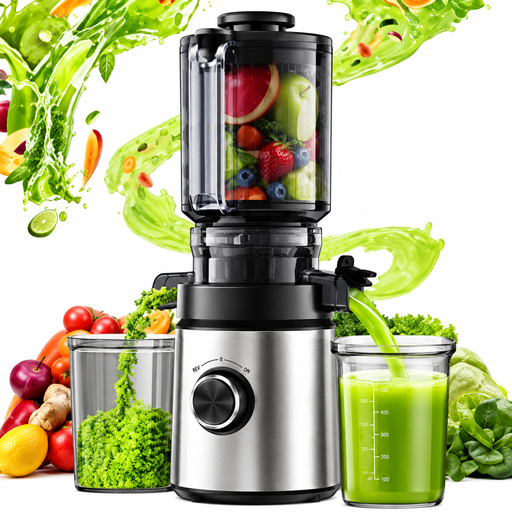 No image available
Its listed use with fruit and vegetables makes it an option if you’re considering a slow juicer for breakfast; check the model manual for how to prepare celery.
The product name lists a capacity of 2 l, an XL feed chute measuring 130 mm and 2 glasses.
 No image available
The instructions list celery as suitable; cut fibrous vegetables into 3–4 cm pieces, as directed.
The product information lists a juice jug with a maximum marking of 600 ml and a pulp container of 836 ml. Use the appliance for no more than 10 minutes at a time, then let the motor rest for 20 minutes.
No. According to the Dutch Consumers’ Association, a slow juicer doesn’t automatically produce more juice; the yield depends on the appliance. Choose one that suits your ingredients and compare the exact models.
Wash raw celery under running water and keep your hands and kitchen utensils clean, as advised by the Netherlands Nutrition Centre. Follow the chosen model’s manual for chopping, feeding and cleaning.
Yes. The Dutch Food and Consumer Product Safety Authority says CE marking is required for electrical products, and kitchen appliances are classed as electrical appliances. Check the marking on the specific appliance; it doesn’t tell you how much juice it will produce.
In the Netherlands, you’re entitled to a product that works properly, and the retailer is your point of contact if something goes wrong. The Dutch Government says there is no fixed statutory warranty period. Before paying for extra cover, compare it with the rights you already have.