
If you mainly juice celery
You mainly make celery juice and want to consider the feed chute, pulp outlet and cleaning process, without basing your choice on general health claims.


If you mainly make celery juice, compare slow juicers by their feed chute, capacity and ease of cleaning. If you’re making several glasses in a row, the juice container is especially important. A centrifugal juicer is a better fit if speed and juicing hard fruit or vegetables matter more to you. According to the Consumentenbond, a slow juicer does not automatically yield more juice than a centrifugal juicer.
You mainly make celery juice and want to consider the feed chute, pulp outlet and cleaning process, without basing your choice on general health claims.
You want to pour several glasses in a row, so you’re looking at the juice container, possible interruptions and preparation.
You want to make juice quickly and take into account how much cleaning and storage time the appliance needs after use.
Choose this option if: celery is your main ingredient and you’re happy to take your time with feeding it in and cleaning the juicer.
Bear in mind: according to the Consumentenbond, a slow juicer is generally slower and often involves more chopping and cleaning; a higher juice yield is not guaranteed.
Choose this option if: speed and minimal preparation matter, and you also want to juice hard fruit or vegetables.
Bear in mind: the Consumentenbond describes centrifugal juicers as often faster, but generally noisier and less suitable for leafy vegetables or soft ingredients.
Choose this option if: your guests might also like a smoothie and keeping all the vegetables in the drink matters more to you than having strained juice.
Bear in mind: a blender makes a smoothie that contains all the vegetables, rather than juice separated from the pulp.
| What to consider | What should you check? | Who is this important for? |
|---|---|---|
| Juicing celery | Check the guidance on preparation, feeding celery into the juicer and pulp disposal. Also check which parts need cleaning after juicing. | I want to be able to feed in the stalks and know how much preparation and cleaning that involves. Around 36% of consumers give practical celery processing their highest priority. |
| Making several glasses | Compare the juice container’s capacity, how to empty the pulp container and how much worktop space the appliance takes up. | If I’m making several glasses for guests, I want to know whether I’ll have to stop to empty the container. Around 29% of consumers put serving capacity first. |
| Cleaning after use | Count the parts you need to take apart and check the manual to see which ones are dishwasher-safe. | I only make juice occasionally and want to know in advance how many parts I’ll need to clean afterwards. Around 21% of consumers make ease of cleaning their top priority. |
| Texture and fibre | Decide whether your guests would prefer strained juice or a smoothie containing all the vegetables. | I want to tailor the drink to the texture people prefer: strained juice or a smoothie that contains the vegetables. Around 14% of consumers give keeping all the vegetables their highest priority. |
The Consumentenbond says that juice yield depends on the appliance, and that a slow juicer does not automatically produce more juice than a centrifugal juicer.
Only compare models using measurements taken with the same ingredient and under similar conditions. Also consider the preparation and cleaning involved for the way you plan to use it.
The Kuvings REVO830 is available in versions with and without an additional filter set. The model name alone doesn’t tell you which parts are included.
Check the full version name and the included accessories before comparing different versions.
According to the Dutch government, there is no fixed statutory warranty period in the Netherlands. A manufacturer’s warranty is in addition to your statutory rights; if a product is faulty, contact the seller.
Read the manufacturer’s warranty terms, but consider your statutory rights separately.
The VitaExtract MESM731M is a slow juicer worth comparing if you need enough capacity to make several glasses.
The HR1832/30 is a compact centrifugal juicer worth comparing if speed and worktop space are important to you.
The H400 is a slow juicer in the Easy Line range worth comparing if ease of use and making larger batches are important to you.
The REVO830 is a slow juicer worth including in a comparison if you plan to use it regularly.
This selection features electric slow juicers for fruit and vegetables; one model specifically mentions celery and the preparation required.
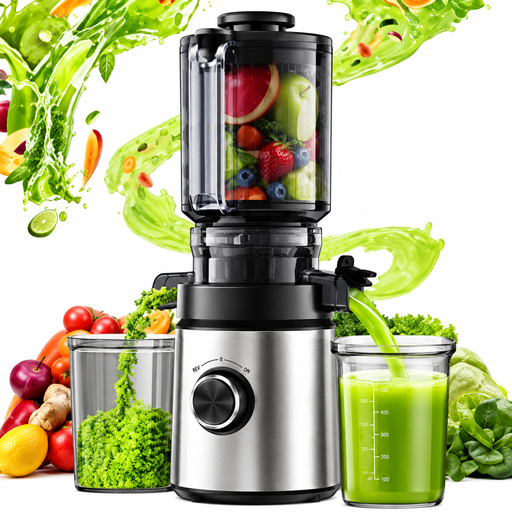 No image available
The title mentions two glasses, making this a good option for preparing juice to serve to guests.
The product name lists a 130 mm XL feed chute, a 2 l capacity and 2 included glasses.
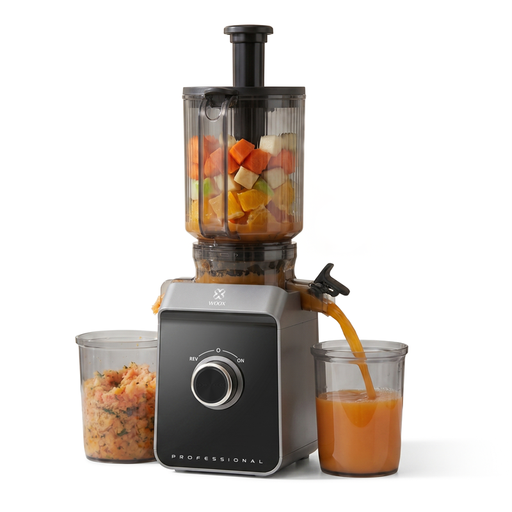 No image available
The product instructions mention celery and recommend cutting the stalks into 3–4 cm pieces before juicing.
The product name lists 150W, a 600 ml juice jug and an 836 ml pulp container. The instructions limit continuous use to 10 minutes, followed by a 20-minute rest.
Rinse the stalks under running water; according to the Voedingscentrum, this is enough to wash off dirt and dust. Don’t use soap or bleach, and follow your appliance’s manual for cutting and feeding in the celery.
It’s best to plan to juice shortly before serving rather than assume homemade juice will keep for a certain length of time. The Voedingscentrum’s storage advice for raw celery applies to the stalks, not to juiced celery.
No. According to the Dutch government, there is no fixed statutory warranty period in the Netherlands. You’re entitled to a product that works properly, and the seller is your point of contact if there’s a problem. A manufacturer’s warranty is additional.
The NVWA states that CE marking is mandatory for electrical products and classifies kitchen appliances as electrical equipment. This applies to electric juicers, but not necessarily to a fully manual press; a CE mark says nothing in itself about juice yield.
No. According to the Consumentenbond, a slow juicer does not automatically produce more juice than a centrifugal juicer; the yield depends on the appliance. Compare the result you’re looking for and the individual models, rather than choosing based only on the type of juicing system.