
Vandaag of morgen in huis

Kwaliteit gegarandeerd

Welkomstaanbiedingen ontgrendelen: GRATIS bezorging | Tot 80% korting | Gratis 30 dagen JoyPlus-proefperiode
Download de app
A scratching post for large cats needs to withstand more than a compact model designed for one small cat. Larger cats jump with more force, need wider resting spots and often use their scratching post more intensively. With several cats, the strain increases further.
However, a tall cat tree isn’t automatically stable. A model may have plenty of accessories but still wobble because of a narrow base or thin baseboard. So pay particular attention to its construction, dimensions and safety warnings.
A tall scratching post offers plenty of vertical space, but a narrow or lightweight base can increase the risk of wobbling. Don’t look at the height in centimetres alone. Also check:
For models measuring 150 cm or more, wall fixing is an important consideration, especially if you have active cats.
A stated maximum load is usually a static load. That doesn’t automatically mean it’s safe for several cats to jump or play on the tree at the same time. Check whether the product information also gives a recommended number of cats and a weight limit per cat.
Even an XXL cat tree with a high total weight capacity may not be suitable if its platforms are too small for your cat. Measure your cat when they’re lying down, then compare that measurement with the platforms, baskets and hammocks.
A cat climbing tower with just one short sisal post will wear out more quickly with daily use. Cats may also have to wait their turn in a multi-cat household. Several vertical scratching posts and scratching surfaces at different levels are more practical.
Look at the difference between a post that’s simply wrapped in sisal and one that’s thick enough for your cat to stretch out against. Large cats often like to scratch with their whole body fully extended.
A wide base and a low centre of gravity are important for a stable scratching post. A model with a 50 × 50 cm base may fit into a small space, but if it’s tall, it needs to be properly secured. Place the cat tree on a flat, non-slip surface and tighten all the connections after assembly.
An anti-tip device is a practical benefit for a tall or particularly wide cat tree. Follow the assembly instructions, then check again after a few days to make sure the screws and connections are still tight.
A cat tree for large cats should offer enough space for them to turn around, sit and stretch out. Look for:
A model with several houses and resting spots often works better in a multi-cat household. That way, the cats don’t all have to use the same place to rest.
Sisal is designed to encourage cats to scratch in a designated spot and can help make furniture less appealing. Check whether the sisal posts can be replaced and whether spare parts are available. With soft plush coverings, removable, washable cushions are useful.
Remove dust, hair and loose sisal fibres regularly. Use a vacuum cleaner or lint roller, and carefully trim away any frayed threads. Stop using the tree if a platform, post or connection becomes damaged.
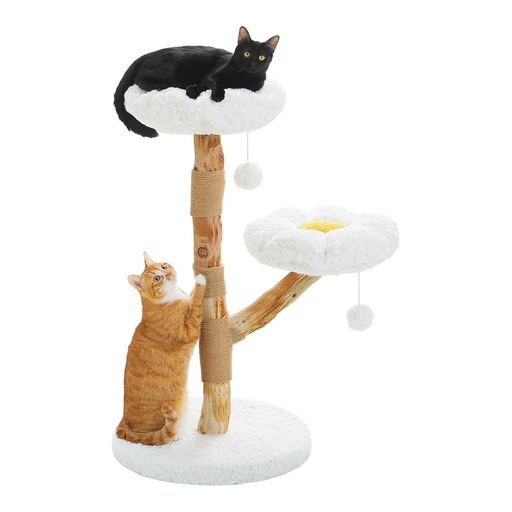
Why it suits this household: This compact model is suitable for a small home and for one or two medium-sized to larger cats weighing up to 7.3 kg, according to the product information.
The product description clearly specifies a doubly reinforced base and a natural wooden construction. Be sure to check all the connections before use.
Measures 49 × 49 × 90 cm, with two platforms and sisal wrapped around the wooden scratching post.
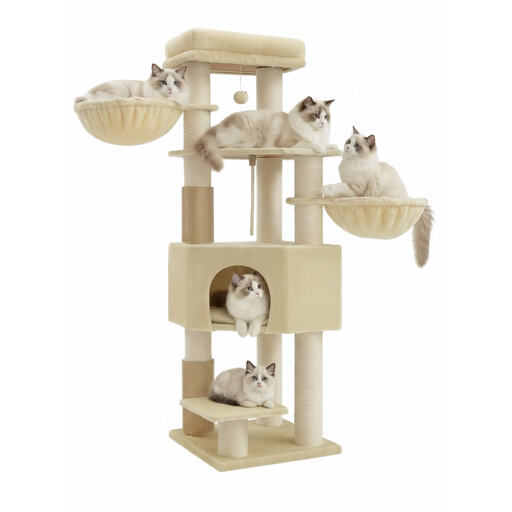
Why it suits this household: This cat tree for large cats combines plenty of scratching spots with a resting area, baskets and an enclosed cat house.
The product information lists nine sisal posts, a reinforced base and an anti-tip kit. After assembly, the tower must be permanently fixed to a load-bearing wall.
Measures 50 × 50 × 160 cm, with a maximum static load of 105 kg and removable, washable parts.
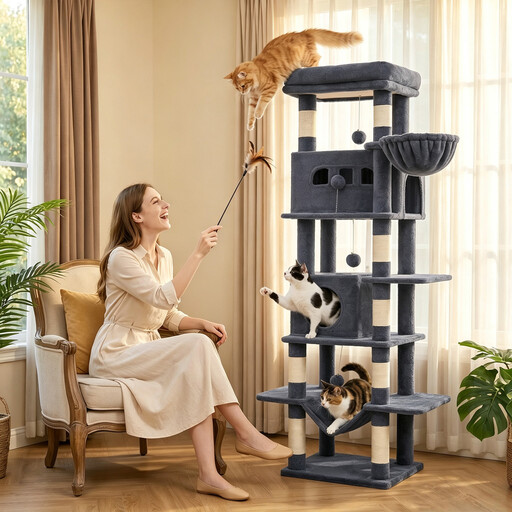
Why it suits this household: This tall scratching post is designed for multi-cat households and cats that love climbing, resting and scratching at different heights.
The specifications list eight sisal posts, a wider base and anti-tip features. Given its height, correct assembly and placement are essential.
A 60 × 40 cm platform, two cat houses, a hammock and removable cushions.
We’ve put together a complete, up-to-date list of products that meet these strict selection criteria and the applicable European safety requirements.
That depends on the space you have and your cat’s habits. A model around 90 cm tall may be enough for resting and scratching. Models from 160 cm to well over 200 cm offer more climbing opportunities for cats that enjoy scaling heights. Measure the ceiling height first and take wall fixing into account.
Place the cat tree on a flat, non-slip surface. Assemble every connection according to the instructions and use the anti-tip kit supplied if required. For a very tall cat climbing tower, fixing it to a load-bearing wall is a good idea. Check the screws, platforms and sisal posts regularly.
Its lifespan depends on how intensively it’s used, how many cats use it and the materials it’s made from. A scratching post used by several cats will be put under more strain than one used by a single cat. Choose one with replaceable sisal posts or parts, clean plush surfaces regularly and replace the cat tree as soon as its structure becomes loose, broken or unstable.
