
Vandaag of morgen in huis

Kwaliteit gegarandeerd

Welkomstaanbiedingen ontgrendelen: GRATIS bezorging | Tot 80% korting | Gratis 30 dagen JoyPlus-proefperiode
Download de app
A cat tree can combine scratching, climbing, playing and sleeping in one place. However, a purchase can sometimes disappoint in practice. A tall cat tree may wobble, a cat house may be too small, and attractive upholstery does not always withstand sharp claws for long.
That is why you should look beyond colour, shape and the number of levels. Pay particular attention to the dimensions, weight capacity, anchoring options and available scratching surfaces. Below, you will find the key considerations and suitable options for different households in the Netherlands.
A tall cat tree provides extra climbing space, but a narrow base can make the structure more prone to movement. This is especially important for large or active cats that jump down from platforms. Check the dimensions of the base, the weight of the furniture and whether an anti-tip feature is included.
A stable cat tree should be placed on a level surface. With taller models, anchoring the unit to a load-bearing wall is often essential. Always follow the supplied assembly instructions.
A listed maximum weight may refer to static load capacity. This does not automatically mean that the furniture can safely withstand the same load when several cats are jumping or running at once. Also check whether the manufacturer specifies a maximum number of cats or a maximum weight per cat.
For a cat tree designed for large cats, the size of the resting areas is just as important as the overall weight capacity. A platform that does not allow a cat to lie down fully may be used less often.
A cat tree with a hammock, baskets and toys may look comprehensive, but check whether it provides enough sisal-covered surface. Scratching posts should also be positioned logically, for example along climbing routes and near resting areas.
Pay attention to loose pom-poms, elastic cords and other small parts. Inspect them regularly and remove them immediately if your cat chews on them or tries to swallow them.
First, measure the area where the cat tree will be placed. Leave extra clearance above the highest platform so your cat can stretch out and the furniture does not come into contact with the ceiling, a cupboard or a light fitting.
A large cat tree measuring approximately 160 to 212.5 cm makes good use of a room’s vertical space, but it also requires a suitably sized base. For an apartment, a vertical model can be a space-saving choice, provided the base is sufficiently sturdy.
Also consider:
Sisal is a widely used material for cat scratching posts. Do not compare only the number of posts; also consider their thickness and positioning. A cat climbing post with several sisal-covered sections may be more practical than a model with one long post and numerous decorative elements.
Product descriptions often mention materials such as particleboard, plush, wood and sisal. When the product arrives, check that all connections are secure and that there are no sharp edges or fraying threads. Upholstery and cushions should be vacuumed or spot-cleaned regularly in accordance with the care instructions.
An anti-tip kit is not a decorative accessory. With tall models, use it exactly as instructed. After assembly, check all screws and connections again. Repeat this inspection periodically, especially if several cats jump and play on the cat tree every day.
A removable or washable cushion can make maintenance easier. Bear in mind that sisal and plush will wear over time. Replace or repair damaged components before allowing your cats to use the cat tree again.
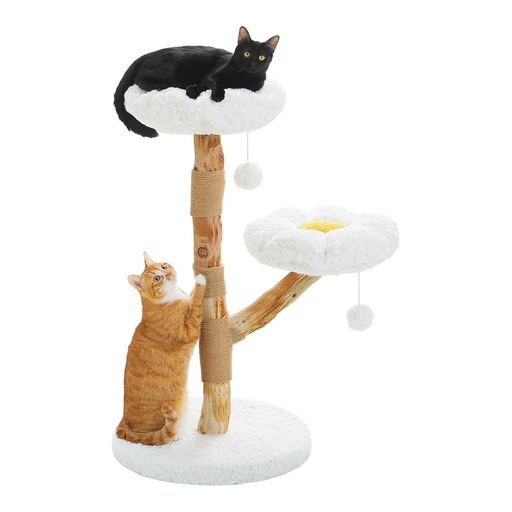
Why it’s a good fit: A compact model for smaller living spaces and households with one or two small to medium-sized cats.
The base plate measures 49 × 49 cm. Measuring your available space in advance is therefore straightforward and helps prevent buying furniture that is too large for an apartment.
92 cm tall, with two platforms, a natural wooden construction and a sisal-wrapped post. The product description states that it is suitable for cats up to 7.3 kg and a maximum of two cats.
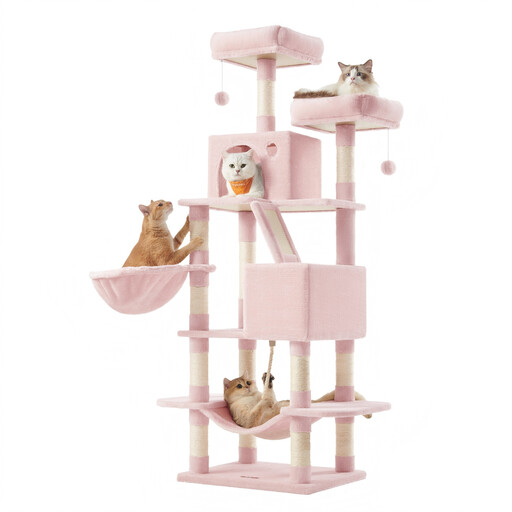
Why it’s a good fit: Ideal for owners who want to combine several resting and play areas in a single cat tree.
The product information specifies a reinforced base and an anti-tip feature. Be sure to use the anchoring system according to the instructions.
168 cm tall, with five levels, two cat houses, a basket, a hammock, two resting areas and 13 scratching posts plus a ramp. Dimensions: 55 × 45 × 168 cm.
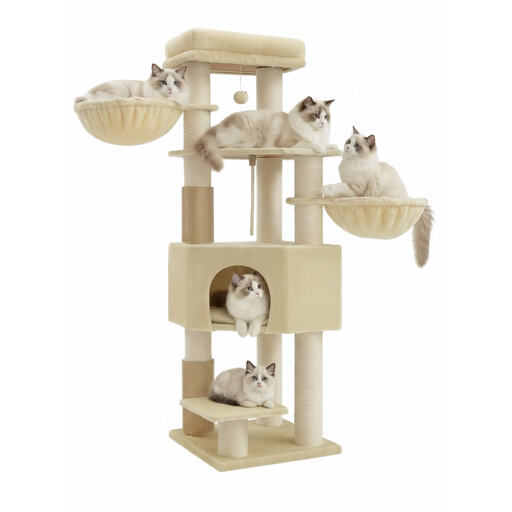
Why it’s a good fit: A spacious option for households with active cats that make frequent use of scratching and resting areas.
The manual specifies permanent anchoring to a load-bearing wall using the supplied anti-tip kit. When correctly installed, this helps reduce the risk during vigorous jumping.
160 cm tall and measuring 50 × 50 cm, with nine sisal posts, removable mats, a resting area, a cave and a basket. The stated static load capacity is 105 kg; the product information recommends a maximum of five cats.
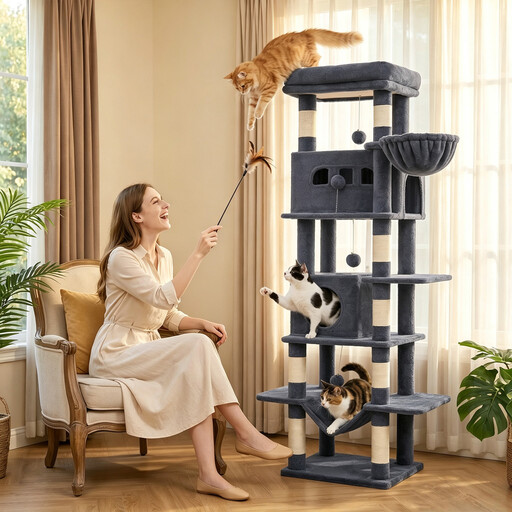
Why it’s a good fit: The vertical layout provides multiple routes and resting areas when several cats share the same space.
The description mentions a reinforced base and anti-tip features. At 212.5 cm tall, proper wall anchoring and regular inspection of all connections remain essential.
Six levels, two caves, a hammock, a basket and a 60 × 40 cm platform. The product listing describes it as suitable for five to six cats; check the current product specifications before purchasing.
Browse a current selection of cat accessories and compare models by size, material, scratching facilities and layout.
A pink cat tree or Christmas model is primarily a style choice. Never let colour take precedence over the base dimensions, stability and size of the resting areas.
Place the cat tree on a level surface, tighten all connections securely and use the supplied anti-tip feature whenever the manual requires it. Anchor the furniture to a suitable load-bearing wall and regularly check for loose components.
Its lifespan depends on the number of cats, their weight, their play habits and the level of maintenance. Inspect the sisal posts, plush covering, platforms and screws regularly. Fraying, cracks or instability are signs that a component should be repaired or replaced.
Remove hair with a vacuum cleaner, brush or lint roller. Spot-clean stains with a slightly damp cloth and mild cleaning solution, provided this is permitted by the product instructions. Washable cushions must be completely dry before you put them back.
