
Vandaag of morgen in huis

Kwaliteit gegarandeerd

Welkomstaanbiedingen ontgrendelen: GRATIS bezorging | Tot 80% korting | Gratis 30 dagen JoyPlus-proefperiode
Download de app
A cat tree can help protect your furniture from scratches, give your cat more room to move and provide a quiet place to sleep. But in practice, a purchase can sometimes disappoint. A tall post that wobbles, a small cat house that won’t fit a large cat or soft covering that’s difficult to clean may offer little value.
So the right choice isn’t just about colour or price. Pay particular attention to dimensions, load capacity, fixings, sisal coverage and the layout of the resting spots.
A tall cat tree offers plenty of vertical space, but a narrow base can make it prone to wobbling. This is particularly important if you have an active or heavy cat, or more than one cat. Check the dimensions of the base, the weight of the tree and whether it comes with an anti-tip device.
For models over around 150 cm, many product instructions recommend securing the tree to the wall. Also place it on a flat, firm surface and check all the screws after assembly.
A platform may look spacious in the product photo, but always check the listed measurements. An adult cat should be able to turn around and stretch out. Smaller steps and shorter jumps are practical for older cats. A tall cat tree with well-spaced levels is more useful in this case than a model with a few large jumps.
Plenty of sisal scratching posts can be useful, but their position matters too. If all the sisal is on one central post, your cat will always have to go there to scratch. Scratching areas on several levels make it easier for your cat to use the tree while climbing. Also check whether parts, cushions or hanging toys can be replaced.
Look beyond the overall height:
A cat tree for multiple cats ideally has several places to rest. Consider a cat house, a cat hammock, multiple platforms and a bed. This means your cats are less likely to have to share the same spot.
Sisal makes a suitable scratching surface, but not all sisal covering is the same. Check its thickness, how many posts are wrapped in sisal and whether they’re spread across several levels. Plush covering feels soft, but needs regular vacuuming or cleaning with a lint roller.
Removable, washable cushions are useful in a home where hair and dust can quickly become visible. Wooden or composite board parts should be kept dry, so place the cat tree indoors, away from damp, radiators and open flames.
A stated load capacity is only useful if you know what it applies to. Some product descriptions give a total static load, while others state a maximum weight per cat. Compare this with your cats’ weight and allow for movement: jumping puts more strain on the tree than simply lying down.
After assembly, check regularly:
Stop using the tree if any part is cracked, loose or unstable.
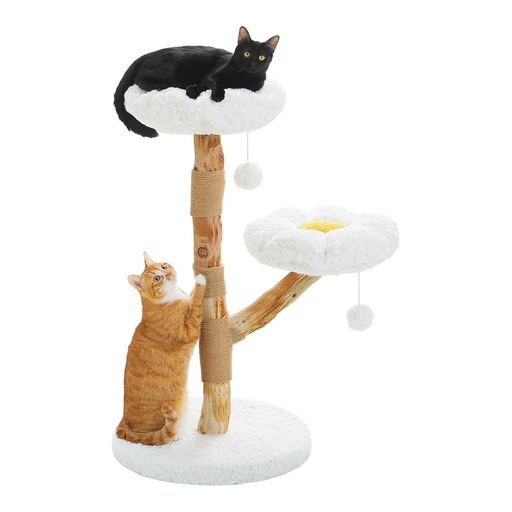
Why it suits this profile: Its compact design takes up little floor space and has two resting spots. This makes it suitable for one or two small to medium-sized cats and smaller homes.
The product description mentions a double reinforced base and a solid wood frame. Still, check regularly that the structure remains stable during use.
92 cm tall, with natural wooden components, sisal wrapped around the trunk and, according to the product information, suitable for cats weighing up to 7.3 kg.
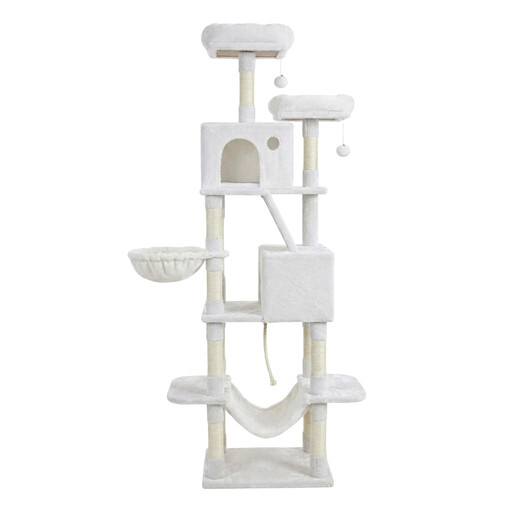
Why it suits this profile: This tall cat tree combines plenty of vertical space with two platforms, two cat houses, a bed and a hammock. It’s a good fit for active cats and homes where several cats need their own place to rest.
The specifications mention a wide reinforced base and an anti-tip kit. For a model of this height, securing it to the wall is still strongly recommended.
13 sisal posts, several resting areas and a stated total static load capacity of up to 75 kg, according to the product description.
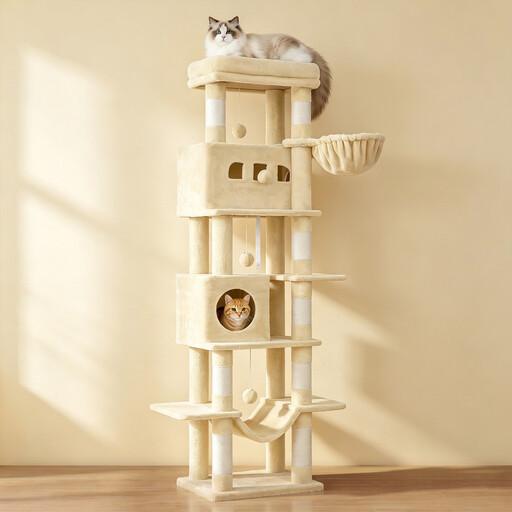
Why it suits this profile: With six levels, eight sisal posts, two cat houses, a hammock and an elevated bed, this tree is designed for intensive use and multiple cats.
The product information mentions 17 support posts, a double base and an anti-tip lock. Check the assembly and secure the tree appropriately for your floor and wall.
65 × 45 cm platform, eight sisal-covered areas and, according to the product description, suitable for up to six cats weighing less than 6.8 kg each.
We’ve put together a complete, up-to-date list of products that meet these strict selection criteria and the current European safety requirements.
Place the cat tree somewhere your cat already likes to spend time, such as in the living room by a window. Avoid busy walkways where people regularly pass by. A non-slip mat can help on smooth floors, but it’s no substitute for proper assembly or securing the tree to the wall.
Clean plush surfaces regularly with a vacuum cleaner or lint roller. Follow the manufacturer’s instructions for washable cushions. Replace hanging balls and strings as soon as they come loose or become damaged. For older cats, a low step or a separate cat scratching post next to the tree can make it easier to get around.
It depends on the space you have, your cat’s age and its behaviour. A model measuring 90 to 130 cm often fits well in a smaller room. A large cat tree measuring 160 cm or more offers extra climbing and viewing space, but you’ll need to pay more attention to the width of the base and anti-tip protection.
Its lifespan depends on the materials, how it’s used and how well it’s maintained. Check the sisal covering, screws, platforms and fabric regularly. With intensive use by several cats, sisal posts and hanging toys may wear out sooner than the wooden base. Replace any loose or damaged parts promptly.
Yes, as long as the levels are easy to reach. Choose a cat tree with shorter jumps, sturdy platforms and a low resting spot. A separate set of steps, such as the Jollypaw Petstair, can help your cat get onto a sofa or bed more safely, but it isn’t a replacement for a stable cat tree.
