
Vandaag of morgen in huis

Kwaliteit gegarandeerd

Welkomstaanbiedingen ontgrendelen: GRATIS bezorging | Tot 80% korting | Gratis 30 dagen JoyPlus-proefperiode
Download de app
A cat tree with a scratching post can give indoor cats space to scratch, climb, play and rest. However, some models can disappoint in practice. A tall post may wobble, a small cat house may go unused, and sisal can quickly come loose if the construction isn’t well finished.
That’s why it’s worth comparing more than just the colour or number of levels. The dimensions, base, materials and layout all affect whether a cat tree remains useful day after day.
A model over a metre tall takes up little floor space, but can become unstable if its base is too narrow or lightweight. This matters especially for active cats that jump down from a platform. Always check the overall height and the dimensions of the base.
A stable cat tree doesn’t necessarily have to be the largest. A lower model with a sturdy base may be better suited to a small living room, a slippery floor or a cat that climbs energetically.
A cat tree with a basket, cat house and play platform sounds versatile. In reality, a resting spot may be too small, too high or awkwardly positioned. Pay attention to the shape and position of the places to lie down, not just the number of features.
For an adult cat, the space to lie down is often more important than an extra dangling toy. For kittens, a lower cat climbing post may be easier to navigate and reach.
Sisal is widely used on scratching posts. It provides a rough surface, but its durability depends on its thickness, how it’s attached and how vigorously your cat scratches. A sisal cat tree isn’t automatically right for every cat.
Check that the scratching posts are long enough for your cat to stretch out fully. It’s also best to place the cat tree in a room your cat already likes spending time in. A piece of furniture in an unused corner is less likely to be used, even if it has lots of features.
Measure the available floor space first. Then compare:
Don’t place a large cat scratching post right next to a delicate cabinet or somewhere it could cause damage if it toppled over. Follow the assembly instructions and check the screws after the first period of use.
A scratching post should suit the way your cat scratches. Horizontal scratching mats are useful for cats that scratch close to the ground; vertical posts are better for cats that stretch up tall.
Check:
Check the material regularly for signs of wear. Replace or repair parts if the sisal starts to come loose or the fixings become loose. This also helps stop your cat pulling at loose threads.
An indoor cat tree works best when the different activities are arranged sensibly. A lower resting spot can be useful for kittens, while adult cats often enjoy having a higher vantage point.
A combination of a scratching post with a resting spot, a cat house and one or more play platforms offers variety. Just check that your cat can reach the upper parts without having to jump across a narrow or wobbly platform.
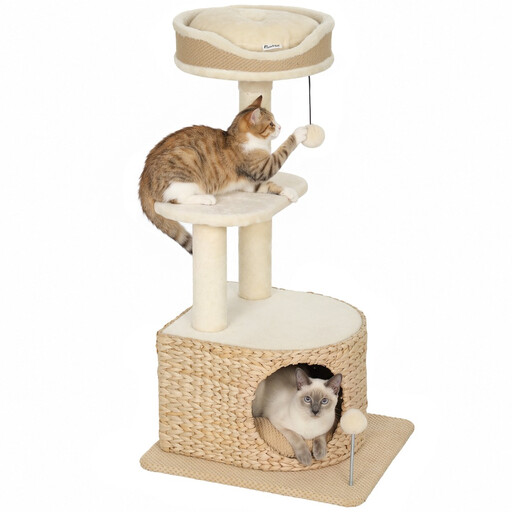
Why it suits this profile: At 87 cm tall with four levels, this model is a good choice if you’re looking for a compact cat tree for a flat or smaller room. The product name lists a jute scratching post, club-shaped cat house and hanging resting spot.
Its lower profile means it doesn’t need a particularly tall structure. Before buying, though, check the base dimensions and fixings in the latest product information.
87 cm tall; four levels; jute scratching post; listed as suitable for indoor cats and kittens.
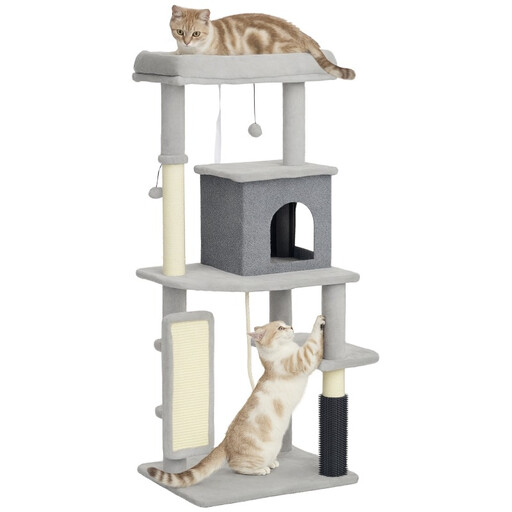
Why it suits this profile: According to the product name, this model combines a height of 132 cm with sisal scratching posts, a bed, a condo, a jumping platform and an anti-tip kit. It’s a good fit for households looking for several features in one piece of furniture.
The listed anti-tip kit gives you the option of securing it more firmly. Check the assembly and use the kit as instructed, especially if you’re placing it somewhere high.
132 cm tall; sisal scratching posts; bed and condo; jumping platform; anti-tip kit as listed in the product information.
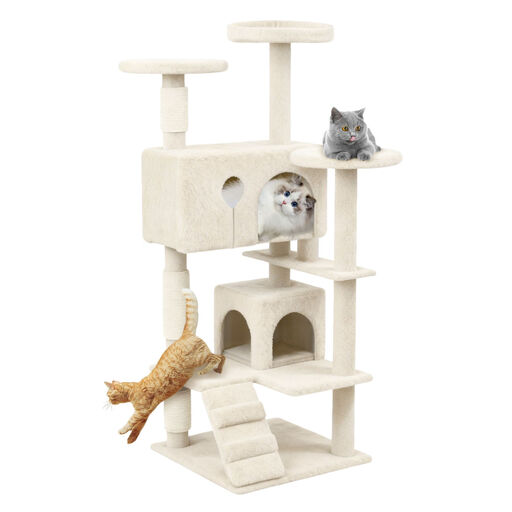
Why it suits this profile: The stated base dimensions of 49 x 49 cm and height of 130 cm give you clear measurements to compare. It may suit cat owners looking for a large scratching post with a defined base and a place to rest.
The stated base dimensions make it easier to assess stability and available space in advance. Check the weight and assembly too, before your cat uses it regularly.
49 x 49 cm base; 130 cm tall; cat bed and scratching post as listed in the product information.
We’ve put together a complete, up-to-date list of products that meet these strict selection criteria and current European safety requirements.
It depends on your cat, the space available and how the tree will be used. Start by measuring the floor space. A model around 80 to 90 cm tall may suit a smaller room or a kitten. A cat tree measuring 130 cm or more offers more climbing space, but needs a sufficiently wide base and a safe position.
Lifespan varies depending on the material, assembly and your cat’s scratching habits. Check the sisal regularly for loose threads and signs of wear. Check the screws, platforms and joins too. With frequent use, the scratching post may need maintenance or replacing sooner than the rest of the cat tree.
Choose a spot where your cat already likes to spend time, such as by a window or near the living area. Avoid a walkway where the tree could be knocked into. Make sure the floor is level, and use an anti-tip feature if one is supplied with the model.
