
Vandaag of morgen in huis

Kwaliteit gegarandeerd

Welkomstaanbiedingen ontgrendelen: GRATIS bezorging | Tot 80% korting | Gratis 30 dagen JoyPlus-proefperiode
Download de app
A large cat tree for multiple cats needs to do more than simply be tall. In a household with several, large or heavy cats, the furniture has to cope with jumping, scratching and simultaneous use every day. A narrow post with a small base can quickly become wobbly, while a cat tree with too few resting areas can lead to competition between cats.
So don’t just focus on the number of levels or an appealing photograph. The following three pitfalls are common when comparing large cat trees.
A two-metre cat climbing post takes up little floor space vertically, but its centre of gravity is high. If the base is narrow or the connections have play in them, the structure may move when a cat jumps down from a higher platform.
So check:
A stable cat tree should also stand on a level surface. Don’t place it on a thick, shifting rug without checking its stability again afterwards.
Some product descriptions state a capacity for multiple cats. Also check the conditions behind that figure. For example, a model may specify that a maximum of six cats, each weighing less than 6.8 kg, can use the furniture. This is a product specification from the listing, not a general guarantee for every cat or every situation.
For a cat tree for heavy cats, these points are particularly important:
If your cats weigh more than the stated limit, don’t use this figure as a guideline. Choose a model whose current product specifications are better suited to their weight.
A cat tree with houses, balls and a hammock may look complete, but cats don’t use every component equally often. Sisal posts are important if you want to reduce scratching damage to your sofa, curtains or chairs. Placement also matters: scratching zones at several heights are more practical than a single post at the bottom.
Pay attention to the number of sisal posts, the thickness of the posts and how they are distributed along the climbing route. Also check whether cushions can be removed and washed. Washable cat cushions make hair and stains easier to manage, but soft upholstery still requires regular maintenance with a vacuum cleaner or lint roller.
A six-tier cat tree offers different climbing and resting levels. A 170 cm model with gaps of around 20 to 30 cm between levels suits cats that enjoy climbing, while a taller 212.5 cm version makes better use of vertical space.
Taller isn’t automatically more practical. Also consider how accessible each platform is. Cats should be able to move between the levels without having to make large jumps. Smaller height differences may be more comfortable for older or less agile animals.
A multi-cat piece of furniture works better when cats can avoid one another. A combination of two houses, a hammock, a basket and open platforms gives cats several options. A large house measuring approximately 50 × 40 cm or a wide 60 × 40 cm resting platform offers more room for larger cats than a compact model.
Ideally, place the cat tree in a quiet spot with a view of the room. Avoid positioning it directly next to a radiator, hob or draughty external door.
A practical design consists of several supporting posts, some of which are covered in sisal. The models mentioned include 17 support posts and 8 sisal posts. According to the product descriptions, the sisal zones are distributed across several levels. This may help redirect scratching behaviour towards the cat furniture, but usage varies from cat to cat.
Before buying, also check:
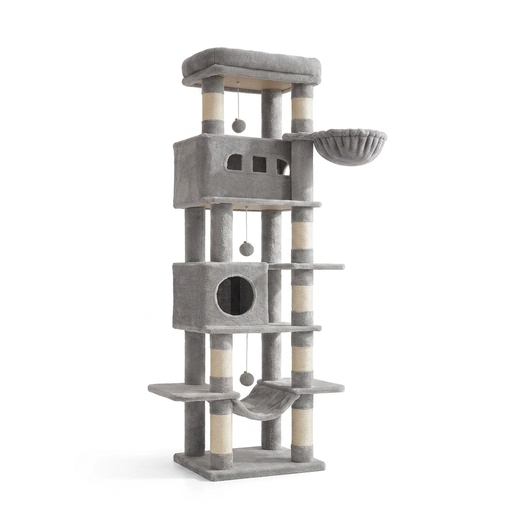
Why it suits this profile: A straightforward model for households buying a large cat tree for the first time and looking for several functions in one piece of furniture.
The listing specifies six levels, 17 support posts, 8 sisal posts and an anti-tip base. This means the design focuses on more than height alone.
170 cm tall, with a 50 × 30 cm platform, a hammock, two houses and two removable cushions according to the product description.
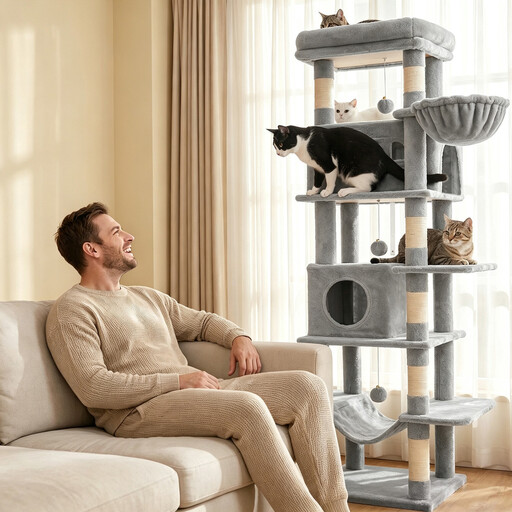
Why it suits this profile: Suitable for buyers considering a tall cat tree with several separate resting areas and a wide lounging space.
According to the product description, this model has a double base, an anti-tip lock, 17 support posts and 8 sisal posts.
The stated dimensions include a 65 × 45 cm platform, two cat houses, a 30 cm basket, a hammock and two washable cushions.
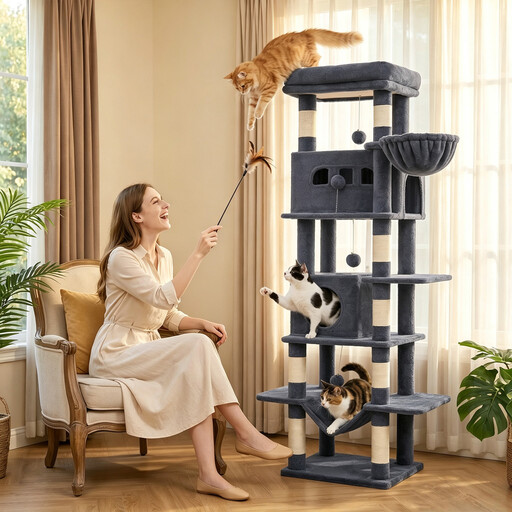
Why it suits this profile: A vertical solution for several active or larger cats, especially when available floor space is limited.
The product information mentions a widened, reinforced base, anti-tip features and eight sisal posts spread across several levels.
212.5 cm tall, with a 60 × 40 cm platform, removable cushions, two hideaways, a hammock and a basket according to the listing.
Before buying, measure the ceiling height and the space around the cat tree. Leave enough clearance above the highest platform and don’t place the furniture where a door could hit it. In a flat, a vertical cat tree for large cats often saves more space than several separate pieces of furniture, but the floor area taken up by the base remains important.
Assemble all parts according to the instructions provided. Afterwards, check that the tree doesn’t wobble and tighten the connections again after a few days. Don’t continue using damaged sisal, loose boards or unstable parts. Product information about an anti-tip base is no substitute for correct assembly or regular checks.
We’ve put together a complete, up-to-date list of products that fully meet these strict selection criteria and the applicable European safety regulations.
Don’t focus on height alone. A model with several platforms, two houses and a separate hammock gives cats more choice. For large cats, resting areas from around 50 cm wide are more practical than small platforms. Always check the stated weight limit per cat.
Its lifespan depends on assembly, use and maintenance. With intensive use, sisal and fabric upholstery wear out more quickly. Vacuum regularly, check the screws and replace damaged hanging toys or parts whenever possible. A cat tree that wobbles or is damaged should be taken out of use until the problem has been resolved.
An ordinary cat tree doesn’t use electricity. Ongoing costs mainly involve maintenance, such as replacement sisal, cushions or toys. Before buying, check whether parts can be replaced and whether the cat cushions can be removed and washed.
