
Vandaag of morgen in huis

Kwaliteit gegarandeerd

Welkomstaanbiedingen ontgrendelen: GRATIS bezorging | Tot 80% korting | Gratis 30 dagen JoyPlus-proefperiode
Download de app
A cat tree can help protect your furniture and give your cat extra space at home. But a model that looks good in a product photo doesn’t always work as well in everyday use. A narrow base, too little sisal or awkwardly spaced levels can mean your cat barely uses it.
There are three pitfalls to watch out for, especially when choosing a large cat tree or one for several cats:
The right cat tree depends on your cat’s weight and behaviour, how many cats you have and how much floor and ceiling space is available.
Start by checking the overall dimensions. A model measuring 170 cm or more uses little floor space for the amount of vertical play space it offers, but it does need a wide or reinforced base. Place the cat tree on a flat, non-slip surface. You can also secure a tall model to the wall with an anti-tip kit.
Pay attention to the ratio between the height and base plate. A cat tree with a wide, double base will generally have more contact with the floor than a narrow design. That doesn’t mean it can’t tip over, so check all the connections after assembly and retighten the screws regularly.
A claim such as “suitable for large cats” should be backed up by specific details. Check:
A stated static load capacity is a product value measured under a fixed load. Jumping and movement create additional forces, so use this figure as a guide. For heavy or very active cats, it’s best to choose a model with plenty of capacity to spare.
With several cats, it’s important to have multiple resting spots. That way, they won’t all have to use the same cat hammock or highest platform.
Sisal scratching posts are designed to encourage your cat to scratch in a designated spot. Check that sisal is available at different heights and that the posts are long enough for your cat to stretch out. A short post can quickly be ignored, even if the material itself is suitable.
Removable, washable cushions are practical in homes where cat hair and dust can quickly build up. Soft covering is comfortable, but check it regularly for loose threads. Replace or repair parts as soon as they become damaged.
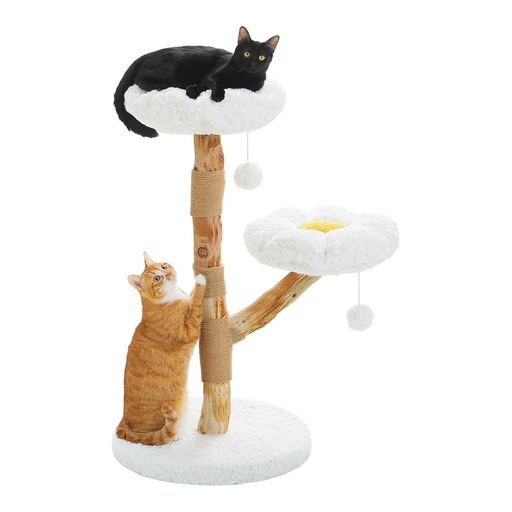
Why it suits this type of buyer: This compact model measures 49 × 49 × 90 cm and is designed for small to medium-sized homes and cats weighing up to 7.3 kg. The product information lists two resting platforms and space for up to two cats.
The double reinforced base and wooden construction put stability first, unlike a tall, narrow model. Still, check the connections yourself after assembly.
Natural wooden parts, a sisal-wrapped post and two soft resting spots.
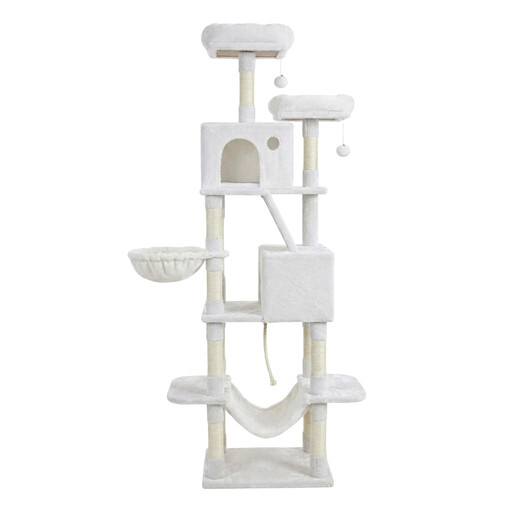
Why it suits this type of buyer: This tall cat tree offers vertical space for active cats and homes with several cats. The product information lists two platforms, two cat houses, a basket and a cat hammock.
The high number of scratching posts listed is matched by natural sisal covering. Given its height, securing it to the wall is strongly recommended in the product instructions.
13 sisal posts and a manufacturer-stated total static load capacity of up to 75 kg.
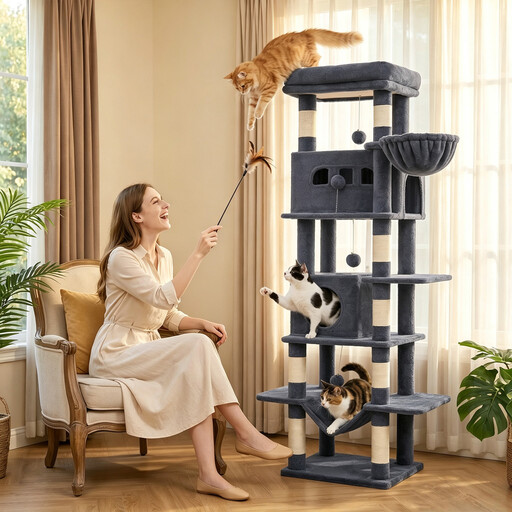
Why it suits this type of buyer: This model is designed for heavy, active cats or homes with five to six cats. It offers several levels, two caves, a hammock and a 60 × 40 cm platform.
The wide base, anti-tip feature and several resting spots make it well suited to intensive use. At this height, securing it to the wall is still a sensible precaution.
Eight sisal posts, six levels, removable cushions and a vertical design that saves floor space.
We’ve put together a complete, up-to-date list of products that meet these strict selection criteria and the applicable European safety regulations.
Start by placing the cat tree where your cat already likes to spend time, for example by a window or in a quiet corner of the living room. Here are a few practical steps:
You may be able to replace individual parts when the sisal wears out. Check first whether the manufacturer offers replacement parts. Stop using the tree if a post is leaning, a platform is cracked or a connection no longer stays secure.
It depends on your cat and your home. A compact model may be enough for a kitten or a calm adult cat. Active cats often enjoy having several levels. Measure the ceiling height in advance and leave clear space above the highest platform.
Use a flat, non-slip surface, assemble all the parts according to the instructions and check the screws after the first few weeks of use. For tall cat trees, securing the tree to the wall with a suitable anti-tip device is a sensible extra precaution.
Its lifespan depends on the materials, your cat’s weight and how intensively it’s used. Regular cleaning and replacing worn sisal or loose parts in good time can help extend its useful life. A sturdy construction won’t necessarily last if the covering or connections aren’t properly maintained.
