
Vandaag of morgen in huis

Kwaliteit gegarandeerd

Welkomstaanbiedingen ontgrendelen: GRATIS bezorging | Tot 80% korting | Gratis 30 dagen JoyPlus-proefperiode
Download de app
A cat tree for large cats needs to withstand more than a compact post designed for one small cat. Larger cats land with more force, take up more room on a platform and often use a cat tree more intensively. In multi-cat households, there is also more movement happening at the same time.
However, an impressive height or a large number of accessories does not tell you everything. The following pitfalls regularly make a cat tree less practical than expected.
A tall cat tree can be appealing to cats that love climbing, but height also increases the risk of wobbling. A narrow base plate or lightweight construction is less suitable when a cat jumps down from a platform.
Therefore, pay attention to:
For models above approximately 150 cm, wall mounting is an important safety measure. Also check regularly that the screws and joints are still secure.
A cat tree with hideaways, a hammock and toys may seem versatile, while the scratching posts are too short or too thin. A cat needs to be able to stretch out while scratching. As a result, short posts are sometimes barely used.
A cat tree with sisal scratching posts works particularly well in practice when the posts:
A greater number of scratching posts can be useful for a cat tree for multiple cats, but consider their positioning too. If all the posts are in one corner, cats may still get in each other’s way there.
The stated maximum load is usually a static load. This means that the weight is resting on the structure without movement. Jumping, turning and landing create more force. Therefore, do not simply divide the stated maximum by the number of cats.
Always check:
An XXL cat tree for multiple cats needs to support not only a substantial amount of weight, but also simultaneous climbing and movement.
First, measure the space where you plan to put the cat tree. Leave enough room around it so that platforms do not come into contact with a cupboard, radiator or window. A large cat tree measuring 50 × 50 cm takes up less floor space than a model with a wider base, but may require additional anchoring if used by an active cat.
For medium-sized to large cats, the size of the resting areas is particularly important. A bed or platform should be wide enough for your cat to turn around and long enough to lie outstretched. Do not look only at the total height of the cat climbing tower.
Materials such as chipboard, solid wood, plush and sisal are widely used. The material alone does not determine whether a model is stable. The joints, base plate, post thickness and weight distribution are at least as important.
A stable cat tree will generally have:
According to the product description, the PAWZ Road Wooden Flower Cat Tree has a natural wood frame and a double-reinforced base. The model is 90 cm high, measures 49 × 49 cm and, according to the stated specifications, is suitable for up to two cats weighing approximately 7.3 kg in total. This makes it more of a compact option for medium-sized cats than a fully fledged XXL cat tree.
Sisal is intended as a scratching surface and can help direct scratching behaviour towards a designated area. It does not guarantee that your furniture will be protected: usage varies from cat to cat. Also look out for replaceable parts and loose threads.
Washable cushions or removable covers are practical in a Dutch household where hair and dust can quickly build up. Always check the care label on plush sections. Any damaged hideaway, cord or toy should be removed or replaced.
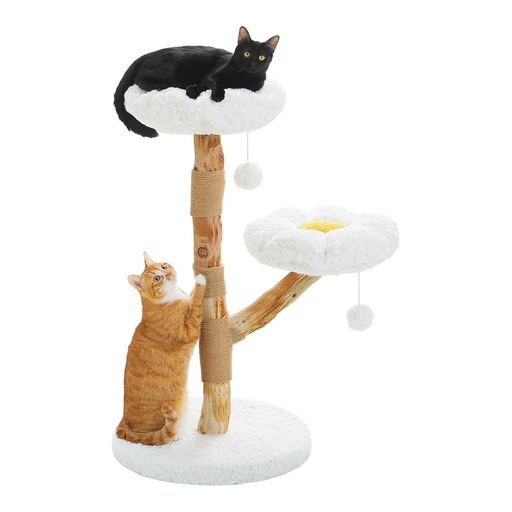
Why it suits this profile: Its compact dimensions fit into smaller living spaces. The model has two platforms and, according to the product description, is intended for medium-sized to larger cats weighing up to 7.3 kg, with a maximum of two cats.
According to the product information, the double-reinforced base and wide base plate are designed to provide greater stability. Nevertheless, check all the joints during assembly.
49 × 49 × 90 cm, natural wood and a sisal-wrapped post; suitable when floor space is limited.
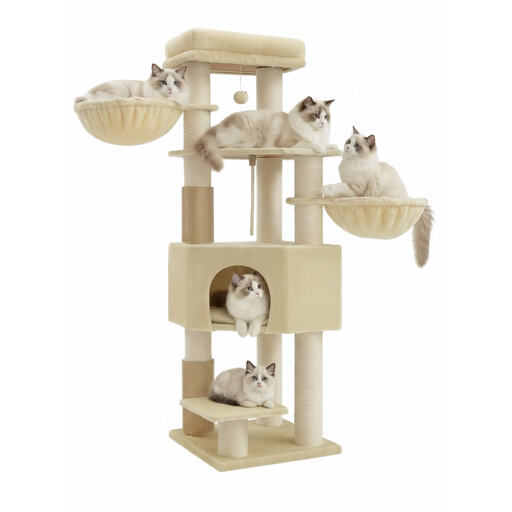
Why it suits this profile: This model combines plenty of scratching space with resting areas and easy maintenance. According to the product information, it is intended for up to five cats, with a stated static load capacity of 105 kg.
The nine sisal posts mean that all the cats do not have to share the same scratching area. After assembly, the supplied anti-tip kit must be permanently attached to a load-bearing wall.
160 cm high, nine sisal scratching posts, a washable mat, a hidden hideaway and a built-in brush.
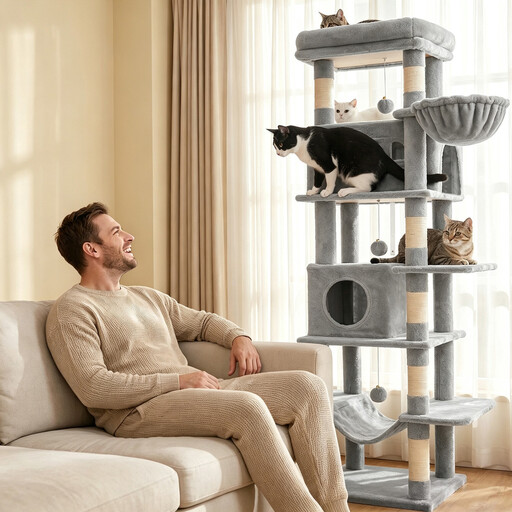
Why it suits this profile: The six levels, two cat houses and hammock are designed for active cats and multi-cat households. According to the product description, it can be used by up to six cats weighing less than 6.8 kg each.
According to the product information, the wide base, double base plate and built-in anti-tip lock are designed to provide greater stability. At this height, wall mounting remains advisable.
Eight sisal posts, two houses, a hammock, a 30 cm bed and a 65 × 45 cm platform.
We have compiled a complete, up-to-date list of products that fully meet these strict selection criteria and the applicable European safety regulations.
Place the cat tree on a flat, dry surface and keep it away from heat sources, naked flames and cables. An anti-slip mat can sometimes be useful with a tall cat tree, but it does not replace wall mounting when the instructions require it.
Check the following when first setting it up and regularly thereafter:
Introduce a new cat climbing tower gradually. If necessary, place a toy on a lower platform and let the cats discover the higher levels for themselves. Do not force a cat to settle in a place where it does not want to rest.
This depends on your cat’s preferences and the space available. A model measuring 90 to 130 cm may be sufficient for scratching and resting. A tall cat tree of 160 cm or more provides more climbing space, but requires extra attention to the base width and wall mounting.
Its service life varies depending on the number of cats, their weight and how intensively they scratch. Regularly tightening the screws, vacuuming the plush and replacing worn sisal in good time can extend its practical lifespan. Stop using the cat tree if a load-bearing component is damaged or unstable.
Not automatically. Check the stated maximum number of cats, the weight per cat, the number of resting areas and the distribution of the scratching posts. A model with multiple levels, houses and separate platforms reduces the likelihood that cats will have to share the same space.
