
Vandaag of morgen in huis

Kwaliteit gegarandeerd

Welkomstaanbiedingen ontgrendelen: GRATIS bezorging | Tot 80% korting | Gratis 30 dagen JoyPlus-proefperiode
Download de app
A cat tree can double as a scratching post, a lookout, a place to rest and a play area. However, not every tall cat tree is right for every home or cat. A model might look sturdy in the product photo, but in practice it could have too little room to move around, a narrow base or upholstery that wears out quickly.
So keep an eye out for these three common pitfalls:
Focusing only on the height
A large cat tree doesn’t automatically offer enough comfort. Without wide platforms, sensible steps between levels and a sturdy base, your cat may struggle to climb or the tower may become unstable.
Confusing a stated weight capacity with everyday use
A stated static load doesn’t tell you exactly how a cat tree will respond when several cats jump on it at once. Check the size of the platforms and base, and look for an anti-tip feature too.
Overlooking scratching surfaces and maintenance
A cat tree without enough sisal may not work well as a scratching post. Also check whether the cushions can be removed and whether the plush fabric is easy to clean.
First, measure the space where you plan to put the cat tree. Leave room around it for assembly, cleaning and safe movement. A compact cat tree of around 90 cm is easier to fit into a smaller living room. A model measuring 170 to 212.5 cm makes more use of vertical space and needs particular attention to stability.
Look out for:
For older cats, an even layout with easy-to-reach resting spots is more practical than a very steep climbing tower. Active cats, on the other hand, may prefer a tall cat tree with several levels.
Check the materials used for the base and posts. Product specifications may list natural wood, chipboard, sisal rope, plush fabric and metal fixings. Assemble the structure correctly on a flat surface.
For taller models, an anti-tip feature or wall fixing is a sensible choice. The manufacturer recommends this for several models over 150 cm tall. It’s no substitute for proper assembly: check the screws, joints and platforms regularly, especially during the first few weeks.
Also note the difference between a stated total weight capacity and the load per platform. For example, the product information for some JOYFURNOS models gives a total static capacity of 70 or 75 kg, while stating around 10 kg per level. Treat these figures as product specifications, not as a guarantee for every kind of play.
A sisal scratching post gives cats a dedicated place to scratch and climb. Don’t just count the posts; look at where they’re positioned too. Vertical posts work well for cats that like to stretch up, while an angled scratching board can add variety.
For resting, a cat house, wide platform or cat hammock can be useful. Removable, washable cushions make everyday cleaning easier. Hanging balls count as cat toys, but check them for loose threads before use and replace them as soon as any material starts to come away.
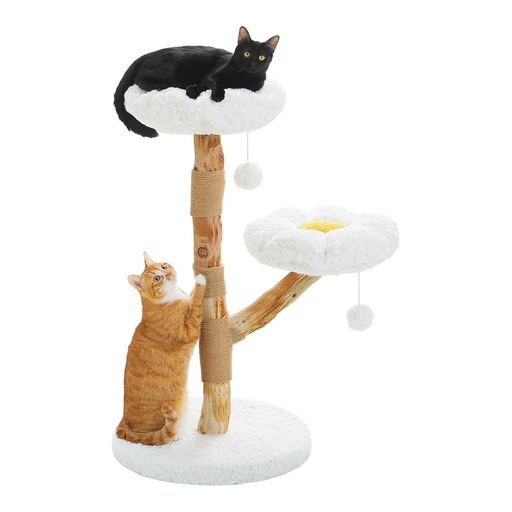
Why it suits this type of buyer: Measuring 49 × 49 × 90 cm, it’s a good fit for smaller living spaces. The product information says it’s suitable for one or two cats weighing up to 7.3 kg.
Its two platforms and natural wood base offer more support than a standalone, narrow scratching post. Remember to check the joints regularly after assembly.
Two soft resting spots, a wooden structure and a sisal-wrapped post.
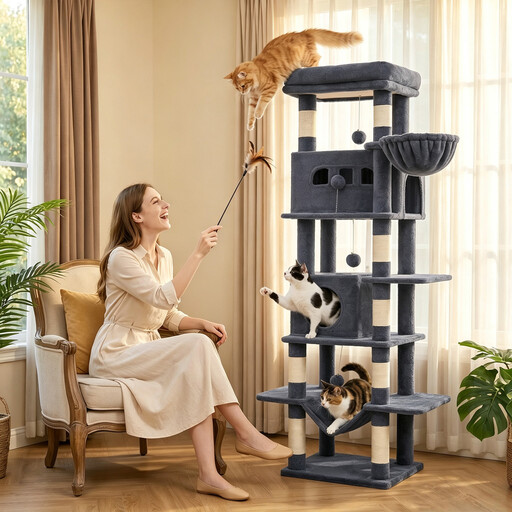
Why it suits this type of buyer: This model has six levels, two enclosed resting spaces, a hammock and a 60 × 40 cm platform, making it well suited to households with several cats.
The wide base, thickened boards and anti-tip features help tackle the risk of wobbling in a tall cat tree. Wall fixing is still recommended.
Eight sisal posts, six levels, two cat houses and removable cushions.
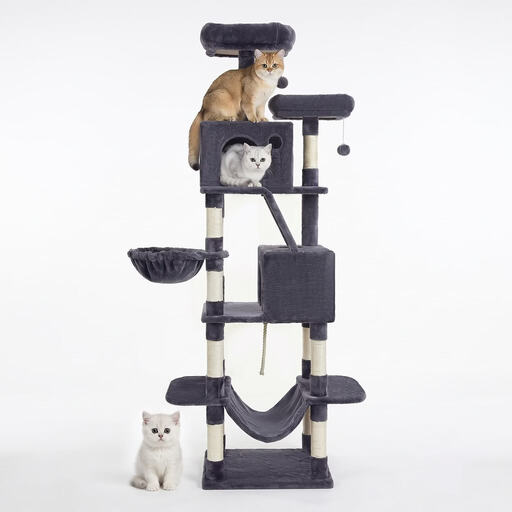
Why it suits this type of buyer: With 13 sisal posts, an angled scratching ramp, two cat houses and a hammock, this model is designed for active cats and households with several cats.
The product information lists a reinforced base and a total static capacity of up to 70 kg. Place the tower on a flat surface and use the recommended wall anchoring.
206 cm tall, with 13 sisal posts, two platforms, two cat houses and a hammock.
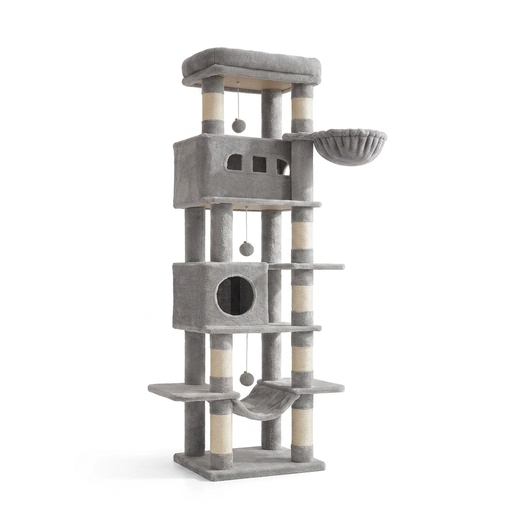
Why it suits this type of buyer: Six levels, two cat dens, a basket, a hammock and two washable cushions provide a range of places to rest and play.
Eight of the 17 support posts are wrapped in sisal. The double reinforced base and anti-tip feature are worth checking to help prevent excessive wobbling.
170 cm tall, with 8 sisal posts, two washable cushions and stated suitability for several cats.
A cat tree is first and foremost a regular place to play and rest. For a change of pace, you can add interactive cat toys:
We’ve put together a complete, up-to-date list of products that meet these strict selection criteria and the applicable European safety regulations.
Consider your cat’s weight, age and behaviour. A model around 90 cm may be enough for a smaller home. Larger or more active cats often benefit from wide platforms and a sturdy base. If you have several cats, multiple resting spots and scratching areas are practical.
Assemble the structure exactly as instructed and place it on a flat, non-slip surface. For a tall cat tree, wall fixing with a suitable anti-tip feature is recommended. Tighten the screws after assembly and check them regularly.
Its lifespan depends on use, weight, materials and maintenance. Vacuum plush surfaces, check the sisal and joints, and replace parts when possible. Stop using the tree if a post, platform or fixing is damaged or loose.
