
Vandaag of morgen in huis

Kwaliteit gegarandeerd

Welkomstaanbiedingen ontgrendelen: GRATIS bezorging | Tot 80% korting | Gratis 30 dagen JoyPlus-proefperiode
Download de app
A cat tree can help you make better use of vertical space at home and give your cat a dedicated place to climb, scratch, play and sleep. However, a large model isn’t automatically the right choice. A tall cat tree with a narrow base may wobble, while a compact cat tree may not offer enough places to rest in a multi-cat household.
So don’t focus only on the number of levels or the colour of the upholstery. In practice, the construction, dimensions and layout determine whether your cat will enjoy using the tree.
A 2-metre cat tree offers plenty of vertical space, but it also needs sufficient depth, a wide base and, often, wall fixings. A tall structure with small platforms is also less suitable for larger cats. Always check the overall dimensions and recommended load capacity.
A cat tree may have several places to rest, but without enough sisal, your cat may keep scratching the sofa or curtains. Check the number of sisal-covered posts, their length and where they’re positioned. Scratching posts at different levels are practical, as cats can scratch while climbing or after a nap.
In a household with two or more cats, a single cat house and one top platform can lead to competition. A cat tree for several cats works better when it has multiple resting areas, such as a combination of a bed, cat hammock, enclosed cubbies and wide platforms.
Also look out for parts that are difficult to clean. Removable cushions and upholstery you can reach with a vacuum cleaner or lint roller make maintenance easier.
Always place a cat tree on a flat, non-slip surface. For tall models, an anti-tip kit is important. The product information for the models below recommends fixing tall structures to the wall. This isn’t a minor detail: jumping and landing create short bursts of force that can exceed the static load capacity.
After assembly, check:
A stated load capacity usually refers to a static load. It doesn’t automatically tell you how a structure will respond to several cats jumping on it at once.
A large cat tree isn’t just about its height. Check the distance between the levels too. Levels that connect logically make it easier for your cat to climb up and down. Smaller differences in height may be more practical for kittens, older cats or cats that can’t jump as well.
A tall cat tree can work well in a living room with enough ceiling clearance, but measure the following in advance too:
Natural sisal is designed as a scratching surface and is often wrapped around posts. Check that the posts are long enough for your cat to stretch out fully. Plush upholstery feels soft, but needs regular care. Removable mats or cushions are a practical bonus.
A cat tree doesn’t always replace a separate cat scratching post. An extra scratching board in a favourite spot can be useful, especially if your cat scratches horizontally.
The following selection is based on verifiable details in the product descriptions, such as height, number of sisal-covered posts, dimensions, resting places and stated load capacity.
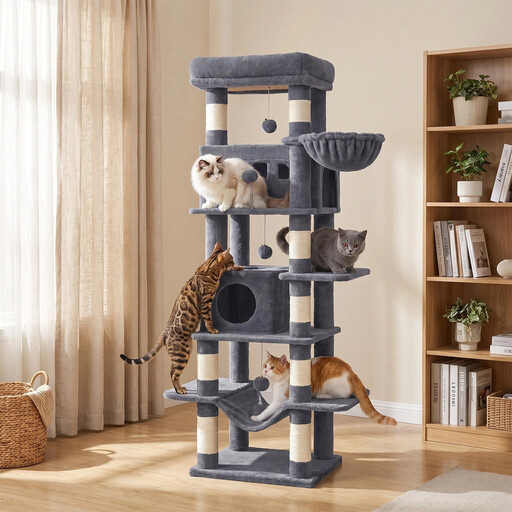
Why it suits this type of buyer: A versatile cat tree for anyone looking for several features without opting for an extra-large model. The tower is 170 cm tall and includes two cat houses, a hammock and a raised bed.
The product description mentions a reinforced double base and anti-tip feature. It has 17 support posts, 8 of which are covered in sisal.
50×30 cm platform, two removable cushions and several scratching areas.
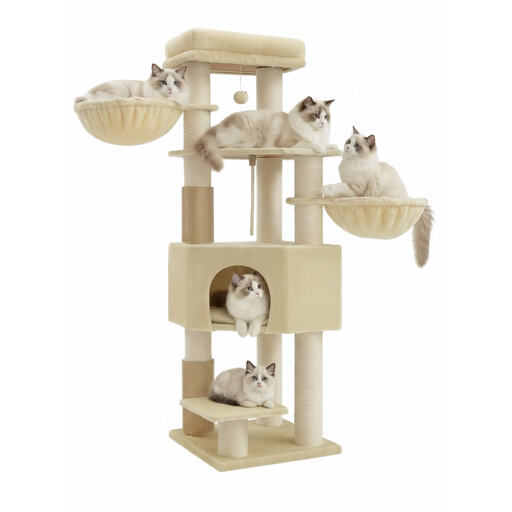
Why it suits this type of buyer: A good choice for large or active cats, and households where easy maintenance matters. This model has a wide base, a large resting area, a cubby and a bed.
The specifications list 9 sisal-covered posts, an anti-tip base and mandatory permanent wall fixings. The stated static load capacity is 105 kg.
Removable mat and cover, built-in brush and dimensions of 50×50×160 cm.
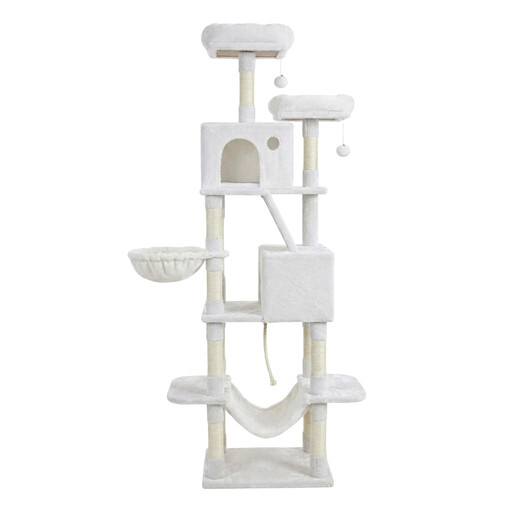
Why it suits this type of buyer: A tall cat tree for active cats and households with several cats that want to climb, scratch or rest at the same time. Its layout combines platforms, two houses, a bed and a hammock.
The product details list 13 natural sisal-covered posts, a reinforced base and an anti-tip kit. Wall anchoring is strongly recommended for a model over 150 cm tall.
Two cat houses, a hanging bed, a cat hammock and a stated static load capacity of up to 75 kg.
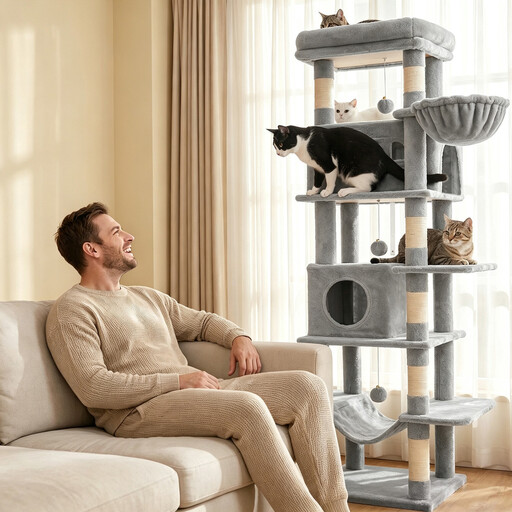
Why it suits this type of buyer: Its six levels, double cat houses, wide platforms and several resting areas are designed for shared use in a multi-cat household.
The description lists 8 sisal-covered posts, a double base and an anti-tip lock. It’s stated to accommodate up to 6 cats, each weighing less than 6.8 kg.
Six levels, two houses, a hammock, a bed and washable cushions.
We’ve put together a complete, up-to-date list of products that meet these strict selection criteria and the applicable European safety regulations.
Your cat may not use a new cat tree straight away. Put a familiar cat bed or blanket in a resting spot, and consider placing a cat toy on a lower level. A teaser wand can help guide your cat between the different levels through play. Keep an eye on small parts and remove a toy if it becomes damaged.
Cat treats can also help introduce your cat to the tree. According to the product description, the INABA Churu Cat Skin & Coat Multipack contains 20 sticks of 14 grams and has an 86% moisture content. It’s a supplementary treat, not a replacement for your cat’s main food. The recommended amount is 1 to 3 sticks a day, depending on their overall diet. Give treats in moderation and make sure fresh drinking water is always available.
Assemble all the parts according to the instructions and place the tree on a flat surface. Wall fixings with an anti-tip kit are important for tall models. Check the screws, posts and platforms regularly, especially during the first few weeks after assembly.
Its lifespan depends on the number of cats, their weight, how often the tree is used and how well it’s maintained. Sisal wears out more quickly when several cats scratch it every day. Replace any loose or damaged parts as soon as they’re no longer secure. A model with replaceable toys, washable cushions or replaceable sisal can be a practical choice for long-term use.
Once you’ve bought it, ongoing costs are usually limited. You may need to replace sisal, cushions or hanging toys, and perhaps buy extra fixings. Regular vacuuming, trimming loose fibres and tightening the connections can help prevent unnecessary wear and tear.
