
Vandaag of morgen in huis

Kwaliteit gegarandeerd

Welkomstaanbiedingen ontgrendelen: GRATIS bezorging | Tot 80% korting | Gratis 30 dagen JoyPlus-proefperiode
Download de app
A cat tree can combine climbing, scratching, play and rest. But in practice, a purchase can sometimes disappoint. A tall cat tree that wobbles, a cat house that’s too small for a large cat or a sisal scratching post that quickly comes loose won’t offer much value.
So don’t focus only on colour and the number of platforms. The most important factors are size, stability, materials and your cat’s habits.
A tall cat tree often gives cats an appealing vantage point. However, its centre of gravity is higher, so a narrow base or insufficient anchoring can make it wobble. This can be especially impractical for active cats, large cats or households with more than one pet.
Check:
A floor-to-ceiling model can provide extra support in a suitable room, but measure the ceiling height carefully beforehand.
A cat tree may look spacious in the product photo, while the cat house or hammock is actually quite cramped. Measure your cat while they’re lying down, especially if they’re medium-sized or large. Also check the diameter of baskets and the dimensions of platforms.
If you’re choosing a cat tree for several cats, multiple resting areas are useful. That way, your cats won’t always have to share the same spot.
A cat tree with lots of dangling balls isn’t automatically suitable for heavy use. Well-spaced climbing levels, sturdy posts and an easy-to-reach scratching surface matter more.
Sisal scratching posts are practical for cats that like to scratch vertically. Check that the sisal is wrapped tightly around the post and that replacement parts are available. If threads come loose or toys are damaged, it’s best to remove the affected part.
A large cat tree needs more than just a certain height. The width of the base, the distance between levels and the space around a resting platform all affect how practical the tree is.
Look out for these points:
Look for a stable cat tree with a wide or reinforced base. An anti-tip kit is a useful addition, but placement still matters: put the tree on a level surface and check all the connections after assembly.
Weight capacities vary by product. According to the product information, the Large Cat Tree Tower is described as suitable for up to six cats weighing 6.8 kg each. Treat this as a product specification and check whether the weight distribution is suitable for your cats.
Sisal is popular because it provides a rough surface for scratching. As well as checking the material, look at how much scratching surface there is and how easy it is to reach. A cat scratching post hidden behind a house or platform may be used less often.
Remove loose hair with a vacuum cleaner or lint roller. Removable cushions and washable parts make cleaning easier. Check dangling toys regularly and replace them as soon as feathers come loose or the sisal starts to fray.
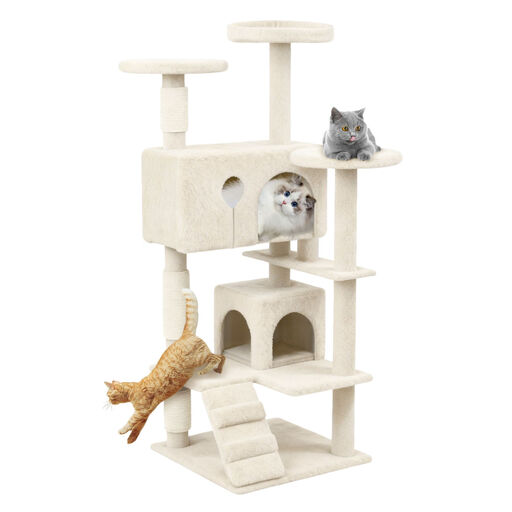
Why it suits this profile: This model combines a cat bed and scratching post in a compact design, making it a good choice for households looking for their first cat tree without adding a very large tower straight away.
The stated base dimensions of 49 × 49 cm and height of 130 cm give you a clear idea of its size before you buy. Do check that it sits level and doesn’t move after assembly.
130 cm high; combines a cat bed and scratching post; neutral beige colour.
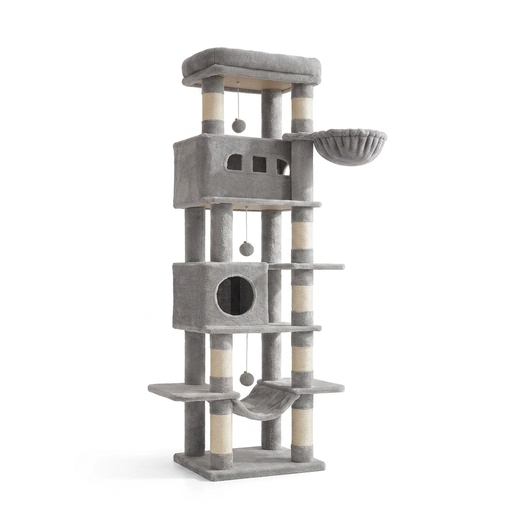
Why it suits this profile: With six levels, two cat houses, a hammock and a raised basket, this layout is ideal for owners who want to combine plenty of places to rest and climb.
The product information mentions a double reinforced base and an anti-tip feature. Eight of the 17 posts are also wrapped in sisal, spreading the scratching spots across several levels.
170 cm high; two cat houses; hammock; two removable cushions; product specification states it’s suitable for up to six cats weighing 6.8 kg each.
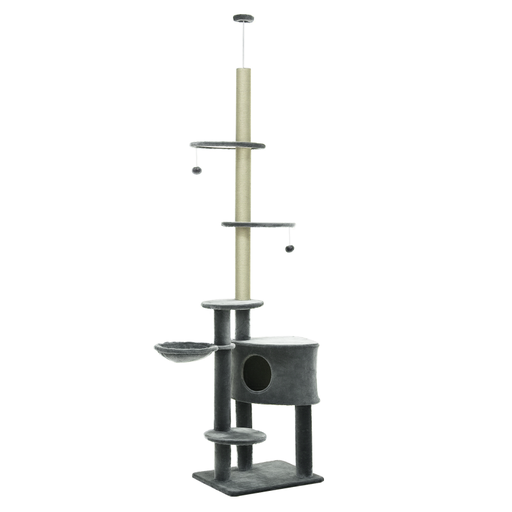
Why it suits this profile: This floor-to-ceiling model is designed for rooms with enough ceiling height and for cats that love to climb high and explore multiple levels.
The adjustable height of 220-265 cm lets you adapt it to your space. Measure your ceiling before buying and follow the assembly instructions for the top fixing.
Adjustable from 220 to 265 cm; multiple levels; cat house, hammock and sisal-wrapped posts, according to the product name.
A cat tree doesn’t have to meet all your cat’s play needs by itself. The Meowmagic Feather and Sisal Ball Toy Pack of 4 contains four lightweight balls with feathers and sisal rope. Roll a ball across the floor or tuck part of it under a rug. According to the product instructions, replace the toy if feathers come loose or the sisal starts to fray.
For cats that respond to scents, the zeze Green Apple Silvervine Toy could be another option. According to the product description, it contains silvervine and catnip. The effect can vary from cat to cat. Supervise your cat the first time they use it and take the toy away if the fabric or filling becomes damaged.
Another type of cat tree is the Cat Tree 132 cm with Sisal Scratching Posts, which includes a cat bed, condo, springboard, brush and anti-tip kit, according to the product name.
We’ve put together a complete, up-to-date list of products that meet these strict selection criteria and current European safety regulations.
Consider your cat’s length and weight, not just the overall height. A medium-sized or large cat needs spacious platforms and a wide place to lie down. If you have several cats, separate resting areas are useful.
Place the tree on a level floor, tighten all the connections and use the included anti-tip feature. With a tall cat tree, it’s a good idea to check the structure again after a few days, as parts can settle with use.
Its lifespan depends on use, weight, materials and maintenance. Check the sisal covering, screws, cushions and dangling toys regularly. Replace damaged parts promptly, and choose a tree with a wide base and several scratching posts if it’ll get heavy use.
