
Vandaag of morgen in huis

Kwaliteit gegarandeerd

Welkomstaanbiedingen ontgrendelen: GRATIS bezorging | Tot 80% korting | Gratis 30 dagen JoyPlus-proefperiode
Download de app
A cat tree should offer more than a tall post with soft covering. For indoor cats, it often combines a scratching post, climbing frame, resting place and play area. Yet many buyers fall into the same traps: a cat tree that looks large on paper but has little usable lounging space, a narrow base that wobbles, or sisal covering only a small section of the post.
Use these practical checks to compare cat trees and find one that will make a real difference in your home.
A large 130 cm cat tree sounds impressive, but height isn’t everything. Check the base dimensions, the width of the platforms and the distance between levels too. A tall tower with a narrow base may feel less stable when your cat jumps onto it.
Also consider how much space you have around the cat tree. In a small living room, a more compact 87 cm model may be more practical than a taller one that gets in the way of furniture or a window.
Cats don’t all scratch in the same way. Some stretch right out, while others prefer to scratch horizontally or at a lower level. So check where the sisal is fitted and how many scratching posts the cat tree has. Covering that’s mainly decorative offers fewer opportunities than several easy-to-reach sisal posts.
A cat house, basket or lounging platform may look comfortable, but soft covering can’t make up for weak joints. Check that the parts can be secured firmly and that the assembly instructions are clear. For an active cat, a stable cat tree matters more than extra decorative details.
First, measure the space where you plan to put the cat tree. Check:
A 49 x 49 x 130 cm model takes up relatively little floor space while still offering several levels. A more compact 87 cm model could suit a flat, bedroom or smaller living room.
A cat tree with sisal scratching posts supports natural scratching behaviour, so you don’t have to rely on just one vertical post. Check that the sisal is wrapped firmly around the post and that the scratching areas are accessible from the floor or a lounging platform.
If possible, place the cat tree somewhere your cat can see into the room. A quiet corner by a window can be appealing, as long as it’s a safe distance from delicate curtains, radiators and loose cables.
Indoor cat trees regularly have to withstand jumping, turning and climbing. Look for:
The product specifications give you a starting point. When buying, also check the current product page, assembly details and any weight information.
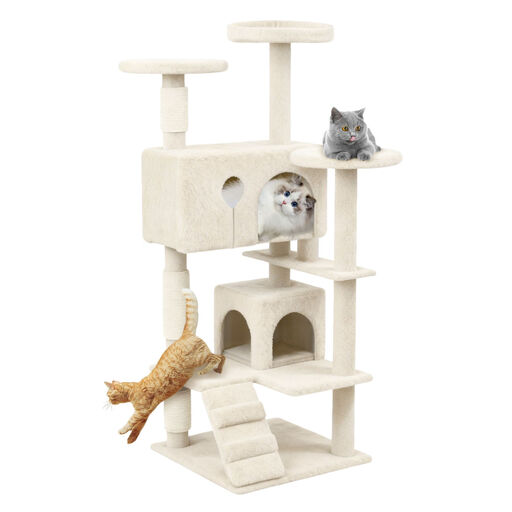
Why it suits this buyer: This model combines a 49 x 49 cm footprint with a height of 130 cm. It’s a practical choice if you’re looking for one piece of cat furniture for climbing, scratching and relaxing.
The fixed base dimensions tell you exactly how much floor space you’ll need. Combining a cat bed and scratching post also means you don’t have to make room for several separate items.
130 cm high; beige finish; includes a cat bed and scratching post, according to the product name.
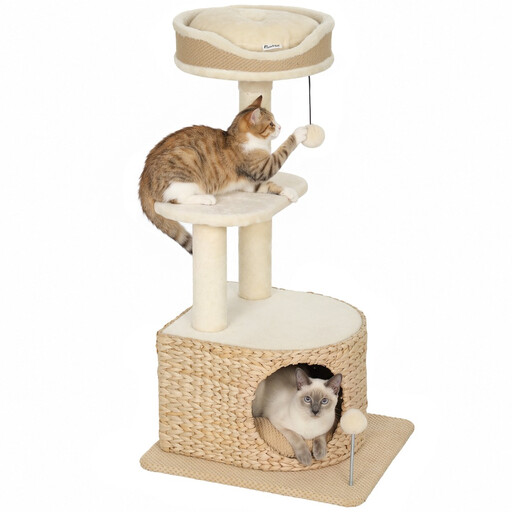
Why it suits this buyer: The woven design and soft beige colour make it a good fit for a home where the cat tree will be on show in the living space.
The product name specifies four levels and a jute scratching post. That gives you a clearer idea of the climbing and scratching features than a model described only by its overall height.
87 cm high; four levels; jute scratching post and club-shaped cat house, according to the product information.
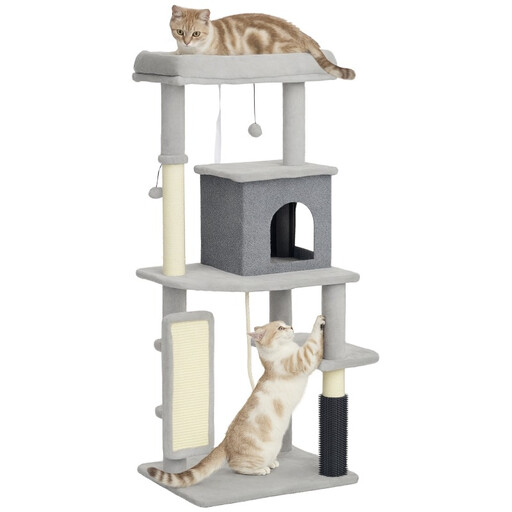
Why it suits this buyer: This light grey model is designed for households looking to combine several features: scratching, relaxing, jumping and playing.
The listed anti-tip kit gives you an extra way to secure the tree. Several sisal scratching posts are also mentioned, so scratching doesn’t depend on just one spot.
132 cm high; anti-tip kit; cat bed, condo, jumping platform and grooming brush, according to the product name.
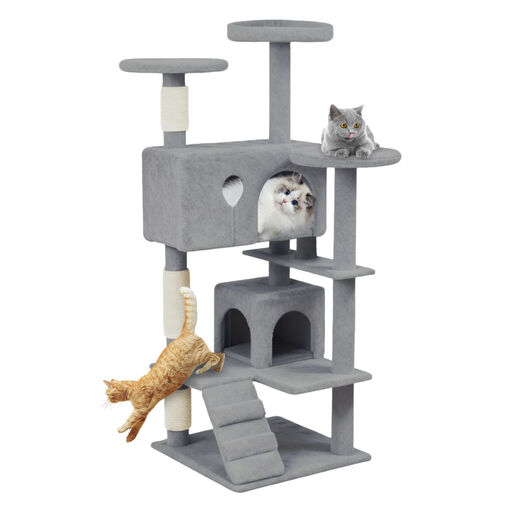
Why it suits this buyer: The light grey colour works well with a neutral décor. With a 49 x 49 cm footprint and a height of 130 cm, it’s a good choice if you want to make use of vertical space.
The set dimensions make it easier to check in advance whether the cat tree will fit in your chosen corner. The cat bed and scratching post also make its features clear.
130 cm high; 49 x 49 cm base; light grey finish with cat bed and scratching post.
We’ve put together a full, up-to-date list of products that meet these strict selection criteria and the applicable European safety regulations.
Place the cat tree on a level surface and check that all the screws are tight after assembly. Check them again after a few weeks of use, especially if your cat jumps around a lot. If an anti-tip kit is included, fit it according to the instructions.
Regularly remove loose fur with a vacuum cleaner or soft brush. Check the sisal for fraying and repair or replace parts as soon as they come loose. This will keep the cat tree in good working order and help prevent loose threads from catching on paws or claws.
It depends on the number of cats, their size and the space available. Don’t just look at the height: check the base, lounging platforms and distance between levels too. An 87 cm model may be enough for one cat. If you’re looking for more vertical play space, consider a 130 or 132 cm model.
A quiet spot with a view of the room is often a practical choice. Keep the cat tree away from frequently opened doors, loose cables and heat sources. Make sure the base is completely level and your cat can jump on and off safely.
Its lifespan depends on the materials, assembly, number of cats and how heavily it’s used. Check the screws, sisal scratching posts and resting areas regularly. A cat tree that stays sturdy and has worn parts replaced promptly will generally remain usable for longer than one that isn’t maintained.
