
Vandaag of morgen in huis

Kwaliteit gegarandeerd

Welkomstaanbiedingen ontgrendelen: GRATIS bezorging | Tot 80% korting | Gratis 30 dagen JoyPlus-proefperiode
Download de app
A cat tree can provide a resting place, scratching post and play area all in one. Even so, a purchase can sometimes disappoint in practice. A tall cat tree may wobble, a cat house may be too small and a cat scratching post may come loose after a short time. This is especially important with large or active cats and in households with several cats: simply looking at the height or number of platforms is not enough.
The Joybuy Product Recommendation Officer therefore selects products based on verifiable factors: dimensions, base construction, sisal covering, weight capacity, maintenance and available resting places.
A tall cat tree gives cats a vantage point, but a narrow base can make the whole structure prone to movement. So check not only the height, but also the base dimensions, the weight of the furniture and whether an anti-tip feature is included.
With a tall cat tree for several cats, a reinforced base is particularly important. Place the furniture on a level surface and, if supplied, use the wall attachment.
A cat tree with lots of levels is not automatically practical. Pay attention to the distance between the platforms. If the jumps are too large, kittens, older cats or heavier cats may struggle to climb up and down safely. A staircase-style layout with manageable distances between levels is usually easier to use.
Also check the dimensions of the resting areas. A medium-sized cat house will not suit every cat. A large cat needs enough room to turn around, lie down and retreat.
A cat tree with sisal is a good choice if your cat likes scratching, but the thickness, positioning and amount of sisal all make a difference. Scratching posts at several heights offer more opportunities than a single short post at the bottom.
Plush surfaces collect hair. Removable, washable cushions and parts that can be cleaned with a vacuum cleaner or lint roller save time. Also check regularly whether the sisal is fraying, balls are coming loose or the joints are becoming slack.
Measure the available space beforehand. A large cat tree can be over two metres high and also needs enough clearance around it. Take doors, windows, radiators and walking routes into account.
When checking a cat tree for large cats, look at:
For example, the product description of the 212.5 cm reinforced cat tree states a capacity of up to six cats, each weighing less than 6.8 kg. This is a product specification, not a guarantee that every home or cat will have the same experience. Assembly and placement remain important.
A stable cat tree should ideally have a wide or double base, sturdy connecting posts and an anti-tip mechanism. After assembly, check that all screws are properly tightened. With intensive use, it is sensible to check the connections again regularly.
A heavier piece of furniture is not automatically more stable, but weight combined with a wide base and a low centre of gravity can contribute to a secure set-up. Always follow the manufacturer's assembly instructions.
Sisal is a commonly used material for scratching posts. Check how many posts are actually wrapped in sisal and where they are positioned. A cat often wants to stretch out fully while scratching, so a sufficiently long, sturdy post is more practical than just a small sisal patch.
Several resting places are useful for households with multiple cats. Consider a cat hammock, an open platform, a raised bed and one or more cat houses. This allows cats to keep their distance from one another without immediately fighting over a single sleeping spot.
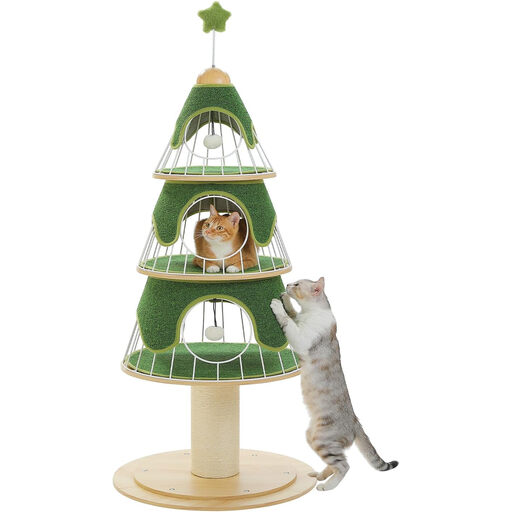
Why it suits this profile: This compact 130 cm cat tree is suitable for households looking for a place to play and rest without installing a very tall piece of furniture.
The base measures 60 × 60 cm and the central post is 12.5 cm thick. The manufacturer also recommends attaching the unit to the wall with an anti-tip device where available.
130 cm high, with three levels, three cat houses and a sisal-covered scratching post. Suitable for indoor use.
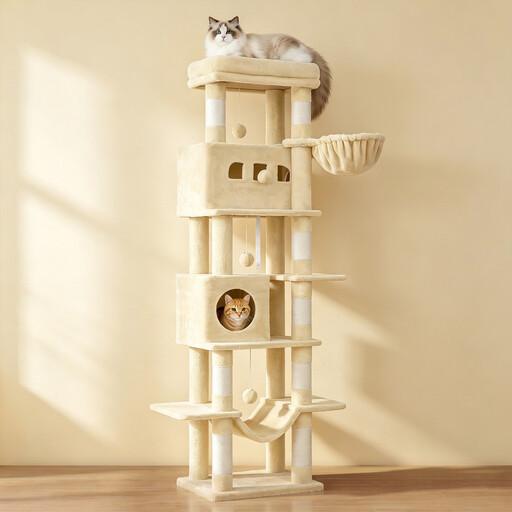
Why it suits this profile: The combination of six levels, two cat houses, a hammock and several scratching zones suits cats that like climbing, scratching and alternating between activity and rest.
The description mentions an integrated double base, an anti-tip lock and 17 reinforced support posts. The stated capacity is a maximum of six cats, each weighing less than 6.8 kg.
212.5 cm high, with 8 sisal posts, two enclosed resting areas, a hammock and a 65 × 45 cm platform.
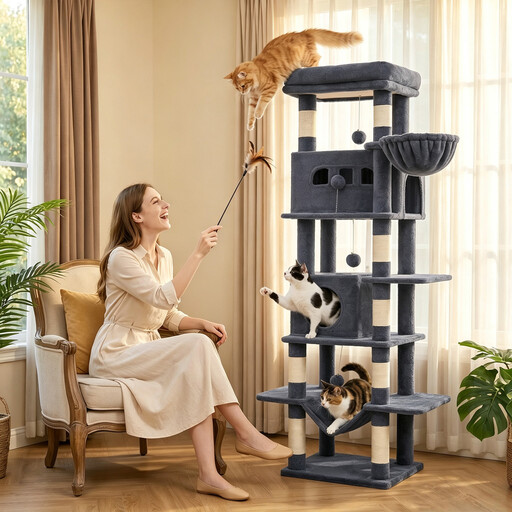
Why it suits this profile: This vertical cat tree makes use of the available height while taking up relatively little floor space. This can work well in a flat with active cats.
The product information mentions a reinforced base, anti-tip features and removable cushions. Before buying, however, check the available ceiling height and attachment options.
Six levels, 8 sisal posts, two cat hideaways, a hammock, a 60 × 40 cm platform and washable cushions.
A cat tree does not always replace separate cat toys. Feather and sisal balls are suitable for short play sessions in which your cat can roll, chase and jump. The Meowmagic Feather and Sisal Ball Toy Pack of 4 contains four lightweight balls. Check them regularly and replace a ball as soon as feathers come loose or the sisal starts to fray.
The zeze Green Apple Silvervine Toy is designed for cats and, according to the product description, contains silvervine and catnip. Observe your cat during first use and remove the toy if the outer fabric or filling becomes damaged.
For dogs, a snuffle mat is a different type of interactive cat toy? No: the zeze Mechanic Snuffle Mat Toy is specifically designed for dogs. Hide dry kibble or treats in it and supervise your dog while playing. According to the care instructions, the mat must not be fully immersed in water. So, if you are looking for a snuffle mat for dogs, make sure you choose one for the correct animal and check the safety warnings.
We have put together a complete, up-to-date list of products that fully meet these strict selection criteria and the applicable European safety regulations.
Assemble all parts according to the instructions and tighten the connections evenly. Place the cat tree on a level floor, preferably with the wide side of the base facing into the room. Use the supplied anti-tip anchor if your cat jumps frequently or if the furniture is tall. Check all screws again after a few weeks.
Its lifespan depends on the number of cats, their weight, how intensely they scratch and how well the tree is maintained. A cat tree will last longer if you replace loose parts promptly, remove hair regularly and check the sisal posts for fraying. Stop using it if a platform is broken, a connection is loose or the base is unstable.
Choose a model with several resting places, at least one enclosed cat house and different scratching zones. Also pay attention to the stated weight capacity and the dimensions of the resting areas. A model with several levels can help distribute the available space, but placement and supervision remain important when cats actively seek one another out.
