
Vandaag of morgen in huis

Kwaliteit gegarandeerd

Welkomstaanbiedingen ontgrendelen: GRATIS bezorging | Tot 80% korting | Gratis 30 dagen JoyPlus-proefperiode
Download de app
A cat tree needs to offer more than a cosy place to rest. Your cat wants to scratch, climb, play and retreat somewhere quiet. At the same time, the tree needs to suit your floor space, ceiling height and cat’s activity levels. A model that looks multifunctional on paper may wobble, wear out quickly or not offer enough room in practice.
So, look out for these common pitfalls:
First, check the overall height, base dimensions and positioning of the platforms. A large cat tree needs enough support, especially if your cat likes to jump. A wide base and sturdy joints help limit movement. If you’re considering a floor-to-ceiling cat tree, measure the room’s height carefully too. Keep an eye out for skirting boards, sloping ceilings and nearby doors that open into the space.
An anti-tip feature can provide extra reassurance. That doesn’t mean you can install the tree without checking it: always follow the assembly instructions and make sure all the connections are secure once it’s assembled.
A sisal scratching post is practical when the posts are fully or mostly wrapped in sisal. Check the diameter of the posts and the length of the scratching surface. A cat that likes to scratch while standing upright will benefit more from a tall post than a small scratching surface close to the ground.
Jute can also be used as a scratching material. Check the product information and how the material has been used. Inspect it regularly for loose threads, and replace or repair parts if the material starts to come away.
A suitable climbing tree for cats combines different heights with a clear route between them. Look for:
A lower design is often easier to navigate for kittens. Active adult cats may benefit from several levels. The amount of space available for resting matters just as much as the number of levels.
The models below are suited to different needs. Before buying, always check the latest product specifications, dimensions, assembly information and whether the product is suitable for your situation.
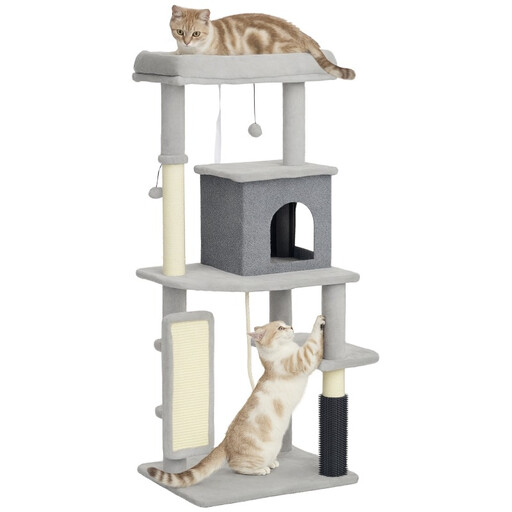
Why it suits this profile: At 132 cm tall, it combines scratching, resting and play without the need for a floor-to-ceiling structure. This makes it an appealing first indoor cat tree.
The product name mentions sisal scratching posts, an anti-tip kit, and a combination of cat bed, condo and jumping platform. Do check that the dimensions suit your cat.
132 cm tall; sisal scratching posts; cat bed, condo, jumping platform, grooming brush and anti-tip kit, according to the product listing.
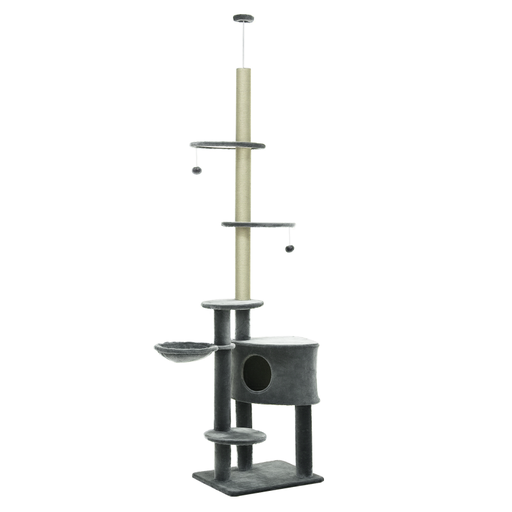
Why it suits this profile: Its adjustable height of 220 to 265 cm is designed for homes with plenty of ceiling height and cats that love to climb. The floor-to-ceiling setup makes good use of vertical space.
The floor-to-ceiling support means it doesn’t rely on a low base alone. Measure the space carefully and follow the assembly instructions before choosing this model.
Adjustable from 220–265 cm; multiple levels; cat cave, hammock and sisal posts, according to the product title.
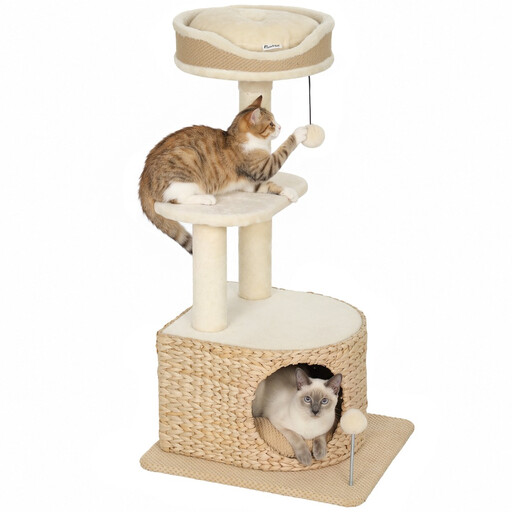
Why it suits this profile: With four levels and a height of 87 cm, this piece of cat furniture suits indoor spaces where you want room for play and rest but can’t fit a tall tower.
The four levels offer a more varied route for play than a single resting platform. Its lower height also means it needs less clearance, but check the base dimensions and weight capacity.
87 cm tall; four levels; jute scratching post; club-shaped cat house, according to the product listing.
We’ve put together a complete, up-to-date list of products that meet these strict selection criteria and the applicable European safety regulations.
Place the cat tree somewhere your cat likes to spend time, such as by a window or in a quiet corner of the living room. Avoid busy walkways where people regularly pass by. On laminate, vinyl or tiled floors, a non-slip layer under the base can help prevent it from sliding, as long as this doesn’t affect stability or assembly.
Check monthly:
A scratching post wears out faster when several cats use the same surface. So, don’t just consider the purchase price; check whether parts can be replaced and how easy the tree is to clean.
It depends on the number of cats, their size and the floor space available. Measure the space and compare it with the model’s base dimensions. For a large cat, wide platforms and a spacious cat house matter more than extra height alone.
Measure the floor-to-ceiling height at several points. Check that there are no skirting boards, beams or sloping ceilings in the way. Assemble the model according to the instructions, then check that the post is secure and stable. If you’re unsure about the surface or assembly, a lower model is often more practical.
Lifespan varies depending on the material, how often it’s used and the number of cats. Sisal and jute can show visible wear with daily scratching. Regular checks will help you see when a post, platform or resting spot needs replacing. A cat tree that stays sturdy and has parts you can maintain is less likely to need replacing altogether before its time.
