
Vandaag of morgen in huis

Kwaliteit gegarandeerd

Welkomstaanbiedingen ontgrendelen: GRATIS bezorging | Tot 80% korting | Gratis 30 dagen JoyPlus-proefperiode
Download de app
A cat scratching post should do more than look good. Your cat wants to scratch, climb, sleep and retreat. At the same time, you want to avoid a post that wobbles, wears out quickly or takes up an inconvenient amount of space. Choosing the wrong model can be a costly mistake, especially if you have large, active or multiple cats.
So don’t focus only on terms such as “luxury”, “extra sturdy” or “for all cats”. Check the dimensions, materials and construction in the product specifications. Below, you’ll find the key points to consider, along with some popular choices for different households.
A tall scratching post or cat climbing tower gives cats an appealing vantage point, but height alone says little about stability. A narrow base plate or lightweight construction can move more easily when your cat jumps enthusiastically. Check the dimensions of the base, the weight of the furniture and whether an anti-tip feature is supplied or recommended.
A scratching post may have several levels, but without enough scratching surface, your cat may continue using the sofa or door frame. With a sisal scratching post, it’s important to check how many posts are covered with sisal, how thick they are and whether they are positioned vertically. Cats often stretch out fully while scratching, so a short post is less practical.
A small cat house or narrow hammock is not automatically suitable for a large cat. Check the stated maximum load, the dimensions of the platforms and the space available in the resting areas. If you have multiple cats, it’s also useful to have several resting zones, so that not every cat has to share the same spot.
First, measure the area where you plan to place the cat tree. Also take account of walking space, windows, doors and radiators. A compact scratching post measuring around 40 to 50 cm high will fit in many flats, while a large scratching post measuring 130 to 172.5 cm offers more opportunities for climbing and looking out.
Pay attention to these measurements:
A model that is 170 cm high does not automatically offer more usable space than a shorter model. The layout, number of platforms and width of the resting areas also matter.
A stable scratching post has a sturdy base, well-fitting connections and sufficient support between the levels. Check whether the manufacturer states a load capacity and how many cats the product is designed for. Product information may, for example, state that a model is suitable for cats weighing up to 7.3 kg or for multiple cats with a specified weight per animal.
Assemble the scratching post according to the instructions. After assembly, check all screws and connections, and repeat this check regularly. With a tall cat tree, securing it to the wall can provide extra reassurance if an anti-tip feature is included. Place the furniture indoors, on a level surface and away from direct heat sources.
Natural wood, sisal and soft upholstery are commonly used. Sisal is suitable as a scratching surface, while fleece or plush is used for covering resting areas. Check whether cushions and hammocks can be removed and washed. This makes it easier to remove hair and stains.
A cat house with fixed upholstery can be more difficult to clean than a model with removable cushions. Also check whether loose toys, ropes or other parts can be replaced. Inspect the sisal covering and attachment points as soon as you notice fraying, tears or loose components.
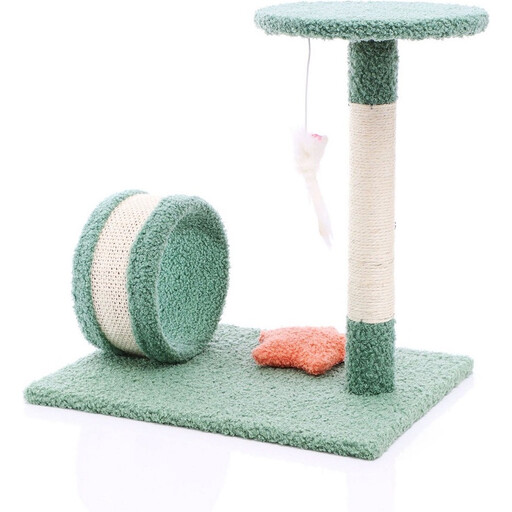
Why it suits this profile: Measuring 40 × 30 × 41 cm, it is suitable for a smaller home or flat, as well as for kittens that mainly need a low-level play and scratching unit.
The product specifications mention a sisal surface, tunnel and toys, so its appeal is not based on appearance alone.
Compact size, three resting areas and an integrated tunnel with toys.
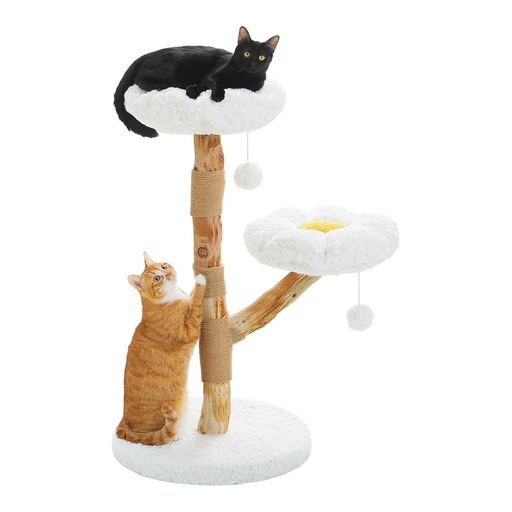
Why it suits this profile: This wooden model combines a modest height with two resting platforms and a design that looks less technical in a modern interior.
The stated double-reinforced base, wooden frame and sisal-wrapped post provide specific information about the construction.
Dimensions of 49 × 49 × 90 cm, natural wood, two platforms and stated suitability for cats weighing up to 7.3 kg.
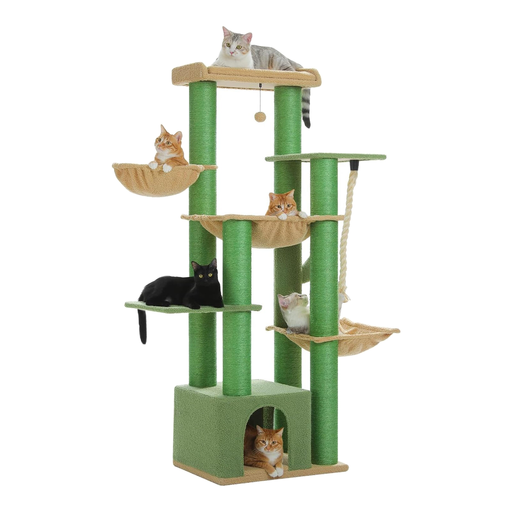
Why it suits this profile: This 170 cm-high cat climbing tower is designed for large and active cats, with multiple levels, hammocks and resting areas.
The specifications list 13 sisal posts with a diameter of 11 cm, making it easy to assess the scratching surface.
Three hammocks, three large seating areas, a cat house and stated suitability for cats weighing up to 10 kg.
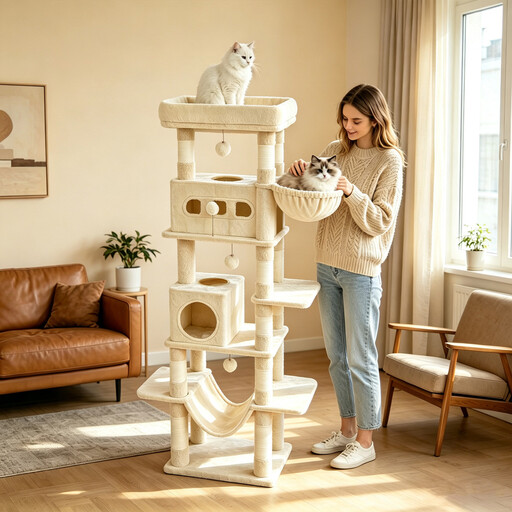
Why it suits this profile: The combination of two hiding spaces, hammocks and a large platform provides separate zones for climbing, resting and retreating.
Eight sisal posts are distributed across the levels, along with a 50 × 30 cm platform. This makes the distribution of space easy to assess.
Six levels, two cat houses, a hammock and removable cushions that are described as washable.
We’ve put together a complete, up-to-date list of products that fully meet these strict selection criteria and the applicable European safety regulations.
Ideally, place a scratching post somewhere your cat already likes to spend time, such as near a window or in the living room. A model placed right in an unused corner may be used less often. A level floor is important for a tall cat tree. On smooth floors, an anti-slip mat can help, provided it does not make the base less stable.
Use a vacuum cleaner or soft brush to remove hair and dust. Washable cushions and hammocks can be cleaned according to the care instructions. Check the following every month:
Stop using the product if any part is damaged or unstable, and replace it before allowing your cat to jump on the post again.
This depends on the available space, your cat’s age and its activity level. A compact scratching post may be sufficient for a kitten or a small home. Large and active cats often benefit more from a tall post with long sisal-covered trunks and wide platforms. Always measure the available height and check the stability of your chosen model.
Its lifespan depends on the number of cats, their weight, how often it is used and how well it is maintained. Intensive scratching causes sisal to wear out more quickly. A model with replaceable parts may remain usable for longer. Regularly tightening connections and replacing damaged parts promptly helps keep the cat tree safe.
Not always. Look at the number of resting areas, the width of the platforms, the number of scratching posts and the stated load capacity. In practice, a scratching post for multiple cats works better when they do not all have to use the same hammock or cat house.
