
Vandaag of morgen in huis

Kwaliteit gegarandeerd

Welkomstaanbiedingen ontgrendelen: GRATIS bezorging | Tot 80% korting | Gratis 30 dagen JoyPlus-proefperiode
Download de app
A cat scratching post should offer more than a sisal column with a soft cushion. Your cat may want to scratch, climb, play and sleep, while you’re after a piece of furniture that doesn’t wobble, won’t wear out quickly and fits the space you have. With an active cat, a large breed or several cats, cheaper models can fall short quickly.
So don’t just look at the colour or number of platforms. These pitfalls are common:
Start by measuring the spot where the scratching post will go. Leave enough space around it and check the ceiling height. A small scratching post of around 40 to 90 cm can work in a flat or next to a cupboard. For active cats, a tall scratching post or climbing tower is more interesting because it allows vertical movement.
For a large cat, don’t just look at the stated maximum weight. Also check:
A product description might say a model is suitable for cats up to 7,3 kg or 10 kg. Treat that as a product spec, not a guarantee that every cat will like the model.
A stable scratching post usually has a wide base, sturdy joints and a construction that isn’t top-heavy. Wall fixing matters for tall models. In the product information for the 206 cm high JOYFURNOS cat tree, the supplied anti-tip kit is recommended. Place a model like this on a flat, solid and preferably non-slip surface.
After assembly, check:
Let kittens, senior cats and very active climbers get used to a new cat tree first. Recheck the construction after the first few weeks.
Sisal is designed to direct scratching to a fixed spot, helping to save your furniture. Look at the amount of sisal and the length of the posts. A cat should be able to stretch while scratching. For a scratching post for large cats, thicker posts are often more practical than slim decorative columns.
Natural wood sections can make the whole thing feel sturdier. Soft fleece or plush upholstery is cosy, but check whether removable cushions or hammocks can be taken out and washed. According to the product information for various models, materials differ by version, for example natural wood sections, sisal rope, polyester plush and metal fittings. Always check the product specs for the variant you choose.
The recommendations below are based on verifiable data such as dimensions, materials, number of levels and the stated suitability. Claims about stability or use come from the relevant product information; always follow the assembly and safety instructions as well.
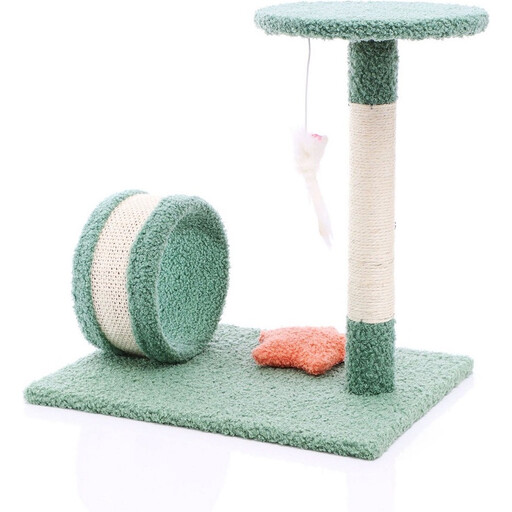
Why it suits this profile: Measuring 40 × 30 × 41 cm, this compact scratching post fits smaller homes and, according to the product information, is suitable for kittens.
The choice is straightforward: a low construction, tunnel and toys without a tall, top-heavy tower. Don’t expect a full climbing tower for large or multiple cats.
Compact size, sisal material, tunnel, toy and three resting spots as per the product specification.
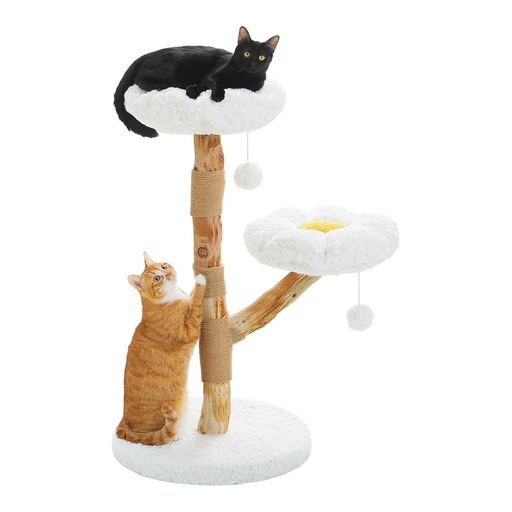
Why it suits this profile: This modern scratching post combines natural wood sections with two flower-shaped resting spots and, according to the product information, is intended for small to medium cats and a maximum of two cats.
The product spec mentions double reinforcement of the base and a weight of 9,2 kg. Still, check the joints regularly after assembly.
Dimensions of 49 × 49 × 90 cm, natural wood, sisal rope and two platforms with soft fleece upholstery.
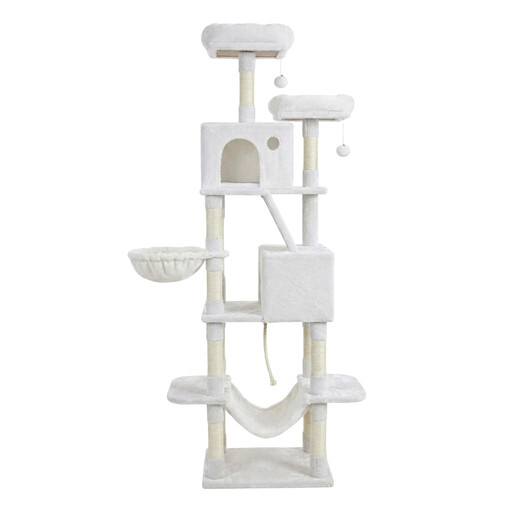
Why it suits this profile: This large scratching post is aimed at active cats and multi-cat households, with two houses, a basket, a hammock and multiple levels.
With 13 sisal posts there’s more designated scratching surface than on a simple model. Due to the height, wall fixing is strongly recommended according to the product information.
206 cm high, 13 sisal posts, two cat houses, a hammock and a stated static total load capacity up to 75 kg.
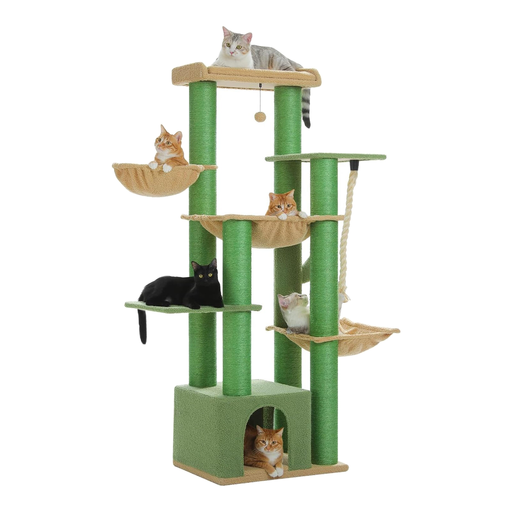
Why it suits this profile: The seven levels, three hammocks, three roomy top perches and the cat house provide different resting and play zones for medium to large cats.
According to the product information, the 13 sisal posts have a diameter of 11 cm. The large base and 25 kg weight are relevant figures, but placing it on a level surface remains essential.
170 cm high, seven levels, sturdy sisal posts and removable, according to the product information washable beds and hammock sections.
We’ve put together a complete, up-to-date list of products that meet these strict selection criteria and current European safety regulations.
Place the scratching post where your cat already likes to be, for example by a window, in the living room or near a piece of furniture that’s been scratched before. A cat scratching unit is less likely to be used if it’s tucked away in a closed-off corner.
For a tall cat tree, use the supplied anti-tip bracket and choose suitable fixings for your wall. Vacuum plush parts regularly and clean removable covers according to the care label. Check sisal rope, screws, baskets and platforms for wear. Replace any damaged part before your cat uses it again.
That depends on your cat and the space available. For kittens or a small home, 41 to 92 cm can be enough. Active and larger cats often make better use of multiple levels and a taller climbing tower. Measure the ceiling height in advance and take wall fixing into account.
Assemble all parts according to the manual, place the base plate on a level surface and retighten screws. For models over 150 cm, wall anchoring is strongly recommended according to the product information. Don’t use a scratching post with parts that are skewed, cracked or coming loose.
Lifespan depends on the number of cats, their weight, scratching behaviour and maintenance. Thick sisal posts and replaceable parts can be practical for intensive use. Check wear regularly rather than relying only on general claims about durability.
