
Vandaag of morgen in huis

Kwaliteit gegarandeerd

Welkomstaanbiedingen ontgrendelen: GRATIS bezorging | Tot 80% korting | Gratis 30 dagen JoyPlus-proefperiode
Download de app
A cat scratching post needs to do more than simply withstand scratching. Your cat will want to stretch, climb, sleep and retreat. At the same time, you will want to avoid a post that starts wobbling after a few weeks, wears out quickly or takes up too much space.
Marketing copy often focuses on the number of levels or a luxurious appearance. That does not always say enough about practical usability. Pay particular attention to these common pitfalls:
First, measure the area where the scratching post will stand. Leave enough space around the post for movement and check whether a socket, window or piece of furniture is in the way.
For a tall scratching post or large cat tree, the following points are relevant:
According to the product information, a model measuring 160 to 170 cm should be placed on a level surface and secured to the wall using the supplied anti-tip kit. This is not an optional decorative step: always follow the assembly instructions and regularly check the screws and joints.
A sisal scratching post supports cats’ natural scratching behaviour. Do not just check whether sisal is included, but also consider:
A scratching post with several well-positioned posts can be more practical in a multi-cat household. Check that the sisal remains firmly attached as it wears. Loose fibres or damaged components should be repaired or replaced.
A compact scratching post for kittens may be sufficient for a kitten. An adult or heavier cat will generally benefit more from a wide resting area, a large bed or a sturdy platform. When choosing a scratching post for large cats, always check:
A scratching post with hammock provides extra resting space, while a scratching post with cat house adds a sheltered area. These features are particularly useful if your cat likes to alternate between having a view and enjoying some privacy.
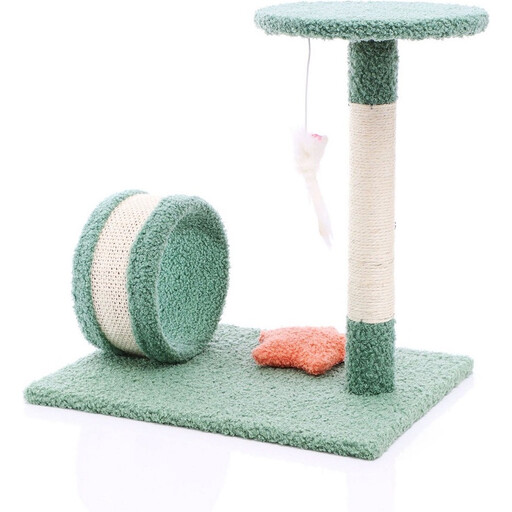
Why it suits this profile: Its compact size makes this scratching post suitable for a smaller home, hallway or quiet corner. According to the product information, this model is suitable for kittens.
The dimensions are clearly stated, allowing you to check in advance whether the model will fit the available space.
40 × 30 × 41 cm, sisal material, tunnel, toys and three resting areas according to the product details.
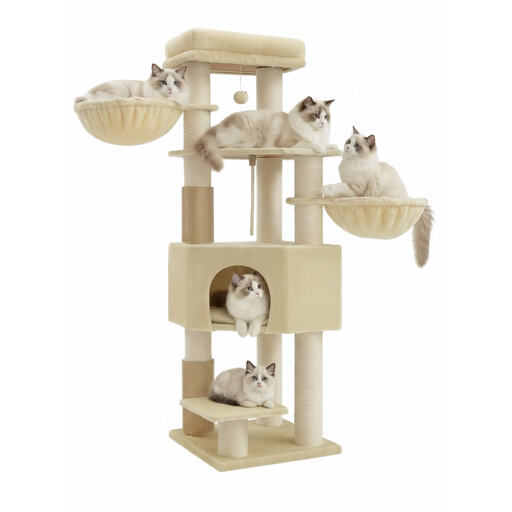
Why it suits this profile: This model combines a tall cat tree with a resting area, cat house, bed and built-in grooming brush. It is ideal for owners looking for several functions in one piece of furniture.
The specifications list nine sisal posts, a reinforced base and an anti-tip kit. According to the warning, it must still be secured to a load-bearing wall.
160 cm high, weighing 22.6 kg, with nine sisal posts, removable mats and a stated maximum static load of 105 kg.
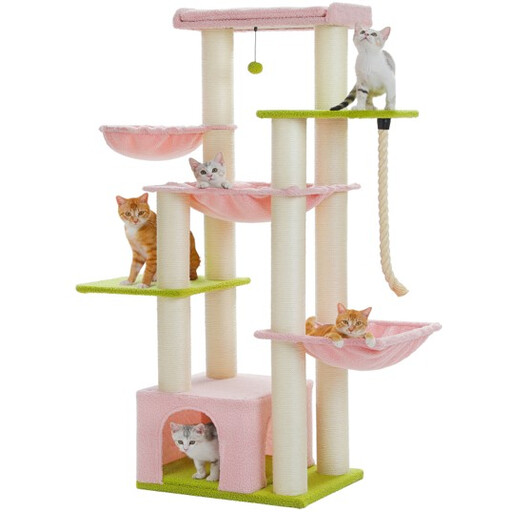
Why it suits this profile: The 7 levels, three hammocks, three elevated resting areas and cat house are designed for active cats and multi-cat households.
Instead of one small scratching post, this model offers 13 sisal posts with a diameter of 11 cm, according to the product description. However, check the available floor and wall space beforehand.
170 cm high, weighing 24 kg, with 13 sisal posts, three hammocks and washable components according to the product information.
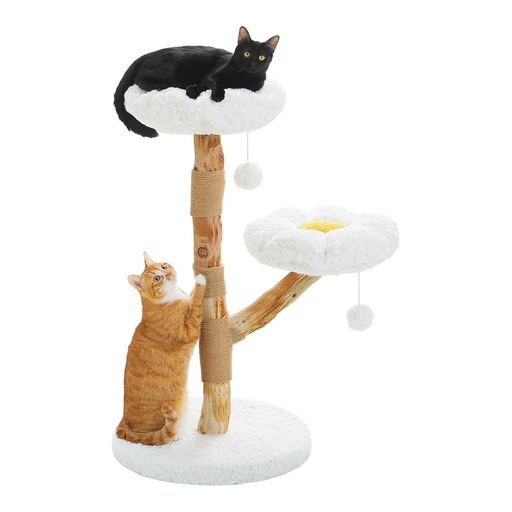
Why it suits this profile: Its height and 49 × 49 cm base make this model a better fit for smaller living spaces, while it still provides two platforms and a sisal post.
The product information mentions a double-reinforced base and a natural wood construction. Proper assembly and checking the joints remain important.
92 cm high, weighing 9.2 kg, with natural wood, sisal and two soft resting platforms; according to the product details, suitable for cats weighing up to 7.3 kg.
We have put together a complete, up-to-date list of products that fully meet these strict selection criteria and the applicable European safety regulations.
Place a large or tall scratching post on a level floor and secure the model to the wall whenever required by the manufacturer. After assembly, give your cat time to get used to the new spot. If necessary, place the post near a favourite sleeping area or close to furniture your cat already scratches.
Check regularly:
Washable cushions and hammocks make everyday care easier. Always follow the washing label and only put components back once they are completely dry.
Do not look only at the overall height. The resting areas need to be wide enough, and the base must provide sufficient stability. Check the recommended weight per cat, the dimensions of the platforms and whether wall mounting is required. For heavy or active cats, a sturdy scratching post with several thick sisal posts is generally more practical than a narrow post.
Its lifespan depends on the material, the number of cats and how intensively it is used. Sisal wears out faster when several cats use the same post every day. Regular vacuuming, securing loose parts and replacing worn components in good time can extend its useful life. A brand’s stated long lifespan is a manufacturer’s claim, not a guarantee for every situation.
Choose a stable spot your cat often visits, such as near a window, sleeping area or piece of furniture that your cat already scratches. Avoid a passageway where the post could be knocked. With a large model, you should also allow for wall mounting and leave enough space around the levels.
