
Vandaag of morgen in huis

Kwaliteit gegarandeerd

Welkomstaanbiedingen ontgrendelen: GRATIS bezorging | Tot 80% korting | Gratis 30 dagen JoyPlus-proefperiode
Download de app
Cat food with fish is popular with Dutch cats, but packaging featuring salmon or tuna does not tell the whole story. Some products are complete meals, while others are intended only as a supplement, treat or source of extra moisture.
As a Joybuy Product Recommendation Officer, I filter product information according to practical criteria. This helps you see more quickly which option suits your cat and prevents you from paying for marketing language that says little about the ingredients.
A recipe may prominently feature a type of fish on the front of the pack, while the ingredients list states, for example, just 4% salmon or tuna. Felix Delicious Fish Strips lists 4% of the named fish species for each variant. The base also includes ingredients such as meat and animal derivatives, vegetable protein extracts and oils.
That is why you should always check the full ingredients list. Ingredients are generally listed in descending order by weight. The name of a flavour is therefore not the same as the proportion of fish.
Cat broth, soup and fish-based cat treats often contain plenty of moisture, but they are not always suitable as a main food. According to the product information, INABA Churu Cat Tuna is a complementary pet food. Felix Soup Fish is also intended as a supplement to a complete food.
A product labelled complete cat food is designed to be given as daily food for the stated life stage. If in doubt, check the legal product name on the packaging.
A cat food multipack can be useful for households with several cats, but pay attention to the shelf life and storage time after opening. An opened tin or pouch usually needs to be stored in the fridge and used within the period stated on the label. For a cat that eats little, smaller portions such as 50 grams or 85 grams can help reduce waste.
This is the first thing to check. Choose complete wet cat food or complete dry food if the product will form the basis of your cat’s daily diet. Give snacks, broths and soups alongside their usual food.
Examples:
Look for terms such as cat food for adult cats, junior or kitten. Kittens have different nutritional needs from adult cats. Only give kitten food when this is clearly stated on the packaging.
Also check the feeding guidelines for your cat’s weight. The recommended amount is a starting point; activity levels, age, neutering and the combination of wet and dry food all affect the daily portion.
Wet cat food generally contains considerably more moisture than dry food. The products listed show this difference clearly:
A high moisture content does not automatically make a product suitable as a complete food. With complementary food, you still need to combine it with a complete meal. Texture also plays a part: mousse, pâté, pieces in sauce, jelly and kibble appeal to different cats.
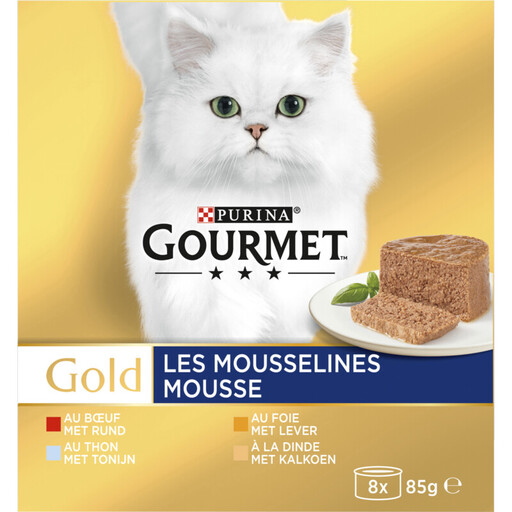
Why it suits this profile: The pack contains 8 tins of 85 grams and several flavours. This makes it practical for discovering your cat’s preferences without immediately buying a large quantity of one variant.
The product information clearly states that this is complete food for adult cats. The fish content is specified for each variant, so you do not have to rely solely on the front of the pack.
Mousse texture, a stated moisture content of 77.5% and 85-gram portions. The feeding guide recommends 2 to 3 tins per day for a cat weighing around 4 kg.
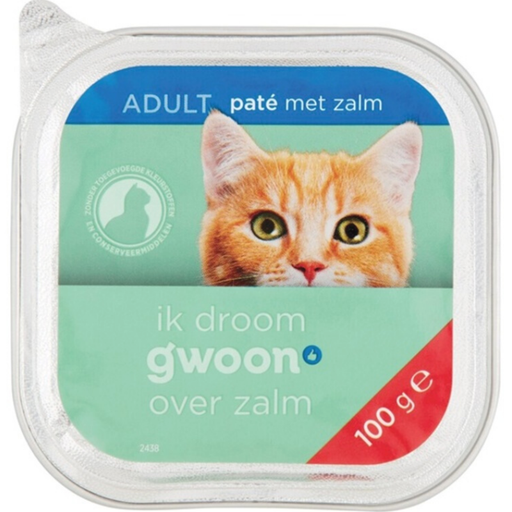
Why it suits this profile: The product description lists salmon as the first ingredient and describes a soft pâté texture. This suits cats that prefer finely textured, smooth food.
The pack contains one 100-gram portion and is intended for adult cats. Always check the current ingredients list and nutritional values on the label.
Soft pâté, 100 grams per tin and, according to the product information, suitable as complete food for adult cats.
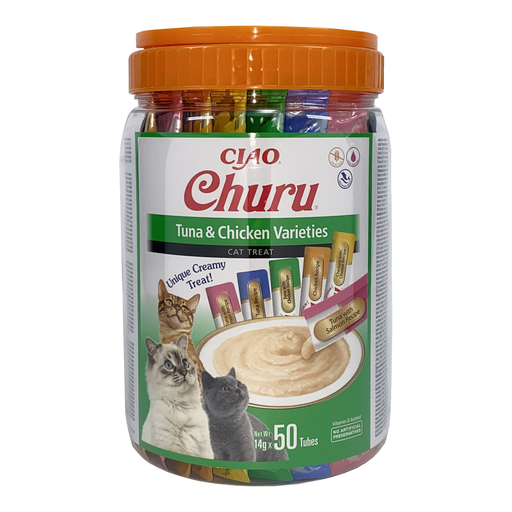
Why it suits this profile: This multipack of 50 tubes is aimed at cat owners who often want to give their cat a small reward, topper or complementary product.
The product information explicitly describes this as a complementary cat treat. This makes it clear that it is not intended to replace your cat’s daily main meal.
A stated moisture content of 91%, 6 calories per treat according to the product details, and 50 tubes of 12 grams.
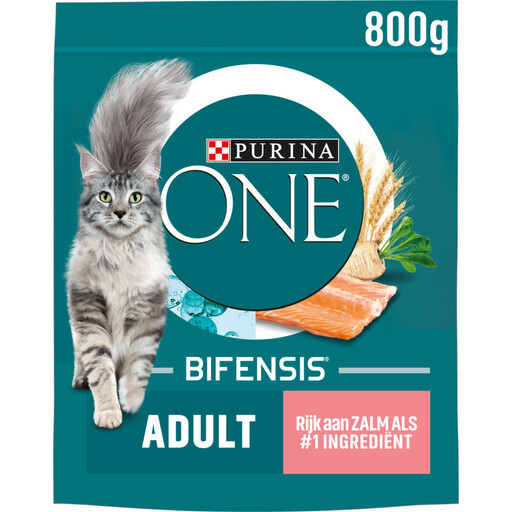
Why it suits this profile: Dry food is easy to portion and store. According to the product description, this variant is intended for adult cats from one year of age.
The life stage and product format are clearly stated. As dry food contains little moisture, fresh drinking water should always be available.
800-gram pack, salmon as the stated main ingredient and a complete formula for adult cats according to the product information.
We have put together a complete, up-to-date list of products that fully meet these strict selection criteria and the applicable European safety regulations.
Not automatically. Check the life stage, ingredients and any known sensitivities. A cat that has previously reacted badly to fish may need a different protein source. If symptoms persist, it is advisable to consult a vet.
That depends on your cat’s preference, the feeding guidelines and how you feed them. Wet food generally contains more moisture and is available as mousse, pâté, sauce or jelly. Dry food lasts longer after opening and is easy to weigh out. A combination can be practical, as long as you keep an eye on the total daily amount.
Always follow the label for the product in question. Many opened portions need to be covered, stored in the fridge and used within 24 to 48 hours. Ideally, serve wet food at room temperature and throw away leftovers that have been left in the bowl for too long. Keep dry food sealed in a cool, dry place to preserve its flavour and quality.
