
Vandaag of morgen in huis

Kwaliteit gegarandeerd

Welkomstaanbiedingen ontgrendelen: GRATIS bezorging | Tot 80% korting | Gratis 30 dagen JoyPlus-proefperiode
Download de app
A cast-iron Dutch oven is suitable for braising, roasting, soups and one-pot dishes. However, not every pan is equally practical. A heavy pan that does not fit your hob, a lid that retains heat poorly or an unclear enamel finish can quickly turn into a disappointing purchase.
This buying guide compares materials, dimensions, capacity, maintenance and everyday use. You will also find several popular options for different households.
A 4-litre pan may hold less food than expected because of its round shape and the clearance recommended during cooking. For a household of three to four people, around 3.8 to 4.2 litres is often practical for stews. If you like to cook ahead, it is better to consider a capacity of 6 litres or more.
Also pay attention to the difference between diameter and capacity. A 24 cm Dutch oven may hold 3.8 litres, 4.2 litres or another volume, depending on its height and shape.
An induction-compatible Dutch oven must have a flat, magnetic base. Also check whether both the pan and lid are oven-safe. The lid knob in particular may determine the maximum oven temperature.
Review the specific product details for every model. Do not rely solely on broad terms such as Dutch oven, cast-iron casserole or casserole pot.
An enameled cast-iron Dutch oven generally does not require seasoning, but its coating can still be damaged by metal utensils, abrasive sponges or sudden changes in temperature. An enameled pan is also different from an untreated cast-iron pot, which must be dried carefully after use and may occasionally need to be re-seasoned with oil.
Cast iron retains heat for a long time and is well suited to slow cooking. This makes it useful as a cast-iron stew pot, soup and stew pot or Dutch oven for braising dishes.
With enameled cast iron, the interior is covered with a glass-like coating. According to the product descriptions of various brands, this layer is intended to make cleaning easier and limit contact with the base material. Always check whether the manufacturer specifies the interior coating, colour and care instructions.
An untreated pan, such as the pure-iron wok included in the COOKER KING set, requires a different approach. According to the product description, this wok must be seasoned with oil before first use and dried immediately after washing to help prevent rust.
Use this guideline as a starting point:
A 20 cm Dutch oven is easier to lift than a 28 cm model, but provides less room for browning ingredients. Also check the weight: the product details list the 24 cm Le Creuset model at 4.305 kg, while the 28 cm model weighs 6.125 kg.
Before buying, check:
Product information varies by model. For example, the 20 cm Le Creuset Signature Round Casserole is described as suitable for all hobs, including induction, as well as for oven use. The 24 cm Le Creuset pan, on the other hand, is listed as not dishwasher-safe. The 24 cm Alpina enameled cast-iron casserole is described as dishwasher-safe. Always check the current product specifications on the product page.
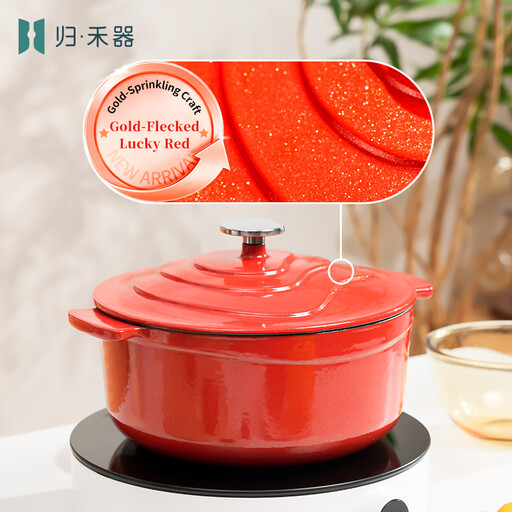
Why it fits: A compact size for smaller households, soups, porridge and simple stews. The product name specifies induction compatibility.
The stated 3.3-litre capacity prevents you from judging the pan by diameter alone. Check the current oven and dishwasher specifications before buying.
Enameled cast iron, a flat base according to the product description and a capacity suited to everyday portions.
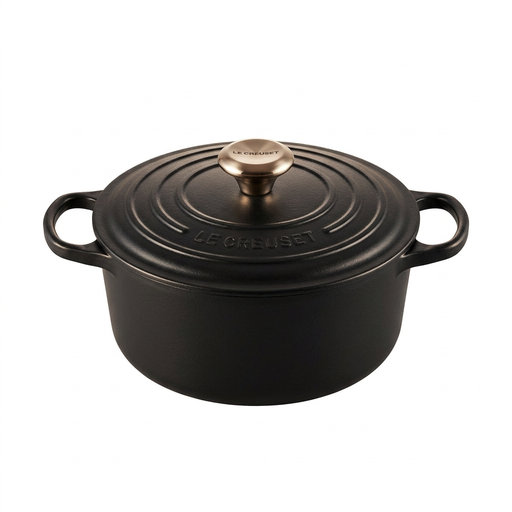
Why it fits: The stated 4.2-litre capacity is suitable for family meals and stews containing larger cuts of meat.
The product information explicitly mentions induction, oven use and an enameled finish. According to the listing, the pan is not dishwasher-safe.
4.2-litre capacity, lid included and a stated minimum two-year statutory EU warranty.
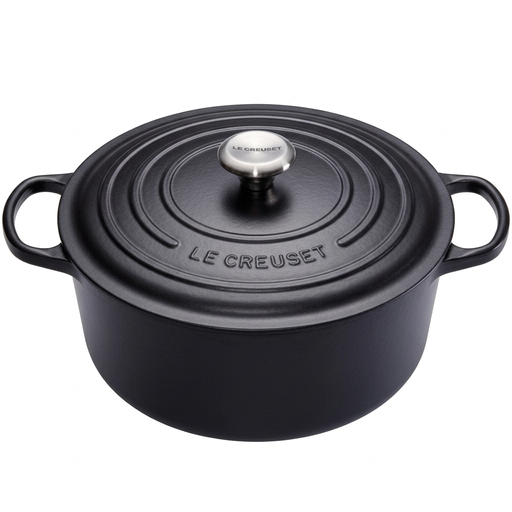
Why it fits: With a stated capacity of 6.7 litres, this Dutch oven provides ample room for large batches of soup, stews and multiple portions.
Both the diameter and capacity are specified, making it easier to estimate the usable space. Keep the listed weight of 6.125 kg in mind.
6.7-litre capacity, lid included and, according to the product description, compatibility with induction and other heat sources.
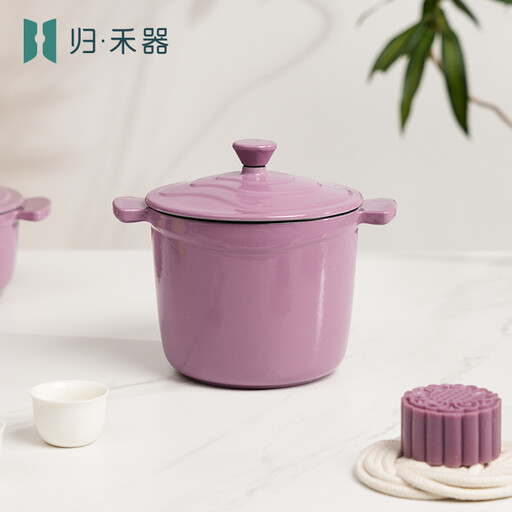
Why it fits: According to the product name, its compact size is intended for one person, porridge, soup and small portions.
The 1.3-litre capacity makes clear that this is not a family-sized pan, helping you avoid choosing a pan that is too small for several diners.
14 cm diameter, 1.3-litre capacity and induction compatibility according to the product name.
Browse a current selection of cast-iron Dutch ovens and compare dimensions, materials, heat sources and care instructions.
Allow a hot pan to cool gradually before filling it with water. Use warm water, a mild dishwashing liquid and a soft sponge. Avoid metal utensils when the interior is enameled. Dry the pan thoroughly, paying particular attention to the rim and the lid contact points.
With an untreated cast-iron pan, seasoning is part of regular maintenance. A Dutch oven with lid can also be heavy; lift it with both hands and use oven gloves when placing it in the oven.
It can be, but check the product specifications. A flat magnetic base and an explicit mention of induction compatibility are important indicators. The product descriptions of several models mentioned above specify induction compatibility, but always verify this for the exact version.
For one to three people, 20 or 22 cm is often sufficient. For a family, 24 cm and approximately 4 litres is a practical choice. If you regularly prepare large quantities of soup or stew, consider a 28 cm model with a capacity of around 6.7 litres.
Its lifespan depends on use, temperature and maintenance. Avoid thermal shock, heating the pan while empty and abrasive materials. Before buying, also check the warranty terms and retain the product information.
