
Portion-conscious snackers
You want to snack on cashews while studying or moving without treating the whole pack as one portion. Check the nutritional information and weigh out the amount you want to eat.


Plain cashews are not a low-calorie snack: the Netherlands Nutrition Centre lists 154 kcal for a 25 g handful of unsalted cashews. To keep the energy in your snack in check, weigh your portion and compare products on the same basis, such as kcal per 100 g. Also check the added salt, how the cashews are prepared and how much you can store properly in your room.
You want to snack on cashews while studying or moving without treating the whole pack as one portion. Check the nutritional information and weigh out the amount you want to eat.
You’re looking for nuts with no added salt and want to know whether they’re unroasted, fried or oven-roasted. The ingredients list and preparation method will tell you more than the word ‘unsalted’ alone.
You want to choose a pack that suits how you use cashews and can be stored in a cool, dry place in a tightly sealed container. A larger quantity is practical if you have enough space and will use it in time.
Suitable if: you want an unseasoned option and prefer unroasted nuts.
Bear in mind: PLUS lists 598 KC of energy per 100 g for the unroasted, unsalted variety reviewed; unroasted does not mean low in calories. The Netherlands Nutrition Centre recommends unroasted or lightly roasted nuts.
Suitable if: you want fried cashews with no added salt.
Bear in mind: the AH and Jumbo varieties reviewed both list 622 kcal per 100 g, or 155,5 kcal per 25 g. Their product information lists sunflower oil, so ‘unsalted’ does not mean a product is unroasted.
Suitable if: you prefer a savoury flavour and take salt content into account.
Bear in mind: Duyvis Oven Roasted Salted Cashews lists 586 kcal and 0,92 g of salt per 100 g. That works out at 146,5 kcal per 25 g for this variety, but it does not prove that oven-roasting generally results in lower energy content.
| What to consider | What to look for | Who it matters to |
|---|---|---|
| Portion and energy | Compare kcal per 100 g, then calculate the kcal in your weighed portion: value per 100 g × portion weight ÷ 100. | If I want a measured snack while studying, I check the nutritional information and weigh my portion; around 38% of consumers make portion size and energy content their top buying priority. |
| Salt and preparation | Check the ingredients, salt per 100 g and whether the nuts are unroasted, fried or roasted. | If I want to avoid added salt but also make an informed choice about how the nuts are prepared, I check both details; around 23% of consumers prioritise these points. |
| Pack size | Compare the net weight with the amount you expect to use; pack weight is not the same as portion size. | If I’m stocking up for my student room, I want to choose an amount that suits how I use cashews; around 23% of consumers make quantity their top buying priority. |
| Storage after opening | Follow the storage instructions on the pack and check that you can keep the contents in a cool, dry place in a tightly sealed container. | If I have limited suitable storage space, I check whether I can seal an opened pack properly; around 16% of consumers make storage and available space their top buying priority. |
An unsalted variety is not automatically low in calories. The Netherlands Nutrition Centre lists 154 kcal for a 25 g handful of unsalted cashews.
Choose a portion that suits how much you want to eat, and use the nutritional information on the pack for a specific variety.
The Duyvis pack reviewed contains 125 g, while the AH pack reviewed lists a portion size of 25 g. Pack weight and portion size are therefore not the same.
Weigh your portion and seal the rest according to the storage instructions.
The AH and Jumbo unsalted varieties reviewed contain sunflower oil. The term ‘unsalted’ does not, in itself, describe how the nuts are prepared.
Read the preparation details and ingredients as well as checking the salt content.
The packs reviewed come in different weights, and nuts should be stored in a cool, dry place in a tightly sealed container.
Choose a size that suits how much you expect to use, and check that you can store the opened pack properly.
The varieties reviewed include Cashews Original and Oven Roasted Salted Cashews.
The AH Unsalted Cashew Nuts reviewed are available in a 170 g pack.
The variety reviewed is Jumbo Unsalted Cashew Nuts 200 g.
Lidl has a Dutch product page for unsalted cashews.
The ALDI product page reviewed describes Trader Joe’s Roasted and Unsalted Cashew Nuts 250 g.
The variety reviewed is PLUS Unsalted, Unroasted Cashew Nuts 200 g.
These products offer a range of cashew varieties, so you can compare nutritional values, salt content and pack information to help you choose.
 Image unavailable
An option to consider if you want to calculate the energy in a portion you weigh out yourself.
The ingredients list states 100% cashew kernels.
Energy: 604 kcal per 100 g.
Once opened, store in a sealed pack in a cool, dry place.
 Image unavailable
A good fit if you’re looking for an oven-roasted cashew variety with a savoury flavour.
Energy: 586 kcal per 100 g.
Salt: 0,92 g per 100 g; this is not an unsalted variety.
The product information recommends sealing the pack tightly after opening.
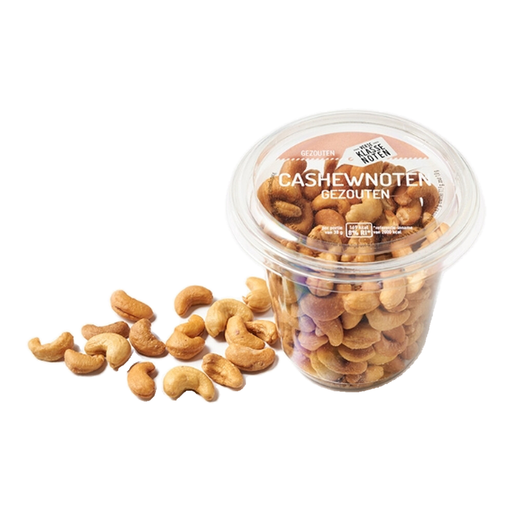 Image unavailable
An option to compare if you’re keeping an eye on energy and salt content.
Energy: 2555 kJ per 100 g.
Salt: 0,9 g per 100 g.
 Image unavailable
A good fit if you’re looking for a roasted variety with no added salt.
Energy: 596 kcal per 100 g.
Salt: 0,067 g per 100 g; the ingredients list states cashew nuts.
Once opened, store in a tightly sealed pack in a cool, dry place.
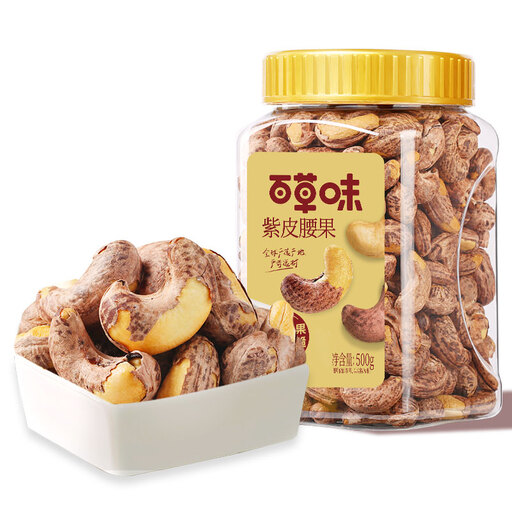 Image unavailable
A larger pack to consider if you can store the contents in a cool, dry place in a tightly sealed container.
Energy: 679 kcal per 100 g.
Salt: 1,2 g per 100 g.
For solid foods, the European Commission sets a maximum of 40 kcal (170 kJ) per 100 g for the ‘low energy’ claim. A small portion or the absence of added salt does not make ordinary cashews low in calories. This limit is a condition for making a nutrition claim, not a recommended maximum snack portion.
Multiply the nutritional value per 100 g by the weight of your portion, then divide by 100. For example, 25 g of a product with 622 kcal per 100 g provides 155,5 kcal. Jumbo’s product information lists this energy value; nutritional values are average figures, as explained by the European Union’s Your Europe website.
The Netherlands Nutrition Centre recommends storing nuts in a cool, dry place in a tightly sealed container, ideally at 10 to 15 °C; refrigeration is not generally required. Follow the storage instructions on your pack, too. For the Duyvis pack reviewed, once opened, storage in a light- and airtight container is recommended.
Before sharing, check the ingredients and allergen information on the specific pack. The products reviewed contain cashews, and some state that other allergens may be present. The NVWA requires allergenic substances to be clearly listed on the label; ‘unsalted’ or ‘unroasted’ tells you nothing about whether allergens are present.
The NVWA warning dated 20 May 2026 concerns Trader Joe’s unsalted cashew nuts, 170 g, with barcode 2003020120930 and best-before date 23-09-2026, due to possible metal particles: do not eat them. The best-before date has passed, but that does not make the warning irrelevant if you still have a pack. The warning does not automatically apply to other pack sizes or batches.