
Those who regularly portion up lunches
You regularly portion out cashews at home for school lunches and want to choose an amount that suits how much you use and how you store your supplies. A large bag is most practical if you’ll use all of it.


A larger bag is handy if you use the contents regularly and can store them properly; the size alone doesn’t automatically make a pack suitable. Before buying, check whether cashews are allowed under the school’s rules and any individual allergy requirements. Then compare the ingredients, preparation method and pack size.
You regularly portion out cashews at home for school lunches and want to choose an amount that suits how much you use and how you store your supplies. A large bag is most practical if you’ll use all of it.
You might be looking for an unsalted option and want to know what unroasted, roasted or oil-prepared means for the ingredients. The packaging gives you more information than a preparation term on the front alone.
You need to take account of a relevant allergy, school rules on allergens or the conditions in which a child eats. These requirements may mean that cashews shouldn’t be taken in, whatever the packaging.
First, check whether cashews are allowed and suitable. Then consider which pack size and ingredients suit your household, and how you’ll store an opened bag.
| Buying question | What should you check? | Who is this relevant to? |
|---|---|---|
| Safety and school rules | Check the rules for your school or class, as well as the allergen information on the packaging. | If there’s an allergy or a nut-free rule, I want to know first whether cashews are allowed; around 29% of consumers put safety and school rules first. |
| Amount for home use | Compare the net weight with how much you’ll actually portion out and use. | If I’m considering a larger pack, I don’t want more in stock than we can use; around 29% of consumers focus on choosing an appropriate amount. |
| Ingredients and preparation | Read the ingredients list and distinguish between unroasted, roasted and salted cashews. | When I’m looking for a particular composition, I want to be able to check it on the label; around 21% of consumers prioritise ingredients and preparation. |
| Storage after opening | Check how the packaging seals and follow the storage advice on the label. | If I portion out supplies at home, I want to be able to seal and store the rest properly; around 21% of consumers focus on stock and storage. |
Unsalted cashews still contain cashews. If there’s a relevant allergy, the ingredients and individual allergy advice are important; you should also check school rules separately.
First decide whether cashews are allowed and suitable. Only then consider the pack size and preparation method.
A larger amount can make portioning at home easier, but only if you’ll use and store it properly. A large bag isn’t the same as individually sealed portions.
Choose a pack size that suits how much you use, and think about how you’ll seal the bag after opening it.
Duyvis describes Cashews Original as oven-roasted without added oil. That doesn’t, by itself, mean that a salted cashew variety contains no salt.
Check the preparation method, ingredients list and salt information separately on the packaging of the variety you’re buying.
Nuts should be kept dry and in a well-sealed container or bag. A large bag therefore needs to be properly resealed after you’ve portioned some out.
Follow the storage advice on the packaging and seal the bag securely after use.
Duyvis offers oven-roasted flavours; the salted cashew variety reviewed comes in a smaller pack.
Albert Heijn lists both smaller packs of unsalted cashews and a 500 g AH Terra unroasted variety in its category overview.
Jumbo offers a 500 g value pack of unsalted cashews for households that want to portion them out at home.
Lidl lists a 500 g pack of unsalted cashews.
Under its Trader Joe’s brand, ALDI sells roasted, unsalted cashews in a 250 g pack, among other products.
PLUS offers a 200 g pack of unroasted, unsalted cashews.
This selection of Joybuy products includes larger and smaller packs for anyone who wants to portion out cashews at home. Check the pack size, preparation and salt information for each variety.
 No image available
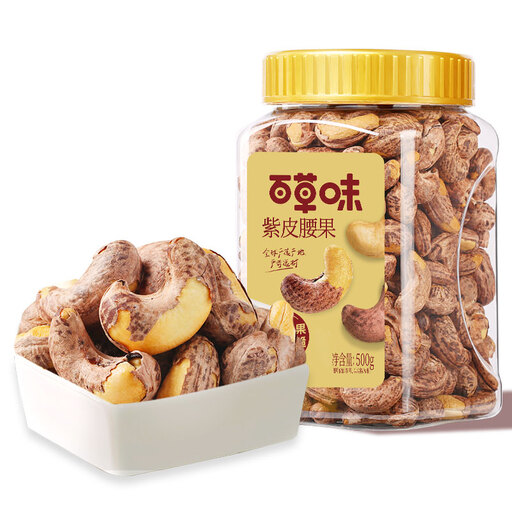
The 500 g pack may suit you if you want a larger amount to portion out at home.
The product description lists 99% cashews and 0.9 g of salt per 100 g. This is a salted variety made with whole cashews.
Contains cashews; check allergy requirements and school rules before packing them for lunch.
 No image available
The 500 g pack may suit you if you want to portion out this amount at home.
The product description lists cashew kernels and 1.2 g of salt per 100 g. This is a lightly salted variety.
Contains cashews; check allergy requirements and school rules before packing them for lunch.
 No image available
The 160 g pack is a smaller amount to portion out at home.
The product description lists cashew kernels as the only ingredient and 0.028 g of salt per 100 g.
Contains cashews; check allergy requirements and school rules before packing them for lunch.
 No image available
The 200 g pack may suit you if you’re looking for a smaller amount of unsalted cashews.
The product description lists cashews as the only ingredient. The title describes the variety as roasted and unsalted.
Contains cashews; check allergy requirements and school rules before packing them for lunch.
 No image available
The 125 g pack is a smaller option if you’re looking for a salted, roasted variety.
The product description lists 98% cashews and 0.92 g of salt per 100 g. The ingredients list also includes a savoury seasoning mix and a stabiliser.
Contains cashews; check allergy requirements and school rules before packing them for lunch.
Not automatically: check the rules for your child’s school or class. If there’s a nut-free rule, choosing unsalted cashews isn’t a way around it.
According to the Netherlands Food and Consumer Product Safety Authority, allergen information for pre-packed products must appear on the label. Nuts and peanuts are among the 14 allergen groups that must be declared under European Regulation 1169/2011. This requirement to provide information doesn’t guarantee that a product is safe for a particular person with an allergy.
Not without considering the circumstances: older children can choke too. Amsterdam UMC recommends nut butter rather than whole nuts for children under 4, and advises eating calmly at the table with an adult present as a precaution. Also consider whether the school setting is suitable.
Keep nuts dry and in a well-sealed container or bag, and follow the advice on the packaging. Jumbo recommends storing them somewhere cool, dry and dark; Albert Heijn says to reseal the packaging securely after use. Instructions can vary between products.
No. On 20 May 2026, the Netherlands Food and Consumer Product Safety Authority warned consumers about 170 g packs of Trader Joe’s unsalted cashews with barcode 2003020120930 and best-before date 23-09-2026 because they may contain metal fragments. Do not eat that specific product; the warning doesn’t automatically apply to other pack sizes or batches.