Cashews are only suitable for a school lunch if they fit your dietary requirements and are allowed at school. If you need to avoid cashews or your school has a nut-free policy, don’t pack them. Albert Heijn labels its 170 g variety as gluten-free and lactose-free, but it contains cashews and may contain peanuts and other nuts. Unsalted, vegan or made without added oil does not mean nut-free. The Voedingscentrum recommends unsalted nuts as a snack, but that doesn’t change allergy or school requirements.
Who should bear these points in mind?
School lunches with dietary and school requirements
If you need to take an allergy or school rule into account, first check whether cashews are allowed. The Netherlands Food and Consumer Product Safety Authority points out that allergen information must appear on the label of pre-packed products.
An unsalted snack for break time
If you’re mainly looking for an unsalted option for break time, compare the ingredients and salt information. The Voedingscentrum recommends unsalted nuts as a snack, but that doesn’t automatically make them suitable for every diet or every school.
Packing your own lunchbox
If you want to divide a pack into portions or store it, check the pack size and the storage instructions after opening. Product and packaging details can vary between varieties.
What should you look for when choosing?
First, work out which ingredient you need to avoid and whether cashews are allowed at school. Then compare the variety, packaging and flavour.
| What to consider |
What should you look for? |
Who is this important for? |
| Diet and school rules |
Check whether cashews are allowed and read the allergen information and warnings on the packaging. |
If cashews don’t fit my dietary requirements or the school rules, I’ll choose something else; around 31% of consumers put dietary and school suitability first. |
| Specific free-from claim |
Look for the claim that matches your needs, and assess the ingredients and allergens separately. |
For example, I might look for a variety labelled gluten-free or lactose-free and check exactly what that means; around 25% of consumers prioritise this specific dietary feature. |
| Unsalted or savoury |
Check whether the variety is unsalted and compare the salt content per 100 g. |
If I want to take a snack to school more often, I mainly look for an unsalted variety; around 19% of consumers prioritise this use. |
| Packaging and storage |
Check the pack size and follow the storage instructions after opening. |
If I want to portion or store the contents myself, I check the packaging and instructions; around 13% of consumers prioritise lunchbox convenience. |
| Flavour and preparation |
Compare unroasted, roasted or seasoned varieties, and check the ingredients in the one you choose. |
If I’m mainly looking for a savoury flavour, I check which herbs, spices and other ingredients are listed; around 12% of consumers prioritise flavour and ingredients. |
Common mistakes
-
Assuming ‘gluten-free’ means ‘nut-free’
Albert Heijn labels its 170 g cashew variety as gluten-free and lactose-free, but the product contains cashews and may contain peanuts and other nuts. The claim does not mean that the product is free from nuts.
Make a note of the ingredient you need to avoid, then check the ingredients and allergen information for the exact variety.
-
Confusing vegan or made without added oil with suitable for your diet
A vegan claim or preparation without added oil says nothing by itself about the possible presence of wheat, peanuts or other nuts. Duyvis states that these ingredients may be present in the savoury variety in question.
Assess dietary claims, ingredients and allergen warnings as separate pieces of information.
-
Assuming a short ingredients list rules out cross-contamination
PLUS lists cashews as an ingredient in its unsalted, unroasted variety and warns that the product may contain peanuts.
Read the warning alongside the ingredients list and compare it with the specific allergen you need to avoid.
Brands and varieties to consider
Albert Heijn
The 170 g AH Unsalted Cashews variety is worth considering if you’re specifically looking for gluten-free and lactose-free claims and can eat cashews.
- Albert Heijn labels it gluten-free and lactose-free; according to the product information, the ingredients are 96% cashews and sunflower oil.
- The variety contains cashews and may contain peanuts and other nuts. This applies to this variety, not necessarily the entire range.
PLUS
PLUS Unsalted Unroasted Cashews 200 g is an option if you’re looking for an unsalted, unroasted variety.
- The product information lists cashews as an ingredient.
- PLUS warns that the variety may contain peanuts. A short ingredients list doesn’t prove that accidental presence is impossible, so check the packaging.
Jumbo
Jumbo Unsalted Cashews 200 g is an unsalted variety made with sunflower oil.
- For this variety, Jumbo lists 99% cashews and 0.02 g of salt per 100 g.
- The product information warns that the cashews may contain other nuts and peanuts. ‘Unsalted’ in the product name is not a free-from claim.
Duyvis
Duyvis Oven Roasted Salted Cashews 125 g may suit you if you prefer a savoury, seasoned variety.
- According to the manufacturer, the Original cashews are roasted without added oil.
- For the savoury variety, Duyvis lists 1.5 g of salt per 100 g and says it may contain wheat, peanuts and other nuts. Made without added oil does not mean unsalted or gluten-free.
Lidl
Lidl lists Alesto and specifically refers to Way To Go cashews.
- Lidl describes Way To Go as Fairtrade.
- A Fairtrade claim doesn’t tell you whether a product is suitable for an allergy or other dietary requirement; check the information for the variety you choose.
ALDI
ALDI lists Trader Joe’s roasted, unsalted cashews in a 250 g pack.
- The product name tells you how the cashews are prepared and the pack size.
- Unsalted is not an allergen claim. Check the ingredients and allergen information on the specific pack.
Cashews at Joybuy
The products below are cashew varieties for a school break where cashews are allowed. Their titles distinguish between unsalted and salted options, among other things; they are not suitable choices for someone with a cashew allergy or at a school that does not allow nuts.
 Image unavailable
Jiazhouyuanye Original Flavour Large cashew nuts, 160 g
An option for a break where cashews are allowed; the product title lists a 160 g pack.
View at Joybuy
 Image unavailable
g'woon roasted unsalted cashew nuts, 200 g
If you can eat cashews and are looking for an unsalted option, the product title lists roasted, unsalted cashew nuts in a 200 g pack.
View at Joybuy
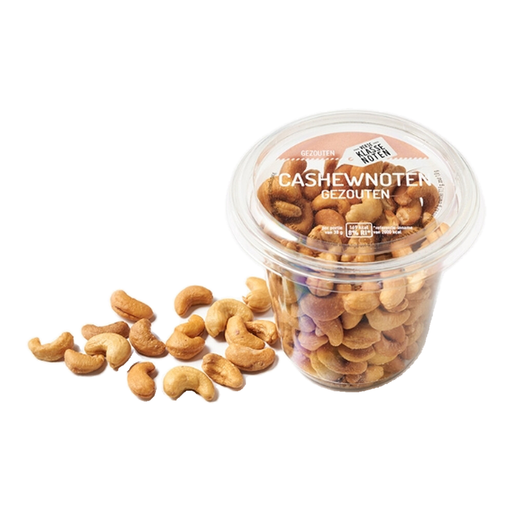 Image unavailable
Verse Klassenoten salted cashew nuts, 150 g
If salted cashews fit your diet, the product title lists a 150 g pack.
The product information lists added salt.
View at Joybuy
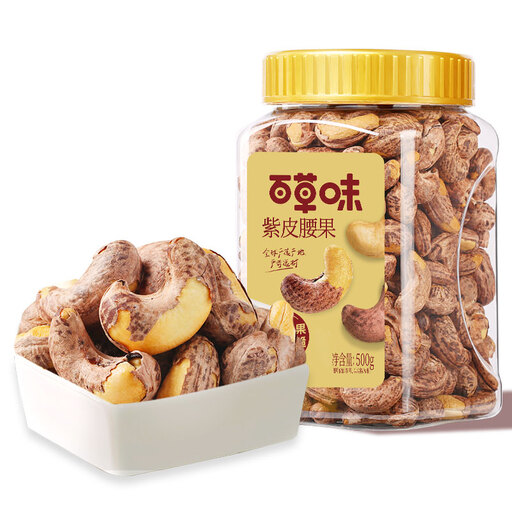 Image unavailable
Be&Cheery cashew nuts with purple skin, 180 grade, 500 g
For a break where cashews are allowed; the product title lists a 500 g pack and the 180 grade.
The product information lists added salt.
View at Joybuy
Frequently asked questions
Are gluten-free cashews also nut-free?
No. Albert Heijn labels its 170 g cashew variety as gluten-free, but the product contains cashews and may contain peanuts and other nuts. The gluten-free claim says nothing about whether the product contains nuts.
Does lactose-free mean suitable for someone with a cow’s milk allergy?
No. Lactose is milk sugar; a cow’s milk allergy involves milk proteins. So check for milk ingredients and relevant warnings, not just the lactose-free claim.
Can I take cashews to secondary school?
Ask about your school’s current rules and the area where you eat. If there’s a nut-free policy, don’t take cashews with you. Zorgeloos naar school recommends discussing allergy arrangements with parents and the school.
What does ‘may contain peanuts’ mean on packaging?
It warns that peanuts may be accidentally present; it doesn’t mean that peanuts have been added as an ingredient. The NVWA states that rules have applied since 1 January 2026 on how and when food businesses should give precautionary allergen warnings. The NVWA lists ‘May contain X’ and ‘Not suitable for people with an X allergy’ among the permitted wordings.
Which ALDI cashews are covered by the NVWA warning?
The NVWA warning issued on 20 May 2026 applies only to Trader Joe’s unsalted cashews, 170 g, with barcode 2003020120930 and best-before date 23-09-2026. The NVWA reported possible metal particles and advised people not to eat these cashews. The warning does not automatically apply to other ALDI packs or batches.


