
Portion-conscious hosts
You want to serve cashews while still being able to work out the energy in your own weighed portion.


If you want to enjoy cashews with your Friday afternoon drinks while keeping an eye on calories, weigh your portion and use the energy value per 100 g shown on the pack. The Netherlands Nutrition Centre gives 154 kcal per 25 g for unsalted cashews. Unsalted, unroasted or roasted doesn’t automatically mean low in calories. Choose unsalted if you want to avoid added salt, and compare the nutritional values of the specific varieties.
You want to serve cashews while still being able to work out the energy in your own weighed portion.
You’re looking for a clearly labelled unsalted variety and don’t want to mistake it for a lower-calorie product.
You match the pack size, preparation method and allergen information to what you’re serving others.
A good fit if: you’re specifically looking for these two characteristics and want to weigh your own portion.
Consider: unroasted and unsalted, on their own, tell you nothing about the energy per 100 g.
A good fit if: you want to choose a roasted variety with no added salt.
Consider: check the energy value on the pack; roasting isn’t a low-calorie claim.
A good fit if: you’re choosing a salted variety intentionally and want to weigh your portion.
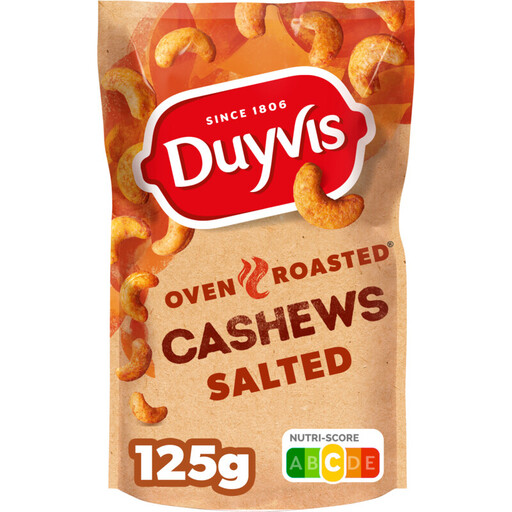
Consider: Flink lists 604 kcal per 100 g for the specific Duyvis Oven Roasted Salted variety; it isn’t a low-calorie option.
First compare the energy per 100 g, then work out how much is in your weighed portion. The Netherlands Nutrition Centre gives 154 kcal per 25 g of unsalted cashews; this is a general reference, not the nutritional value of every pack.
| What to consider | What to look for | Who it matters to |
|---|---|---|
| Calories per portion | Weigh the amount and use the kcal per 100 g shown on the pack. Using the Netherlands Nutrition Centre’s general reference, 15 g works out at 92.4 kcal. | If I want to limit how much I eat with my drinks, I look at the energy in my weighed portion. Around 42% of consumers prioritise calories per portion. |
| Added salt | Check whether the variety is described as unsalted and look at the salt per 100 g too. Unsalted doesn’t necessarily mean salt-free; the Netherlands Nutrition Centre lists 0.01 g of salt per 25 g for the general unsalted variety. | If I want to avoid added salt, I look specifically for an unsalted variety. Around 25% of consumers prioritise this choice. |
| Preparation method | Read the variety name and ingredients list. PLUS describes an unroasted variety, while ALDI lists a roasted one; neither preparation term replaces the nutrition table. | If the preparation method determines my first choice, I check whether the pack says unroasted or roasted. Around 17% of consumers mainly choose based on preparation method. |
| Pack size | Compare the net weight with the amount you want to serve. Examples include 200 g at PLUS and 250 g at ALDI; a bag isn’t automatically one portion. | If I’m buying for a group, I want to be able to divide the contents without serving more than planned. Around 16% of consumers mainly consider quantity and pack size. |
These descriptions don’t prove that a product has a low energy value. For solid foods, the European Commission only allows a claim such as ‘low calorie’ at a maximum of 40 kcal (170 kJ) per 100 g. Flink lists 604 kcal per 100 g for the specific Duyvis Oven Roasted Salted variety.
Compare the energy per 100 g, then work out the value for your own portion. Don’t treat a preparation description as a calorie claim.
A lower value for a smaller portion doesn’t mean a product contains less energy per 100 g.
First compare the values per 100 g, then convert the varieties to the same portion weight of your choice.
200 g or 250 g packs may contain several portions. The pack and the amount you serve aren’t the same thing.
Decide in advance how much you want to serve, then follow the storage instructions on the pack for the rest.
Without weighing portions in advance, you may serve or eat more than you intended.
Duyvis describes Cashews Original as oven-roasted with no added oil.
Albert Heijn lists its own-brand Cashew Nuts Unsalted variety.
Jumbo lists Cashew Nuts Unsalted in a 200 g pack.
Lidl lists the Way To Go! Cashew Nuts Unsalted variety.
ALDI lists TRADER JOE'S roasted and unsalted Cashew Nuts in a 250 g pack.
PLUS lists Cashew Nuts Unsalted Unroasted in a 200 g bag.
These product choices help you compare energy per 100 g, pack size, and salt or preparation variety.
 No image available
A good choice if you want to weigh your portion and are looking for a product with cashew kernels as its only ingredient.
The product description lists 2526 kJ per 100 g and a pack size of 160 g.
Contains cashew kernels; check the allergen information if you’re serving them to others.
 No image available
A good choice if you’re looking for an oven-roasted variety and want to work out your portion using the nutritional information.
The product description lists 2437 kJ per 100 g and says no fats or oils have been added.
The description lists cashew, gluten, wheat and peanuts as allergens; check the current packaging if you’re serving others.
 No image available
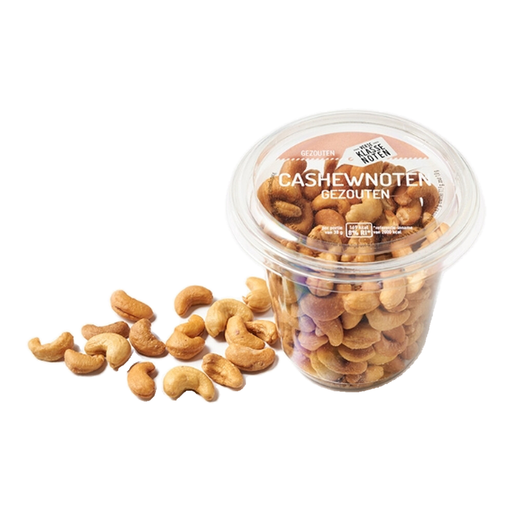
A good choice if you deliberately want to serve a salted variety and weigh the portion yourself.
The product description lists 2555 kJ per 100 g and a pack size of 150 g.
The ingredients include sunflower oil and salt. Check the current packaging for allergen information.
 No image available
A good choice if you’re looking for roasted cashews with no added salt and want to weigh your portion.
The product description lists 2496 kJ per 100 g and a pack size of 200 g.
Contains cashews; check the allergen information on the current packaging if you’re serving them to others.
 No image available
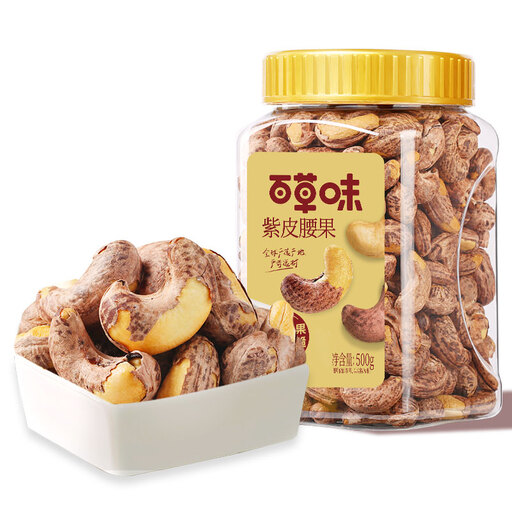
A good choice if you’re looking for a larger pack so you can divide the contents into weighed portions.
The product description lists 2839 kJ and 1.2 g of salt per 100 g, with a pack size of 500 g.
Contains cashews; check the allergen information on the current packaging if you’re serving them to others.
For solid foods, the European Commission sets a maximum of 40 kcal (170 kJ) per 100 g for a ‘low calorie’ claim. A smaller portion doesn’t change the energy per 100 g, so compare the nutritional value of the specific pack.
Multiply the kcal per 100 g shown on your pack by the portion weight in grams, then divide by 100. This lets you compare the amount you’re serving without directly comparing portions of different sizes.
No. ‘Unsalted’ describes the salt variety and doesn’t prove a lower calorie content. Choose this variety if you want to avoid added salt, and compare the nutritional value per 100 g to check calories.
Check the ingredients and allergen warnings on the packaging of the exact variety you’re serving. The NVWA says allergen information must also be available for unpackaged products in hospitality and catering; this business requirement doesn’t automatically apply to a private gathering at home.
No. NOS reported in May 2026 on 170 g packs of TRADER JOE'S unsalted cashews with a best-before date of 23 September 2026. The notice doesn’t provide evidence about all ALDI varieties, and a past best-before date doesn’t prove that a potentially affected product is safe.