Who is this relevant to?

If you want to compare total fat

You want to compare the total fat content of picnic snacks and distinguish between nutritional information, unsalted products and those made without added oil. The Netherlands Nutrition Centre explains how to compare nutrition labels.

If you plan your portion in advance

You want to know how many cashews you’ll take with you and eat, without needing a special nutrition claim. Compare the pack size with the amount you weigh out for yourself.

If you’re sharing cashews

You’re buying for several people and want to consider allergens, warnings about young children and how to store an opened pack. The NVWA explains which allergen information must appear on pre-packed products.

What should you look for when choosing?

Consideration What should you check? Who is this important for?
Total fat Compare the fat content in g per 100 g for the exact product, and check what a reduced-fat claim is based on. If your main concern is comparing total fat, use the same basis for comparison on the label. Around 46% of consumers give total fat the highest priority.
Portion size Check the net weight and nutritional information per 100 g, then weigh out separately how much you’ll take on your picnic. If you want to decide in advance how much you’ll eat, weighing your portion helps you see it separately from the whole bag. Around 27% of consumers prioritise portion control.
Salt and oil Read the ingredients list and compare the salt content in g per 100 g; unsalted does not tell you whether oil has been added. If you want to limit added salt or oil, check both separately. Around 18% of consumers put this at the top of their shopping priorities.
Taking them along and sharing Check the allergens, warnings about young children, and the storage and resealing instructions on the pack. If you’re sharing the bag, you’ll want to know what’s in it and how to store the rest. Around 9% of consumers put safe sharing and carrying at the top of their list.

Common mistakes

  • Assuming no added oil means low in fat

    The AH product page for Duyvis Oven roasted cashews salted lists 43 g of fat per 100 g. Preparing cashews without added oil does not remove the fat naturally present in the nut.

    Compare total fat per 100 g, and don’t treat ‘made without added oil’ as a synonym for low-fat. For solid foods, the European Commission sets a maximum of 3 g of fat per 100 g for a ‘low-fat’ claim.

  • Confusing unsalted with oil-free

    The AH Unsalted Cashews reviewed contain sunflower oil. So ‘unsalted’ does not automatically describe the ingredients or the total fat content.

    Read the ingredients list if you specifically want to avoid added oil, and check the salt and total fat content separately.

  • Comparing a portion with a whole bag

    Nutritional information per 100 g and the amount you eat answer different questions. With a large pack, you could easily take more than you need for your planned portions without realising it.

    Compare nutritional information per 100 g, then weigh out the amount you’ll take on your picnic separately.

Brands and varieties to compare

Duyvis

Duyvis describes Cashews Original as oven-roasted without added oil. This may be relevant if you’re choosing based on how the cashews are prepared.

  • The AH product page for Duyvis Oven roasted cashews salted lists 43 g of fat and 0.92 g of salt per 100 g.
  • Made without added oil does not mean low-fat or unsalted. Original and Sea Salt are different varieties.

Albert Heijn

The AH Unsalted Cashews reviewed are a roasted option for anyone looking to avoid added salt.

  • The product page lists 0 g of salt per 100 g.
  • The same variety contains sunflower oil and lists 50 g of fat per 100 g. This does not mean the whole range is low-fat.

Jumbo

Jumbo lists several preparation methods in its cashew range, including unroasted and dry-roasted varieties.

  • The preparation method and exact pack are useful details to check on the product label.
  • The product page for the 100 g Fairtrade pack says it is no longer part of the online range, so it is not a current purchase recommendation.

Lidl

Lidl has a product page for unsalted cashews.

  • The product name indicates that this is an unsalted variety.
  • Unsalted does not prove a lower fat content and, by itself, tells you nothing about other varieties.

ALDI

ALDI lists Trader Joe’s roasted, unsalted cashews in a 250 g pack.

  • The product page lists the preparation method, the unsalted variety and the pack size.
  • Unsalted does not mean reduced-fat. An NVWA warning applies to a specific 170 g pack and batch; see the frequently asked questions.

PLUS

PLUS Unsalted Unroasted Cashews, 200 g, may suit anyone looking for an unroasted variety with cashews as the only ingredient.

  • PLUS lists cashews as the only ingredient.
  • The product page lists 46.5 g of fat per 100 g and says the product may contain peanuts. A simple ingredients list does not make it low-fat.

Cashews at Joybuy

These Joybuy products are standard cashews with different preparation methods, salt levels and pack sizes; they are not described as reduced-fat varieties. Compare the fat per 100 g, then choose based on the ingredients and how much you want to take with you.

Duyvis Dry Roasted Cashews, 125 g

Duyvis Dry Roasted Cashews, 125 g

The description says they are oven-roasted without added oil. This is a preparation detail, not an indication that the total fat content is low.

43 g of fat and 0.92 g of salt per 100 g; net weight 125 g. The description says there are 4–5 servings per pack.

The ingredients information lists cashews, wheat and peanuts as allergens.

View at Joybuy
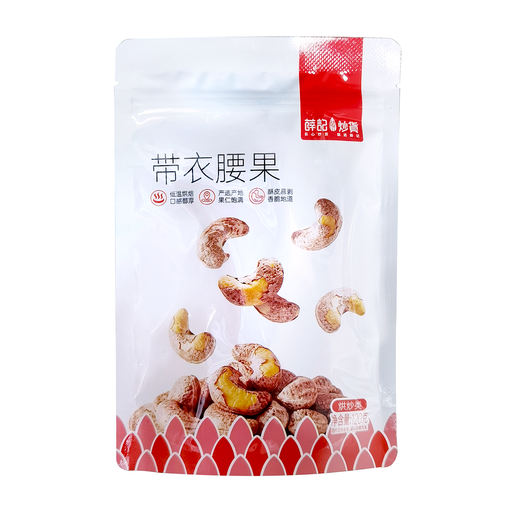
Xue Ji Chaohuo Salted Cashews with Skin, 120 g

Xue Ji Chaohuo Salted Cashews with Skin, 120 g

According to the product description, the 120 g pack is ready to serve. Check how much you want to take with you on your picnic.

42.9 g of fat and 0.9 g of salt per 100 g. The ingredients are cashews and salt.

View at Joybuy

g'woon Roasted & Unsalted Cashews, 200 g

g'woon Roasted & Unsalted Cashews, 200 g

This roasted, unsalted variety may suit you if you want to limit added salt; check the label for the exact nutritional information.

46.67 g of fat and 0.067 g of salt per 100 g. The ingredients list contains only cashews; the pack contains 200 g.

View at Joybuy

Jiazhouyuanye Original Flavour Large Cashew Nuts, 160 g

Jiazhouyuanye Original Flavour Large Cashew Nuts, 160 g

The product description says the cashew kernels are ready to eat; the pack contains 160 g.

47.7 g of fat and 0.028 g of salt per 100 g. The ingredients list says 100% cashew kernels.

The description says to store in a cool, dry place and reseal the pack after opening.

View at Joybuy
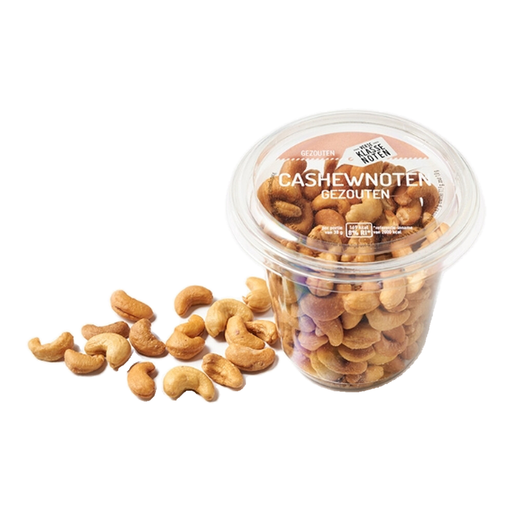
Verse Klassenoten Salted Cashew Nuts, 150 g

Verse Klassenoten Salted Cashew Nuts, 150 g

This salted variety contains sunflower oil; check the ingredients if you want to avoid added oil.

48 g of fat and 1.0 g of salt per 100 g. The pack contains 150 g.

The description says to store in a cool, dry place and close the pack after opening.

View at Joybuy

Frequently asked questions

When can cashews be called ‘low-fat’?

For solid foods, the European Commission sets a maximum of 3 g of fat per 100 g for a ‘low-fat’ claim. This is a condition for making the claim, not a recommended daily amount. The Netherlands Bakery Centre describes ‘reduced content’ as meaning at least 30% less of the relevant nutrient than in comparable products; this industry guidance does not amount to approval of a specific cashew variety.

Do unsalted cashews automatically contain less fat?

No. ‘Unsalted’ alone tells you nothing about the total fat content. The Netherlands Nutrition Centre’s general nutritional information lists 12.2 g of fat per 25 g handful for both salted and unsalted cashews. When choosing a product, always compare the labels of the exact varieties.

How do I compare a portion with the nutritional information on the pack?

First compare the nutritional information per 100 g, then weigh out the amount you want to take with you. The Netherlands Nutrition Centre uses 25 g as an example of a handful in its general cashew nutrition information; this should not be taken as personal dietary advice.

What should I check if I’m sharing cashews?

Check the ingredients and allergens on the original packaging, and consider the people who’ll be eating them. The NVWA says that allergen information must appear on pre-packed products. AH and PLUS also warn that young children may choke on nuts in the products reviewed.

Which ALDI cashews were covered by the NVWA warning?

The NVWA warning dated 20 May 2026 concerns 170 g packs of Trader Joe’s unsalted cashews, barcode 2003020120930, with a best-before date of 23-09-2026, due to possible metal fragments. Do not eat a pack matching these details. The warning applies to this specific pack and batch, not all ALDI cashews.
