
Walkers who want to eat less fat
You want to snack on less fat or a smaller amount during a leisurely walk. Compare the nutritional values per 100 g, and consider portion size separately from product features such as being unsalted or oven-roasted.


If you want to eat less fat while out walking, compare the fat content per 100 g or take a smaller portion with you. Unsalted or made without added oil doesn’t automatically mean low in fat. Among the varieties reviewed, the Duyvis option contains less fat per 100 g than the PLUS and Jumbo options mentioned, but more salt. A smaller portion doesn’t change the product’s nutritional composition, but it does limit how much you eat.
You want to snack on less fat or a smaller amount during a leisurely walk. Compare the nutritional values per 100 g, and consider portion size separately from product features such as being unsalted or oven-roasted.
You want to choose a snack that suits your own tolerance during exercise. The Netherlands Nutrition Centre advises against eating large portions or foods high in fat, protein or fibre just before exercising. How this applies to walking depends on factors including timing, intensity and your own experience.
You may buy a larger pack and weigh out an amount to take with you. Check the serving information and follow the storage instructions, such as resealing the pack properly after use.
First decide whether you mainly want to manage the nutritional composition, the amount you eat, your comfort during exercise, or how you carry and store your snack. These choices can work together, but a smaller portion doesn’t make the nuts themselves lower in fat.
| What to consider | What should you check? | Who is this important for? |
|---|---|---|
| Fat per 100 g | Compare the same quantity on the label. The Duyvis variety reviewed lists 43 g of fat per 100 g, compared with 46.5 g for PLUS and 48.6 g for Jumbo; product details are available from Albert Heijn, PLUS and Jumbo. | If you mainly want less fat for the same amount, compare the exact varieties and weigh this against other values on the label. Around 42% of consumers prioritise product composition. |
| Portion size | Decide how much to take with you; AH lists a 25 g serving for the pack reviewed. This is product information, not a standard walking portion for everyone. | If you don’t want to mindlessly treat a large pack as a walking portion, weighing out a serving in advance can help. Around 25% of consumers prioritise portion control. |
| Stomach comfort | Consider portion size and timing, as well as fat, protein and fibre. The Netherlands Nutrition Centre’s advice relates to eating around exercise and doesn’t specify a cashew portion for walking. | If a large snack doesn’t agree with you just before exercise, choose what suits your own experience and the type of walk. Around 17% of consumers prioritise stomach comfort during exercise. |
| Taking with you and storage | Check the net weight and follow the storage and resealing instructions. For the AH pack reviewed, the instructions are to store in a cool, dark and dry place and reseal properly after use. | If you often take small amounts with you, you’ll want to be able to store and portion the rest properly at home. Around 16% of consumers prioritise convenience for taking snacks with them and storing them. |
For solid foods, the European Commission sets a maximum of 3 g of fat per 100 g for the ‘low fat’ nutrition claim. The Duyvis, PLUS and Jumbo varieties mentioned are all well above this limit. So having a lower fat content than another variety doesn’t mean a product meets the limit.
Fat and salt are separate considerations: the Duyvis variety mentioned lists 0.92 g of salt per 100 g, while PLUS lists 0.07 g and Jumbo 0.02 g. Choosing an unsalted product doesn’t, by itself, tell you how much fat it contains.
The method of preparation or salt content doesn’t tell you whether a product is low in fat. All the Duyvis, PLUS and Jumbo varieties reviewed list more than 3 g of fat per 100 g.
Check the nutritional information for the exact variety and assess fat, salt and portion size separately. For solid foods, the European Commission sets a maximum of 3 g of fat per 100 g for the ‘low fat’ claim.
The AH pack reviewed contains 500 g and lists a serving size of 25 g. The amount in the pack and the amount you eat while out and about are two different things.
Decide in advance how much you want to take with you, and follow the storage instructions for the rest. Don’t treat the listed serving as a fixed limit for every walk or exercise session.
When it comes to eating around exercise, the Netherlands Nutrition Centre also highlights portion size, protein, fibre and timing. This doesn’t mean that every walker will have trouble tolerating cashews.
Pay attention to your own experience and when you eat, especially just before more intense exercise.
Worth comparing if you’re looking for an oven-roasted cashew variety.
The 500 g unsalted pack reviewed lists a serving size.
The unsalted variety reviewed provides a point of comparison for fat and salt per 100 g.
The variety reviewed is unsalted and unroasted.
The product page reviewed confirms an unsalted variety.
The product page reviewed lists Trader Joe’s roasted, unsalted cashews in a 250 g pack.
These products offer a range of cashew varieties to compare by nutritional values per 100 g, salt content and pack size.
 No image available
Useful for comparison if you’re checking fat per 100 g; the product information lists 43 g of fat and 0.92 g of salt per 100 g.
The product information lists 4–5 servings per pack.
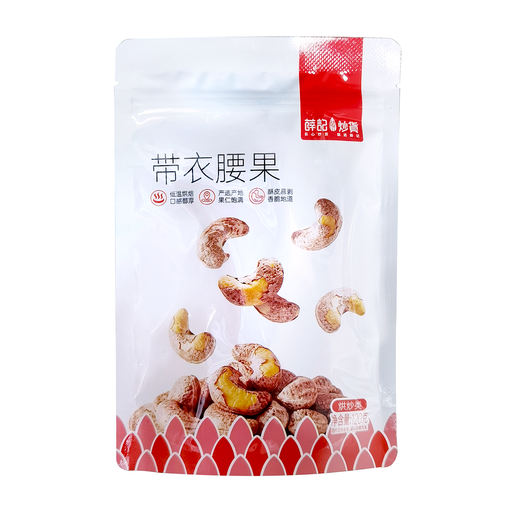 No image available
A packaged variety to compare if you want to check fat and salt for the same quantity.
The product information lists 42.9 g of fat and 0.9 g of salt per 100 g. The pack contains 120 g.
 No image available
Suitable if you want to compare a variety with no added salt; the ingredients list cashew kernels as the sole ingredient.
The nutritional information lists 47.7 g of fat and 0.028 g of salt per 100 g. The pack contains 160 g.
 No image available
An unsalted, roasted variety to compare with other labels if fat per 100 g matters to you.
The nutritional information lists 46.67 g of fat and 0.067 g of salt per 100 g.
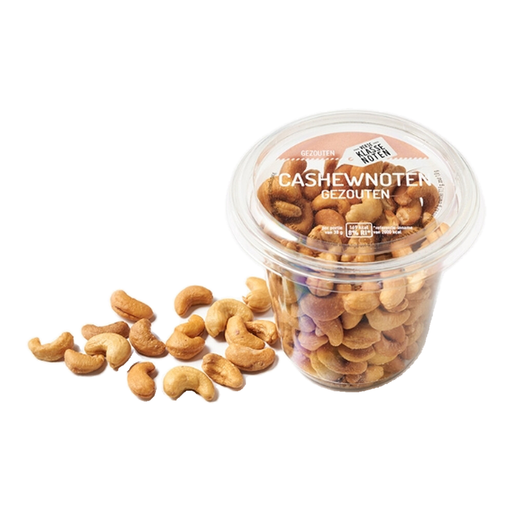 No image available
Useful for comparing the amounts of fat and salt per 100 g side by side.
The ingredients information lists 98% cashews, sunflower oil and 1% salt. The nutritional information lists 48 g of fat and 1.0 g of salt per 100 g.
No. Being unsalted doesn’t, by itself, tell you anything about the fat content. The Netherlands Nutrition Centre lists 12.2 g of fat per 25 g handful of plain unsalted cashews; this is a general nutritional value, not the figure for every brand. For solid foods, the European Commission sets a maximum of 3 g of fat per 100 g for the ‘low fat’ claim.
Decide in advance how much you want to take with you, then reseal the pack properly. For the AH pack reviewed, the instructions are to store it in a cool, dark and dry place and reseal it properly after use. The listed 25 g serving is product information, not a fixed amount for every walk.
Not necessarily: a product serving isn’t a complete fuelling plan for exercise. The Netherlands Nutrition Centre discusses different needs for prolonged, intense exercise and shorter workouts; this doesn’t mean that every long, gentle walk requires a larger portion of cashews.
Check the allergen information for the exact variety. The products mentioned contain cashews; information about the possible presence of other nuts, peanuts or wheat can vary by product. Roasting doesn’t make nut allergens harmless.
No. The NVWA warning dated 20 May 2026 concerns 170 g packs of Trader Joe’s unsalted cashews with barcode 2003020120930 and best-before date 23-09-2026. That date has passed; do not eat any pack still at home that matches these details. The warning doesn’t automatically apply to other packs or batches.