
You’re looking for genuinely less fat
Compare the fat content per 100 g and check exactly what claim appears on the pack. ‘Unsalted’ and ‘no added oil’ describe different characteristics and don’t, in themselves, prove that the fat content is lower.


Don’t choose based solely on ‘unsalted’ or ‘no added oil’: compare the nutrition table and decide whether you want less fat per 100 g, fewer calories per portion or less salt. For solid foods, the European Commission defines the ‘low fat’ claim as a maximum of 3 g of fat per 100 g; a particular preparation method alone does not prove that the fat content is lower. Weighing out a portion in advance gives you a specific amount to compare with the nutrition information on your pack.
Compare the fat content per 100 g and check exactly what claim appears on the pack. ‘Unsalted’ and ‘no added oil’ describe different characteristics and don’t, in themselves, prove that the fat content is lower.
Weigh the amount you want to serve and use the nutrition information per 100 g on your pack to work out the portion. The Voedingscentrum lists 154 kcal for a typical 25 g handful of unsalted cashews; this isn’t a product-specific figure.
Check both the salt content and the ingredients. Unroasted and oil-fried varieties may be prepared differently; neither description proves that the product is low in fat.
First decide whether you’re mainly looking for less fat in the nuts themselves, fewer calories in your portion or a different salt and flavour profile. Then compare the nutrition information per 100 g and choose an amount that suits what you want to serve.
| What to consider | What should you check? | Who is this more important to? |
|---|---|---|
| Fat content and claims | Read the exact nutrition claim and compare total fat per 100 g. No added oil doesn’t mean less total fat. | If reducing fat is my top priority, I want to compare the fat content and understand what a claim is based on. Around 36% of consumers put reducing fat first when choosing what to buy. |
| Calories per portion | Check the calories per 100 g, weigh your portion and calculate using the nutrition information on your pack. | If I want to know how many calories are in my movie-night bowl, I weigh the portion and use the product information. Around 29% of consumers put this priority first. |
| Salt and flavour | Read the salt content and ingredients, including any flavourings and oil. | If I want to avoid added salt, I also check whether oil has been used; ‘unsalted’ tells me nothing about that. Salt and flavour are top priorities for around 21% of consumers. |
| Packaging and storage | Check the net weight and follow the storage advice on the pack once opened. | If I want to keep leftovers, I consider the amount and whether I can reseal the pack after use. Packaging and storage are the top priority for around 14% of consumers. |
The AH product page lists sunflower oil for AH Unsalted Cashews, along with 50 g of fat per 100 g. So the product name ‘unsalted’ doesn’t automatically tell you how the cashews were prepared or how much fat they contain.
Check the ingredients, total fat and salt as separate characteristics.
Duyvis describes Cashews Original as oven-roasted with no added oil. In itself, this doesn’t mean that the total fat content is lower.
Choose this preparation method if it suits your preferences, but assess fat claims using the nutrition information and the claim on the pack.
The AH Unsalted Cashews pack contains 170 g; the product page lists a portion size of 25 g. So the amount you eat may be different from the portion shown as an example on the pack.
Weigh out the amount you want in advance and calculate using the nutrition information for that pack.
The NVWA warning issued on 20 May 2026 concerns 170 g packs of Trader Joe’s unsalted cashews with barcode 2003020120930 and best-before date 23-09-2026, due to the possible presence of metal fragments.
If you have a pack at home, check the product name, barcode and best-before date. Do not eat the specific batch covered by the warning.
Duyvis describes Cashews Original as oven-roasted with no added oil and savoury flavourings.
Albert Heijn lists both unsalted cashews fried in oil and organic unroasted cashews.
Jumbo Unroasted Cashews lists 100% cashew nuts as its ingredient.
Lidl’s product name, ‘Unsalted cashews’, suits shoppers choosing based on salt content.
The ALDI product listing names Trader Joe’s roasted, unsalted cashews in a 250 g pack.
PLUS Unsalted Unroasted Cashews lists only cashews as an ingredient.
These Joybuy products show a range of cashew varieties, preparation methods and salt options. Compare the nutrition information per 100 g, and don’t treat roasting or ‘unsalted’ as proof that the fat content is lower.
 No image available
A straightforward cashew option if you’re mainly interested in the ingredients.
The ingredients list states 100% cashew kernels. The nutrition table lists 47.7 g of fat and 604 kcal per 100 g.
 No image available
A good fit if you’re looking for roasted cashews with no added oil; this doesn’t prove a reduced-fat claim.
The product description says the cashews are oven-roasted without added fats or oil, and that the pack contains 4–5 portions. The nutrition table lists 43 g of fat and 586 kcal per 100 g.
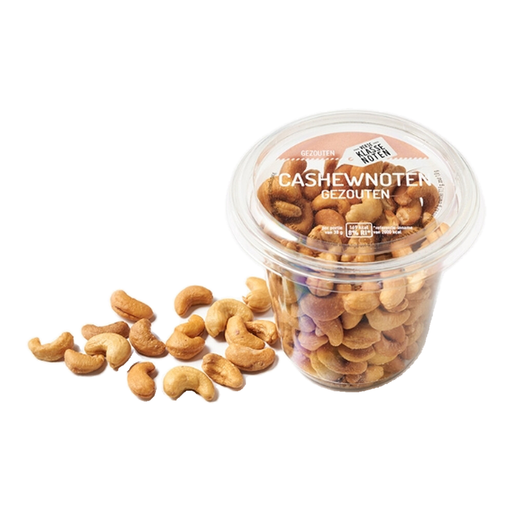 No image available
A good fit if you’re looking for salted cashews and want to compare the ingredients.
The product description lists 98% cashews, sunflower oil and 1% salt. The nutrition table lists 48 g of fat per 100 g.
 No image available
A good fit if you’re looking for a roasted, unsalted variety.
The product title describes the cashews as roasted and unsalted. The nutrition table lists 46.67 g of fat and 596 kcal per 100 g.
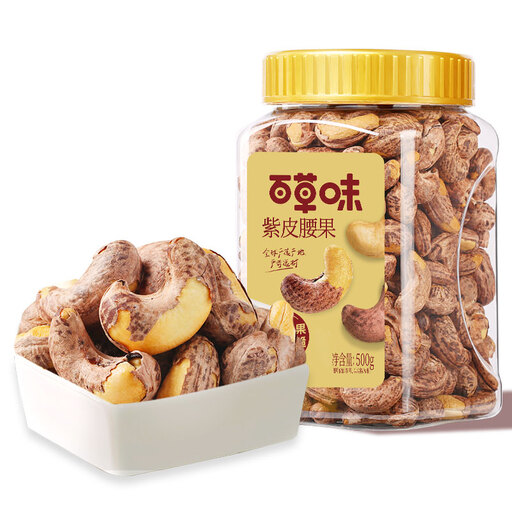 No image available
A good fit if you’re looking for this purple-skinned cashew variety with the grade shown.
The nutrition table lists 60.1 g of fat, 679 kcal and 1.2 g of salt per 100 g.
No. For solid foods, the European Commission sets a maximum of 3 g of fat per 100 g for the ‘low fat’ claim. No added oil describes a preparation method and doesn’t prove that a product meets this limit.
No. The 25 g figure is an example used by the Voedingscentrum’s calorie checker and a portion size listed on the AH product page; it isn’t a universal daily recommendation. Use your own portion weight and the nutrition information for your product.
Read the allergen information on the pack for the exact variety and ask about allergies in advance. The NVWA says allergens in an ingredients list must be clearly distinguished; cashew packs may also include warnings about other allergens.
The NVWA warning issued on 20 May 2026 concerns 170 g packs of Trader Joe’s unsalted cashews with barcode 2003020120930 and best-before date 23-09-2026, due to the possible presence of metal fragments. Do not eat that specific batch; check the product name, barcode and best-before date on any pack you still have at home.
No. The AH, PLUS and Jumbo product pages warn that young children can choke on nuts. So don’t assume that a bowl of whole cashews is a suitable snack for children.